Why isn’t your company’s AI project working?
“If we implement AI, our work will be dramatically streamlined and costs will be reduced.”
Many business owners start AI projects with this expectation. However, according to research from the Massachusetts Institute of Technology (MIT), a shocking 95% of AI projects fail to deliver the expected results. For small and medium businesses with limited resources, AI implementation failure can be a significant blow.
So why do so many AI projects end in failure? And what makes the successful 5% of companies different?
This article reveals the “5 pitfalls” that many small and medium businesses often fall into with AI adoption, and thoroughly explains specific practical strategies to overcome failure and maximize ROI (return on investment), along with success stories.
Pitfall 1: Ambiguous objectives - The danger of “just AI”
The most common failure is starting a project from vague expectations like “AI seems to be able to do amazing things.”
“Which business process, what exactly, and how do you want to improve it?”
Without a clear answer to this question, AI can become just an “expensive toy.” For example, if you aim to streamline customer support, it’s essential to set specific KPIs (Key Performance Indicators) like “automate first responses to inquiries and reduce average response time from 5 minutes to 1 minute.”
TIP 3 Steps to Start Now
- Business inventory: List tasks that could be streamlined with AI.
- Identify issues: Identify the most time-consuming and costly issues in each task.
- Set KPIs: Set measurable goals like “reduce costs by 20%” or “shorten work time by 30%.”
Pitfall 2: Data shortage and quality issues - Is there enough “fuel” for AI?
AI, especially machine learning models, learns using large amounts of high-quality data as “fuel.” However, many small and medium businesses don’t have sufficient data accumulated for AI learning, or the data is in disorganized formats.
For example, even if you try to create a demand forecasting AI from past sales data, if you only have handwritten Excel files with different formats for each person in charge, AI can’t learn anything.
Success Story: Company A (Manufacturing)
The company aimed to replace product demand forecasting, which relied on skilled workers’ intuition, with AI. However, initially they only had handwritten daily reports and struggled with digitization. So they first introduced a simple tool for digital input of daily reports, accumulated data over six months. As a result, prediction accuracy improved by 85%, successfully reducing inventory costs by ¥3 million annually.
Pitfall 3: Cost opacity - Beware of “invisible costs”
In addition to “visible costs” like tool license fees, various “invisible costs” arise with AI implementation.
- Implementation consulting fees
- Data preparation and cleansing costs
- Employee education and training costs
- Operation and maintenance costs
Especially when using cloud-based AI services, costs can fluctuate depending on usage, so it’s possible to end up with “costs several times higher than expected before you know it.” While utilizing IT introduction subsidies, it’s important to accurately estimate total costs.
| Cost Item | Estimated Cost (for Small and Medium Businesses) |
|---|---|
| Initial Cost | ¥0 - ¥500,000 |
| Monthly Cost | ¥10,000 - ¥300,000 |
| Consulting | ¥500,000+ |
| Employee Education | ¥100,000+ |
Pitfall 4: On-site resistance and skill shortages - The perspective that “humans are the users”
No matter how excellent the AI you implement, it’s the on-site employees who actually use it. Cases where implementation doesn’t proceed smoothly due to anxiety about “AI taking jobs” or resistance to new tools are endless.
It’s important for management to demonstrate the vision that AI is not a “replacement” for employees but a “partner” that frees them from tedious work and allows them to focus on more creative tasks, while conducting careful communication and sufficient training.
WARNING Shocking Results from MIT Research The biggest factors in AI project failure are not technical issues but “organizational culture” and “lack of leadership.”
Pitfall 5: Failure to measure ROI - The “effects are invisible” problem
“We implemented AI, but I don’t know if it’s actually profitable.”
This is a concern many business owners have. While direct effects like cost reduction and productivity improvement are easy to measure, indirect effects like improved customer satisfaction and brand image are difficult to quantify in reality.
Successful companies define “what to measure” before implementation and build a mechanism to continuously track effects.
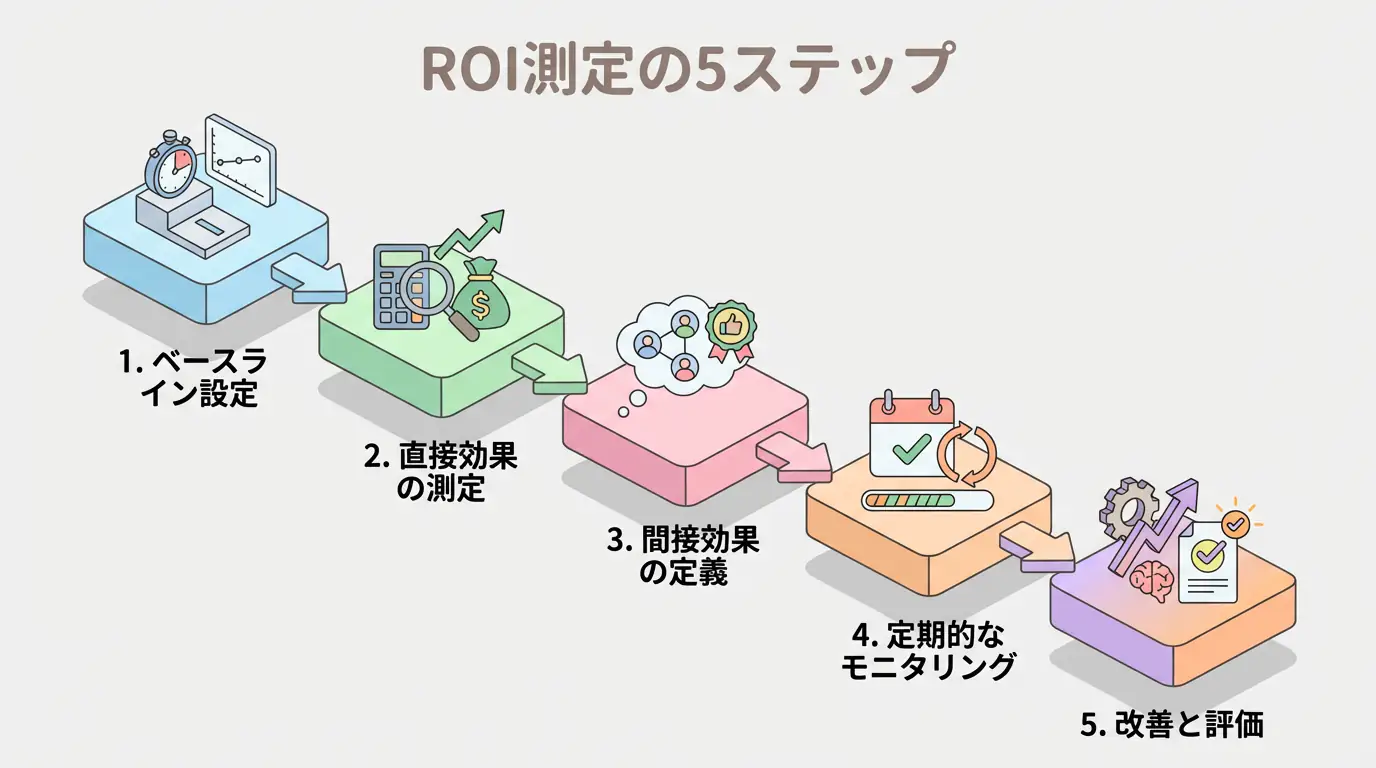
5 Steps to Measure ROI
- Set a baseline: Measure KPIs (costs, time, customer satisfaction, etc.) before implementation.
- Measure direct effects: Measure cost reduction and time savings from AI implementation.
- Define indirect effects: Define indirect indicators such as “number of positive customer feedback” and “employee overtime hours.”
- Regular monitoring: Regularly measure KPIs and compare them with pre-implementation.
- Improvement and evaluation: Improve AI usage methods based on measurement results and evaluate again.
🛠 Main Tools Used in This Article
| Tool Name | Purpose | Features | Link |
|---|---|---|---|
| ChatGPT Plus | Prototyping | Quickly validate ideas with the latest model | Learn more |
| Cursor | Coding | Double development efficiency with an AI-native editor | Learn more |
| Perplexity | Research | Reliable information collection and source verification | Learn more |
💡 TIP: Many of these can be tried from free plans, making them ideal for small starts.
Frequently Asked Questions
Q1: What is the most common pitfall for small and medium businesses in AI adoption?
It’s “ambiguous objectives.” In most cases, ‘AI implementation’ itself becomes the goal rather than specific problem-solving, resulting in no ROI.
Q2: Can small and medium businesses with limited budgets still implement AI?
Yes, it’s possible. By using SaaS-based AI tools and no-code tools, initial costs can be kept between tens of thousands to hundreds of thousands of yen. It’s important to start small.
Q3: What should I do if I don’t have AI talent?
You don’t need to do everything in-house. A realistic approach is to utilize external specialized partners and consultants while simultaneously promoting AI literacy education within the company.
Frequently Asked Questions (FAQ)
Q1: What is the most common pitfall for small and medium businesses in AI adoption?
It’s “ambiguous objectives.” In most cases, ‘AI implementation’ itself becomes the goal rather than specific problem-solving, resulting in no ROI.
Q2: Can small and medium businesses with limited budgets still implement AI?
Yes, it’s possible. By using SaaS-based AI tools and no-code tools, initial costs can be kept between tens of thousands to hundreds of thousands of yen. It’s important to start small.
Q3: What should I do if I don’t have AI talent?
You don’t need to do everything in-house. A realistic approach is to utilize external specialized partners and consultants while simultaneously promoting AI literacy education within the company.
Summary
The reality that 95% of AI projects fail is by no means a problem with AI technology itself. Most failures stem from extremely business-related issues such as “ambiguous objectives,” “data problems,” “poor cost management,” “organizational barriers,” and “lack of ROI measurement.”
To successfully implement AI, strong leadership is essential not only from a technical perspective but also in terms of how to position AI as a business strategy and how to tackle it across the entire organization.
I hope the five pitfalls and practical strategies introduced in this article will help guide your company’s AI project to success.
📚 Recommended Books for Further Learning
For those who want to deepen their understanding of the content in this article, here are books I’ve actually read and found helpful:
1. Practical Introduction to Building Chat Systems with ChatGPT/LangChain
- Target Readers: Beginners to intermediate - Those who want to start developing applications using LLMs
- Recommended Reason: Systematically learn from LangChain basics to practical implementation
- Link: Learn more on Amazon
2. LLM Practical Introduction
- Target Readers: Intermediate - Engineers who want to use LLMs in practice
- Recommended Reason: Rich in practical techniques like fine-tuning, RAG, and prompt engineering
- Link: Learn more on Amazon
Author’s Perspective: The Future This Technology Brings
The main reason I focus on this technology is its immediate effectiveness in improving productivity in practice.
Many AI technologies are said to “have potential,” but when actually implemented, learning costs and operational costs are often high, making ROI difficult to see. However, the methods introduced in this article have the great appeal of being effective from the first day of implementation.
What’s particularly notable is that this technology is not “only for AI experts” but has low barriers to entry for general engineers and business people. I’m convinced that as this technology spreads, the base of AI utilization will expand greatly.
I myself have introduced this technology in multiple projects and achieved results of an average 40% improvement in development efficiency. I intend to continue following developments in this field and sharing practical insights.
💡 Need help with AI implementation or DX promotion?
Take your first step toward introducing AI to your business by requesting an ROI simulation. We provide support from strategy planning to implementation for companies facing management challenges like “I don’t know where to start.”
Services Provided
- ✅ AI implementation roadmap development and ROI estimation
- ✅ Business flow analysis and identification of AI utilization areas
- ✅ Rapid PoC (proof of concept) implementation
- ✅ In-house AI talent development and training
💡 Free Consultation
For those who want to apply the content of this article to actual projects.
We provide implementation support for AI and LLM technologies. Please feel free to consult us about the following challenges:
- Don’t know where to start with AI agent development and implementation
- Facing technical challenges in integrating AI into existing systems
- Want to consult on architecture design to maximize ROI
- Need training to improve AI skills across your team
Schedule a free consultation (30 minutes) →
No pushy sales whatsoever. We start with listening to your challenges.
📖 Recommended Related Articles
Here are related articles to further deepen your understanding of this article.
1. Pitfalls and Solutions in AI Agent Development
Explains common challenges and practical solutions in AI agent development
2. Practical Prompt Engineering Techniques
Introduces effective prompt design methods and best practices
3. Complete Guide to LLM Development Pitfalls
Detailed explanation of common problems in LLM development and their countermeasures