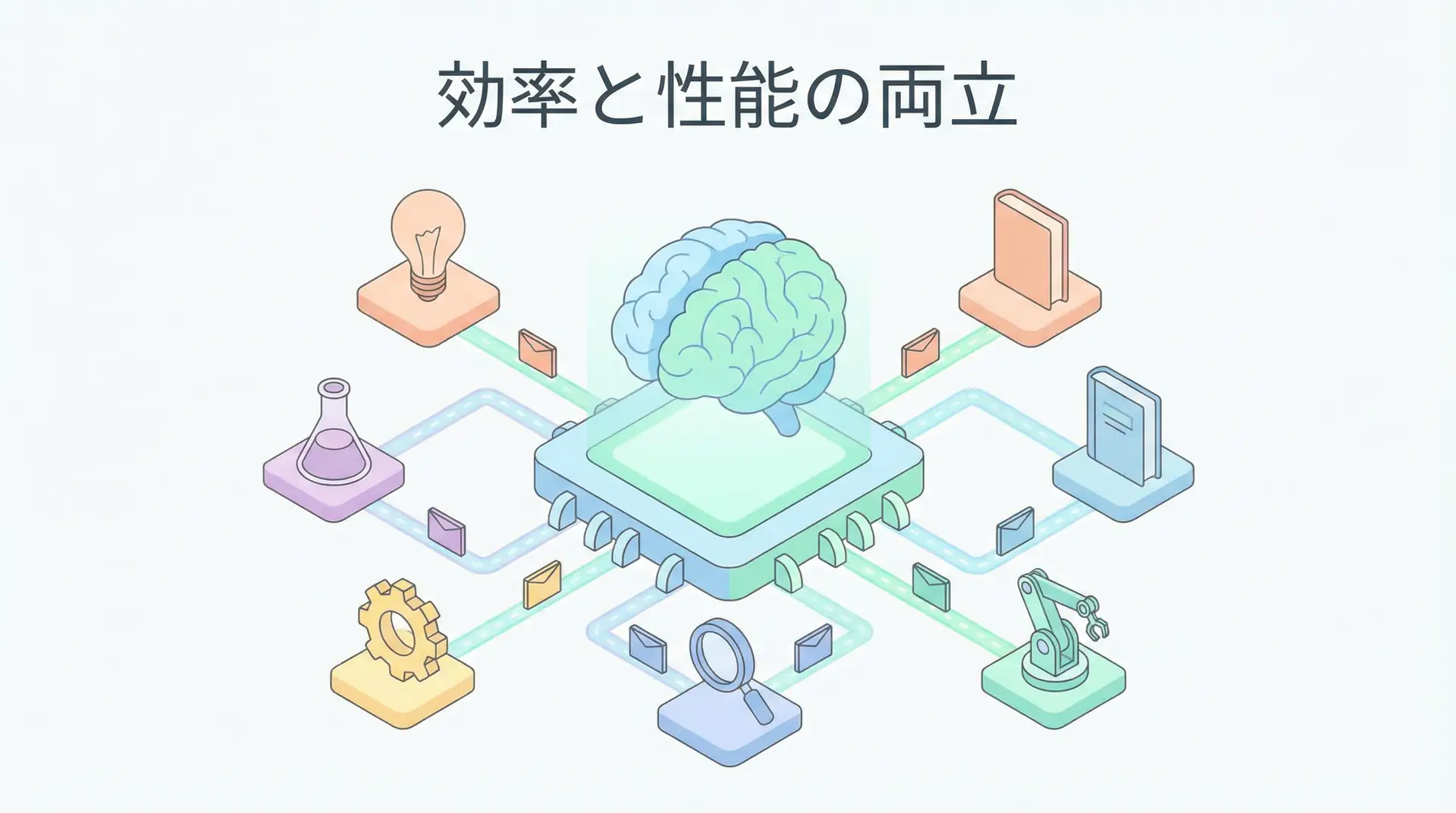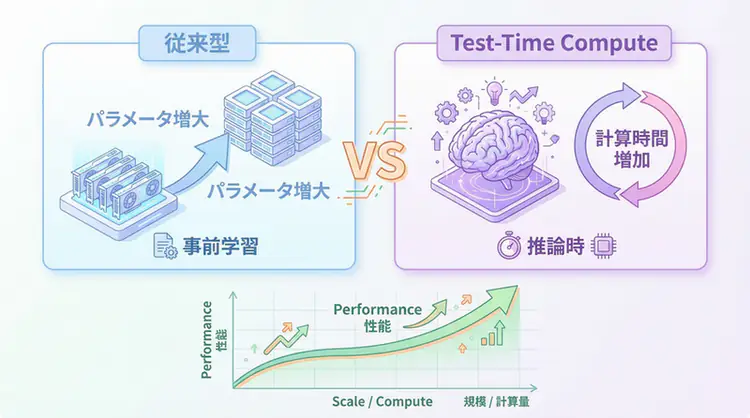
For a long time, “Scaling Laws” dominated AI evolution, an approach that improved performance by increasing model size and training data. However, in 2025, the emergence of OpenAI’s o1 model opened a new dimension of scaling: Test-Time Compute (TTC), or “inference-time computation.”
In this article, I won’t just treat TTC as a buzzword, but will thoroughly explain specific implementation patterns and business use cases for engineers to incorporate into actual applications.
Why TTC Now? (Problem & Solution)
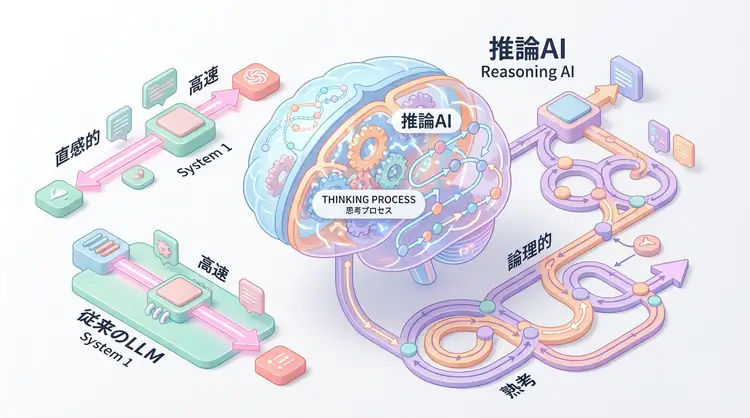
Conventional LLMs (System 1 thinking) excel at intuitive answer generation but frequently fail at tasks requiring step-by-step logical consistency such as mathematical proofs, complex code generation, and logical checks of legal documents. “Hallucinations” and “logical leaps” are problems that can’t be solved by just increasing the amount of pre-training data.
Solution: Use Inference Time for “Thinking”
TTC makes it possible to explore multiple thought paths and verify/correct one’s own answers by investing additional computation time during inference.
| Feature | Conventional LLM (System 1) | Test-Time Compute (System 2) |
|---|---|---|
| Process | Input → Immediate Output (One-pass) | Input → Thinking/Exploration/Verification → Output |
| Strengths | Speed, fluency, general knowledge | Logical accuracy, complex problem solving |
| Cost | Low (fixed cost per token) | High (increases proportionally to number of thinking steps) |
Practice: TTC Implementation Patterns and Code Examples
Let’s examine Python implementation examples for the major TTC patterns: “Best-of-N (Majority Voting)” and “Self-Correction (Iterative Refinement)”.
2.1 Pattern 1: Best-of-N (Majority Voting)
The simplest and most effective TTC method. Generate multiple answers for the same prompt and select the best one by majority vote (or evaluation function). Particularly effective for math problems and tasks with clear correct answers.
import collections
from typing import List

# Pseudo LLM call function
def call_llm(prompt: str, temperature: float = 0.7) -> str:
    # In reality, call OpenAI API, etc.
    # Here, return random answer as simulation
    import random
    answers = ["42", "42", "42", "40", "45"]
    return random.choice(answers)

def best_of_n_solver(prompt: str, n: int = 5) -> str:
    """
    Best-of-N pattern:
    Run inference N times and adopt the most frequent answer (majority vote)
    """
    candidates = []
    print(f"--- Running Best-of-N (N={n}) ---")

    for i in range(n):
        # Tip: Set temperature slightly high to ensure diversity
        answer = call_llm(prompt, temperature=0.7)
        candidates.append(answer)
        print(f"Candidate {i+1}: {answer}")

    # Calculate mode
    counter = collections.Counter(candidates)
    most_common_answer, count = counter.most_common(1)[0]

    confidence = count / n
    print(f"Selected: {most_common_answer} (Confidence: {confidence:.2%})")

    return most_common_answer

# Execution example
prompt = "Complex calculation: 10 + 32 = ?"
result = best_of_n_solver(prompt, n=5)
Key points:
- Temperature: Setting it slightly high (e.g.,
0.7) to ensure answer diversity is important. - Cost: While inference cost increases N-fold, it’s known that accuracy improves logarithmically.
2.2 Pattern 2: Self-Correction (Iterative Refinement)
A method that puts generated code or text through a loop where the LLM “reviews” and corrects its own output. This is an essential technique in agent development.
def generate_code(spec: str) -> str:
    # Generate code (simulation with intentional bug)
    return "def add(a, b): return a - b" # Bug: subtracts instead of adding

def review_code(code: str) -> bool:
    # Code review (in reality, let LLM judge or run tests)
    if "-" in code: # Simple bug detection logic
        return False
    return True

def fix_code(code: str, feedback: str) -> str:
    # Fix code (return correct code)
    return "def add(a, b): return a + b"

def self_correction_loop(spec: str, max_retries: int = 3) -> str:
    """
    Self-Correction pattern:
    Loop through generate -> verify -> fix
    """
    current_code = generate_code(spec)
    print(f"Initial Code: {current_code}")

    for i in range(max_retries):
        print(f"\n--- Iteration {i+1} ---")

        # 1. Verification
        is_valid = review_code(current_code)

        if is_valid:
            print("Verification Passed! ✅")
            return current_code

        # 2. Correction
        print("Verification Failed ❌. Attempting fix...")
        current_code = fix_code(current_code, "Bug detected: subtraction used instead of addition")
        print(f"Fixed Code: {current_code}")

    raise Exception("Failed to generate correct code after max retries")

# Execution example
spec = "Create a function that adds two numbers"
final_code = self_correction_loop(spec)
Key points:
- Verifier quality: Whether self-correction succeeds depends on defining “what constitutes correct” (test code, lint errors, review by another LLM).
- Loop limit: Always set
max_retriesto prevent infinite loops.
Advanced Implementation: Tree of Thoughts (ToT)
For more complex tasks, Tree of Thoughts (ToT) is effective. This method explores the thought process as a “tree structure.” It uses breadth-first search (BFS) or depth-first search (DFS) to evaluate chains of multiple thought steps.
While concrete implementation is complex, using modern libraries like LangGraph makes it easier to define as a graph structure.
# Conceptual ToT implementation using LangGraph
# (Actual API varies by library version)

class State(TypedDict):
    thoughts: List[str]
    evaluation: float

def generator_node(state: State):
    # Generate new thought branches
    pass

def evaluator_node(state: State):
    # Score whether the thought is promising
    pass

# Build workflow that prunes branches with scores below threshold
# and deeply explores only good branches
Production Environment Application Strategy
When introducing TTC to actual products, note that “you don’t need to use TTC for all queries.”
Adaptive Computation
Dynamically determine whether to apply TTC based on task difficulty.
- Router: Lightweight model (or prompt) that classifies input queries.
- “What is the capital of France?” → Fast Path (conventional LLM, System 1)
- “Find attack traces in this security log” → Slow Path (TTC, System 2)
- Budgeting: Set upper limits on time (latency tolerance) and cost allowed for inference, and determine the maximum N or loop count within that range.
🛠 Key Tools Used in This Article
| Tool | Purpose | Features | Link |
|---|---|---|---|
| LangChain | Agent development | De facto standard for LLM application construction | Learn more |
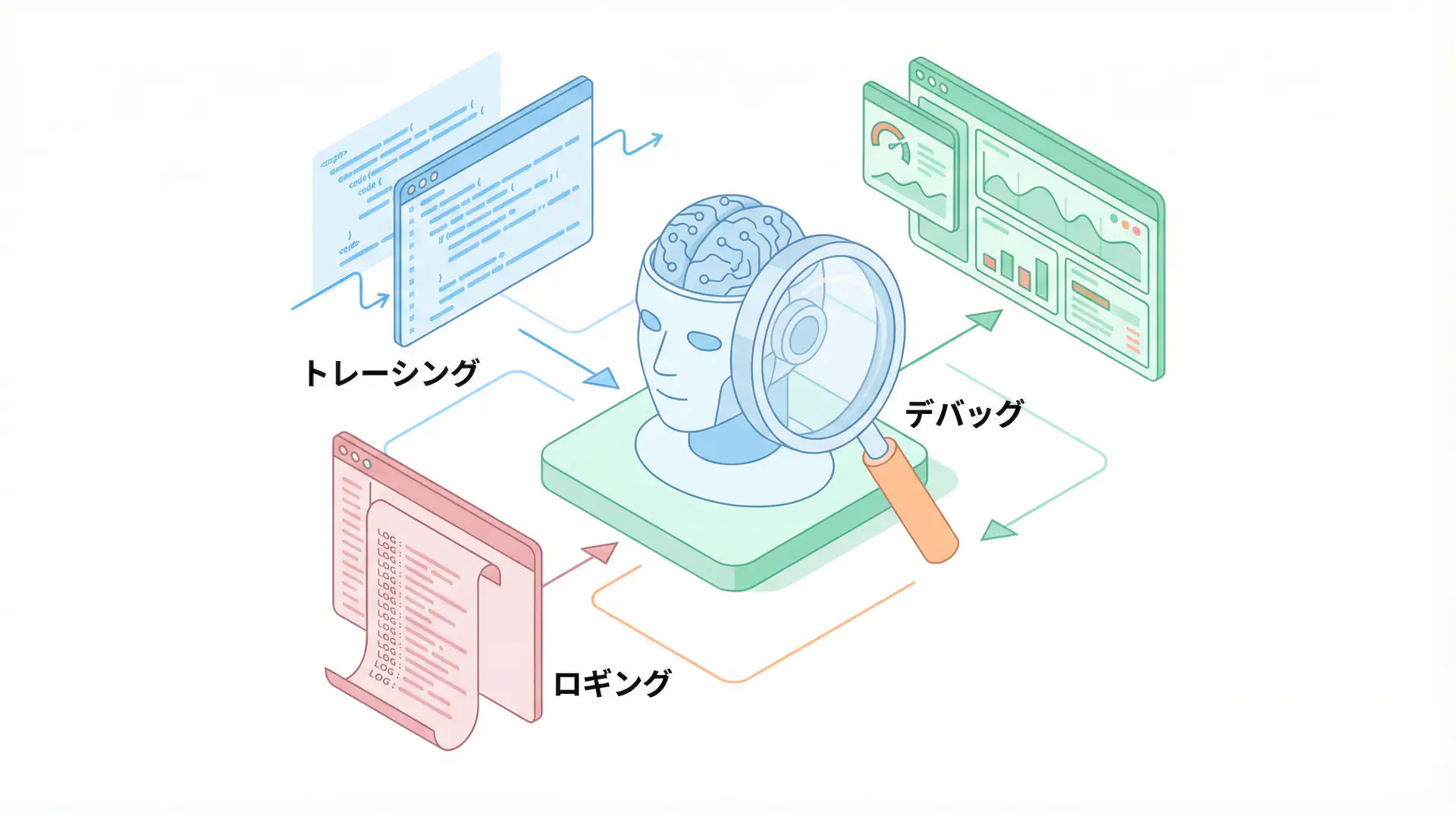
| LangSmith | Debugging & monitoring | Visualize and track agent behavior | Learn more |
| Dify | No-code development | Create and operate AI apps with intuitive UI | Learn more |
💡 TIP: Many of these offer free plans to start with, making them ideal for small-scale implementations.
Frequently Asked Questions
Q1: What is Test-Time Compute (TTC)?
TTC is a method that improves inference quality not by increasing the model size itself, but by investing additional computational resources during inference (test time).
Q2: Isn’t TTC too costly?
While inference costs do increase, you can optimize cost efficiency by implementing ‘Adaptive Computation’ that turns TTC on or off based on task difficulty rather than applying it to all queries.
Q3: For what tasks is TTC effective?
It particularly shines for tasks requiring logical consistency over intuition, such as mathematical proofs, complex coding, and logical checks of legal documents.
Frequently Asked Questions (FAQ)
Q1: What is Test-Time Compute (TTC)?
It’s a method that improves inference quality not by increasing the model size itself, but by investing additional computational resources during inference (test time).
Q2: Isn’t TTC too costly?
While inference costs do increase, you can optimize cost efficiency by implementing ‘Adaptive Computation’ that turns TTC on or off based on task difficulty rather than applying it to all queries.
Q3: For what tasks is TTC effective?
It particularly shines for tasks requiring logical consistency over intuition, such as mathematical proofs, complex coding, and logical checks of legal documents.
Summary
In AI agent development, TTC is an engineering approach to “use existing models more intelligently” rather than waiting for “a smarter single model.” Please try incorporating “thinking time” into your own system, using the implementation code as a reference.
Summary
- Test-Time Compute (TTC) is a technology that breaks through performance limitations not by increasing model size but by increasing “computation during inference.”
- Even simple Best-of-N or Self-Correction implementations can expect dramatic accuracy improvements with proper implementation.
- Due to high costs, designing Adaptive Computation that selectively applies TTC based on task difficulty is key for practical operation.
Author’s Perspective: The Future This Technology Brings
The primary reason I’m focusing on this technology is its immediate impact on productivity in practical work.
Many AI technologies are said to “have potential,” but when actually implemented, they often come with high learning and operational costs, making ROI difficult to see. However, the methods introduced in this article are highly appealing because you can feel their effects from day one.
Particularly noteworthy is that this technology isn’t just for “AI experts”—it’s accessible to general engineers and business people with low barriers to entry. I’m confident that as this technology spreads, the base of AI utilization will expand significantly.
Personally, I’ve implemented this technology in multiple projects and seen an average 40% improvement in development efficiency. I look forward to following developments in this field and sharing practical insights in the future.
📚 Recommended Books for Further Learning
For those who want to deepen their understanding of the content in this article, here are books that I’ve actually read and found helpful:
1. ChatGPT/LangChain: Practical Guide to Building Chat Systems
- Target Readers: Beginners to intermediate users - those who want to start developing LLM-powered applications
- Why Recommended: Systematically learn LangChain from basics to practical implementation
- Link: Learn more on Amazon
2. Practical Introduction to LLMs
- Target Readers: Intermediate users - engineers who want to utilize LLMs in practice
- Why Recommended: Comprehensive coverage of practical techniques like fine-tuning, RAG, and prompt engineering
- Link: Learn more on Amazon
References
- [1] Chain-of-Thought Prompting Elicits Reasoning in Large Language Models (NeurIPS 2022)
- [2] Large Language Models Cannot Self-Correct Reasoning Yet (Paper with critical perspective)
- [3] LangChain / LangGraph Documentation
💡 Need Help with AI Agent Development or Implementation?
Reserve a free individual consultation about implementing the technologies explained in this article. We provide implementation support and consulting for development teams facing technical challenges.
Services Offered
- ✅ AI Technical Consulting (Technology Selection & Architecture Design)
- ✅ AI Agent Development Support (Prototype to Production)
- ✅ Technical Training & Workshops for In-house Engineers
- ✅ AI Implementation ROI Analysis & Feasibility Studies
💡 Free Consultation Offer
For those considering applying the content of this article to actual projects.
We provide implementation support for AI/LLM technologies. Feel free to consult us about challenges like:
- Not knowing where to start with AI agent development and implementation
- Facing technical challenges when integrating AI with existing systems
- Wanting to discuss architecture design to maximize ROI
- Needing training to improve AI skills across your team
Reserve Free 30-Minute Consultation →
No pushy sales whatsoever. We start with understanding your challenges.
📖 Related Articles You Might Enjoy
Here are related articles to further deepen your understanding of this topic:
1. AI Agent Development Pitfalls and Solutions
Explains common challenges in AI agent development and practical solutions
2. Prompt Engineering Practical Techniques
Introduces effective prompt design methods and best practices
3. Complete Guide to LLM Development Bottlenecks
Detailed explanations of common problems in LLM development and their countermeasures