Why Small and Medium Businesses Should Embrace AI Management Now
“AI is for large companies with financial resources”—this thinking is now a thing of the past. In 2025, AI is becoming the most powerful weapon to fundamentally transform the management of small and medium businesses. Intensifying labor shortages, unpredictable market environments, and fierce competition. AI offers clear solutions to these deep-rooted challenges facing small and medium businesses.
This article thoroughly explains the concrete roadmap for successful AI management and strategies to maximize ROI, along with success stories, for business owners and managers who wonder, “I want to implement AI but don’t know where to start” or “Will I really get a return on investment (ROI)?”
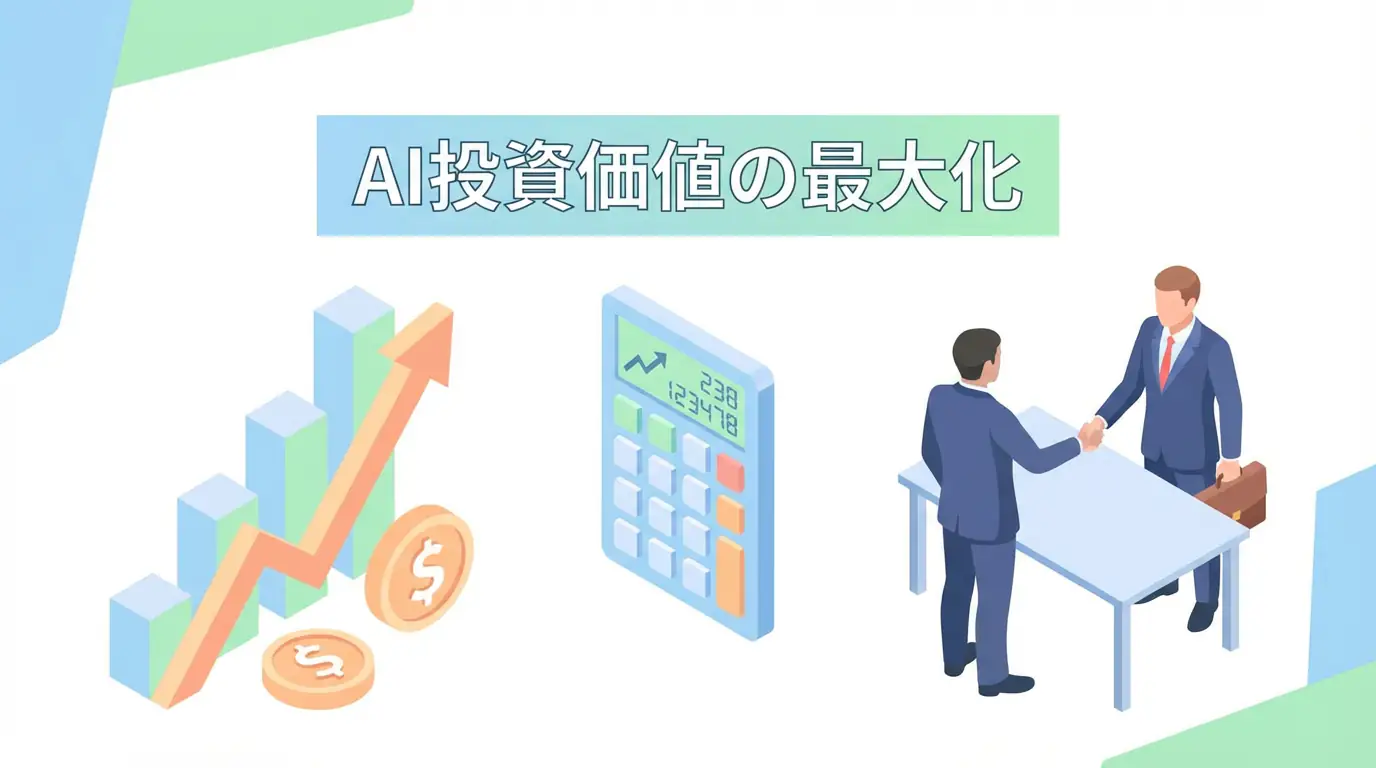
The Overwhelming Business Value of AI Management
AI management is not just about tool implementation. It’s a new management style that combines the experience and intuition (KKD) of managers with objective AI-based data analysis and prediction, dramatically improving the quality and speed of decision-making. The value AI brings goes beyond mere cost reduction.
| Business Value | Specific Impact |
|---|---|
| Dramatic productivity improvement | Automation of routine tasks allows employees to focus on higher-value core business. This simultaneously reduces overtime and improves productivity. |
| High-precision future prediction | AI analyzes real-time market and customer data to predict demand fluctuations and new business opportunities. Enables inventory optimization and precise marketing strategies. |
| Escape from personalization | By having AI learn the know-how of skilled technicians and top salespeople’s decision criteria, it raises the overall skill level of the organization and helps solve successor issues. |
| Creation of new customer experiences | 24/7 customer support via AI chatbots and optimized product/service proposals for individual customers dramatically improve customer satisfaction. |
[Case Studies] AI is Already Transforming SME Workplaces
AI is no longer a theory or a future concept. Many small and medium businesses are already using AI to achieve concrete results.
Case 1: Manufacturer A - AI image recognition achieves 99%+ inspection accuracy, reduces labor costs by 30%
A regional parts manufacturer introduced an AI image recognition system for product inspection that previously relied on skilled workers’ eyes. Before AI, rework and complaints due to inspection errors were issues, but after AI implementation, inspection accuracy improved to over 99%. Furthermore, automating the inspection line successfully reduced annual labor costs by 30%.
Case 2: Retailer B - AI demand forecasting reduces waste loss by 50%, increases sales by 15%
A community-based supermarket built a system where AI analyzes various data such as weather, local events, and past sales performance to predict product demand. This reduced waste loss from excess inventory by half while preventing lost opportunities from stockouts, successfully increasing sales by 15%.
AI Implementation Roadmap for Maximizing ROI
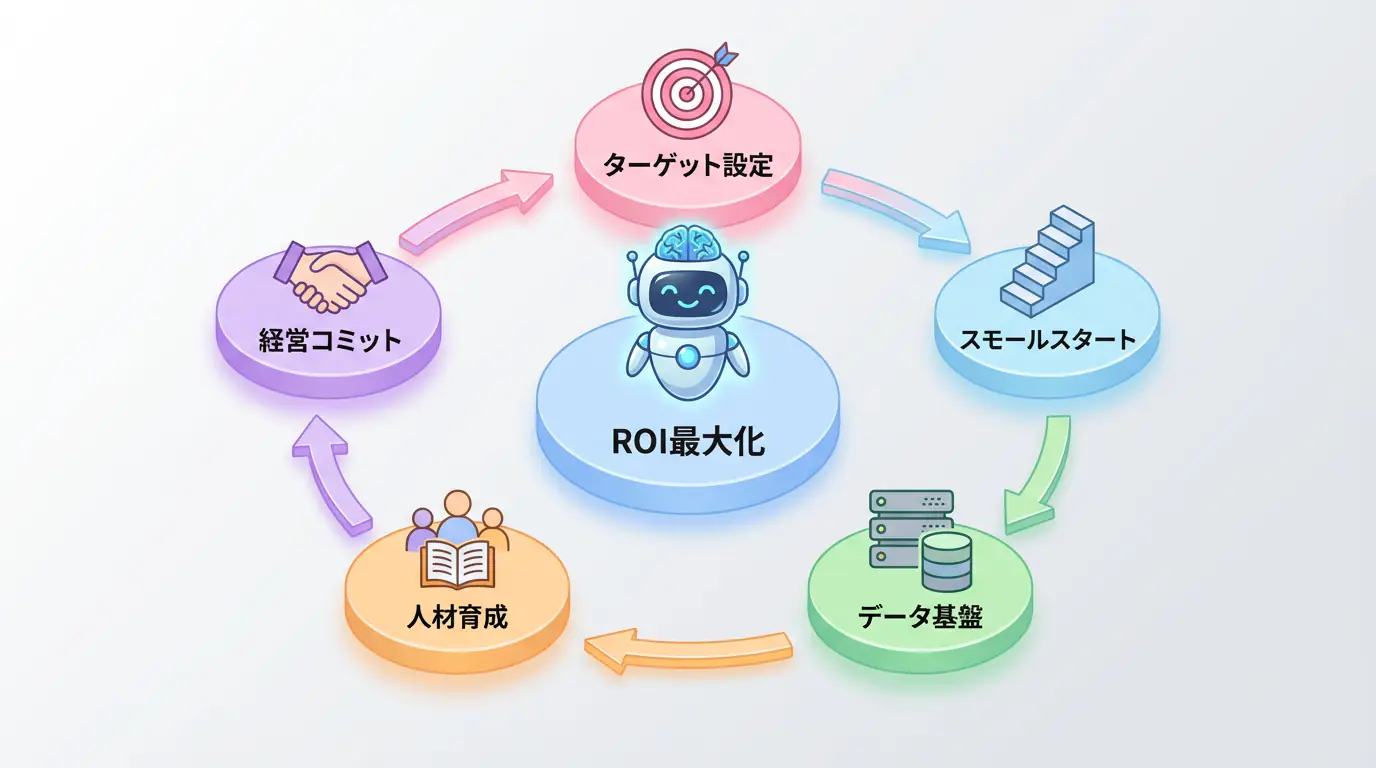
To successfully implement AI and maximize return on investment, unplanned implementation is forbidden. The following “small start & phased expansion” roadmap is crucial.
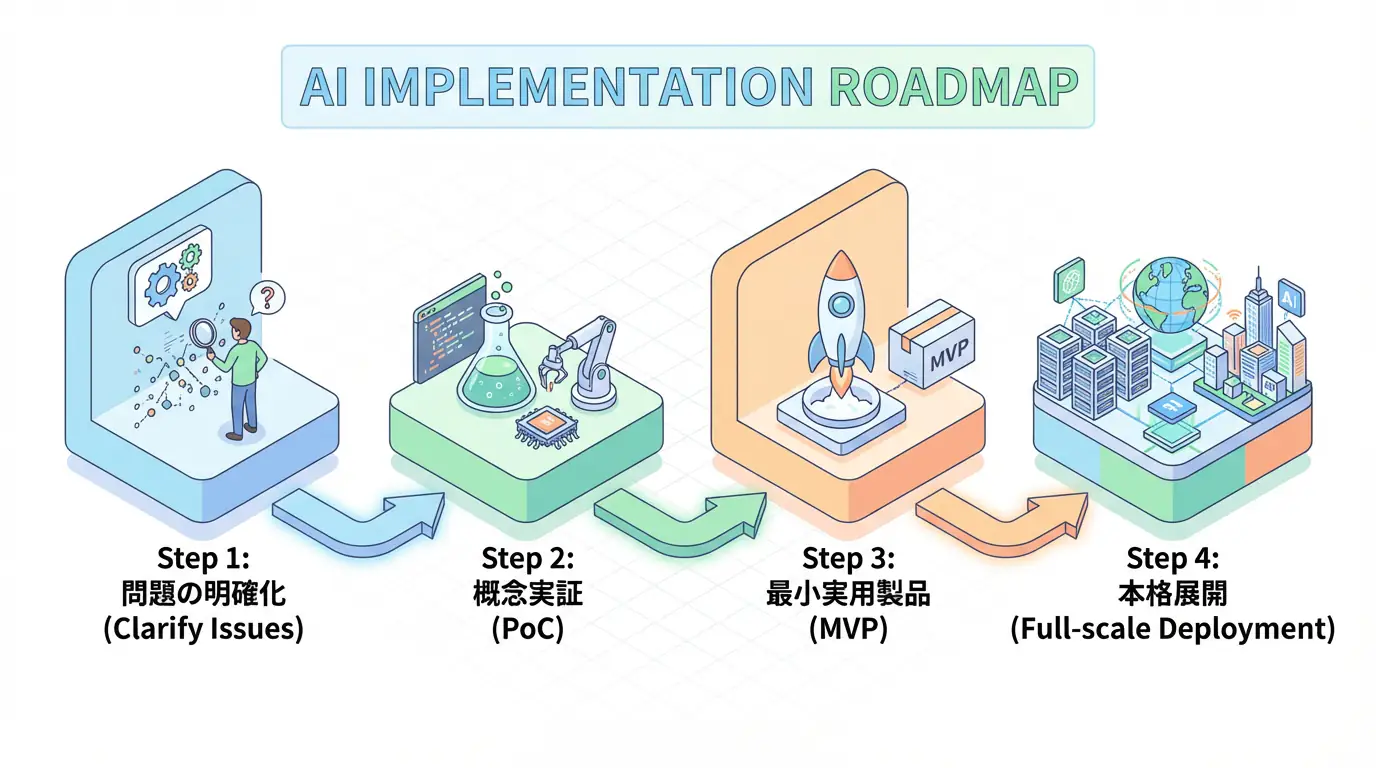
Step 1: Clarify issues and select themes (1-3 months)
First, clarify “what you want to solve with AI.” AI is not a magic wand. The golden rule for success is to start with issues that “have abundant data,” “occur repeatedly,” and “are bottlenecks in business.” For example, consider the following issues:
- Manual work like invoice processing and data entry takes time
- Being overwhelmed by inquiry responses, unable to focus on core business
- Inventory management is complicated, with much waste loss and opportunity loss
Step 2: Verify effectiveness through PoC (proof of concept) (3-6 months)
Once the theme is decided, don’t immediately develop a large-scale system. First, verify on a small scale through PoC (Proof of Concept) whether the issue can really be solved with AI. Use limited data and time, and use affordable cloud services and AI tools to minimize investment while evaluating effectiveness.
Step 3: Partial implementation with MVP (minimum viable product) (6-12 months)
If the PoC confirms effectiveness, develop an MVP (Minimum Viable Product) with the minimum necessary functions and start actual operation in specific departments. Here, for the first time, collect feedback from on-site employees and measure the impact on business processes and specific ROI.
Step 4: Full-scale deployment and continuous improvement
Based on the results and insights obtained from the MVP, improve and expand the system and deploy it company-wide. AI implementation isn’t a one-time event. Continuously learning new data and improving AI models to adapt to changing business environments leads to sustainable competitive advantage.
“Pitfalls” of AI Implementation and Countermeasures
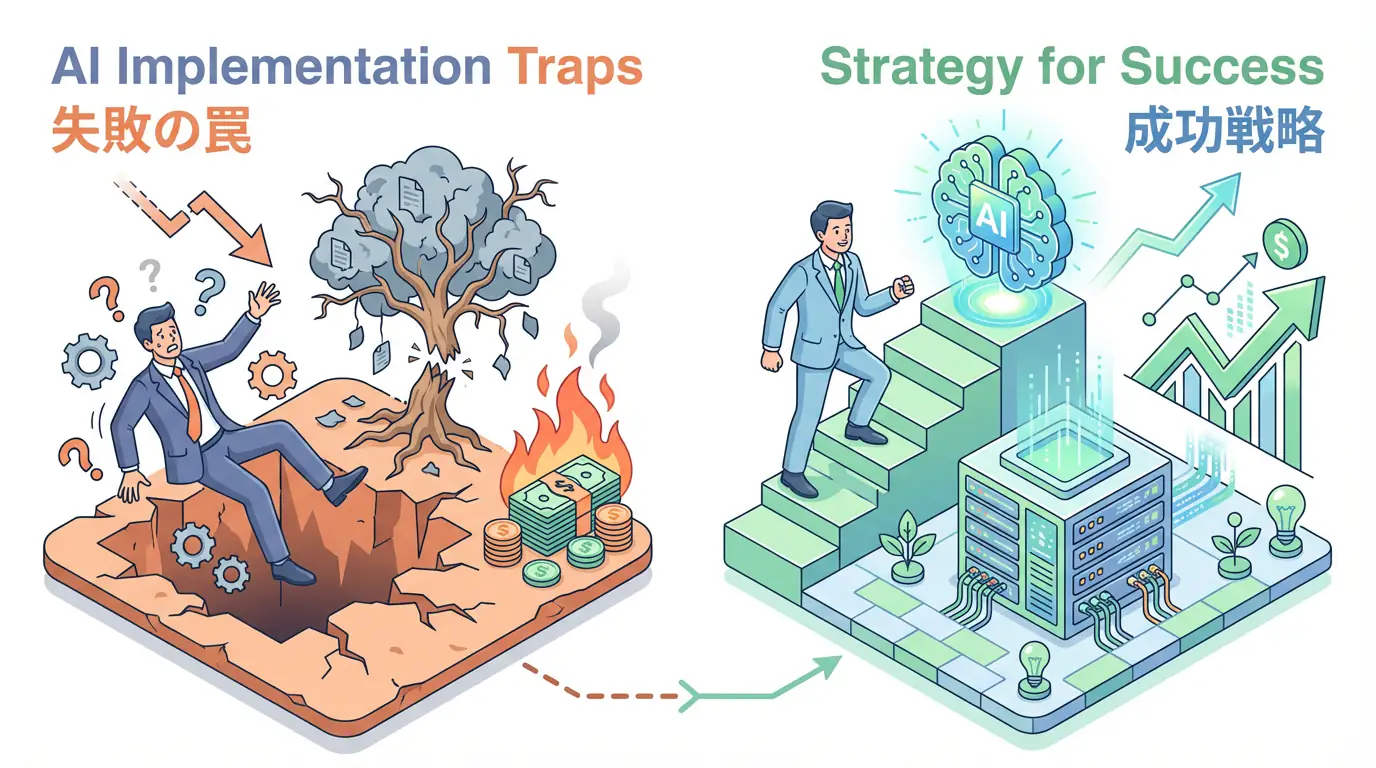
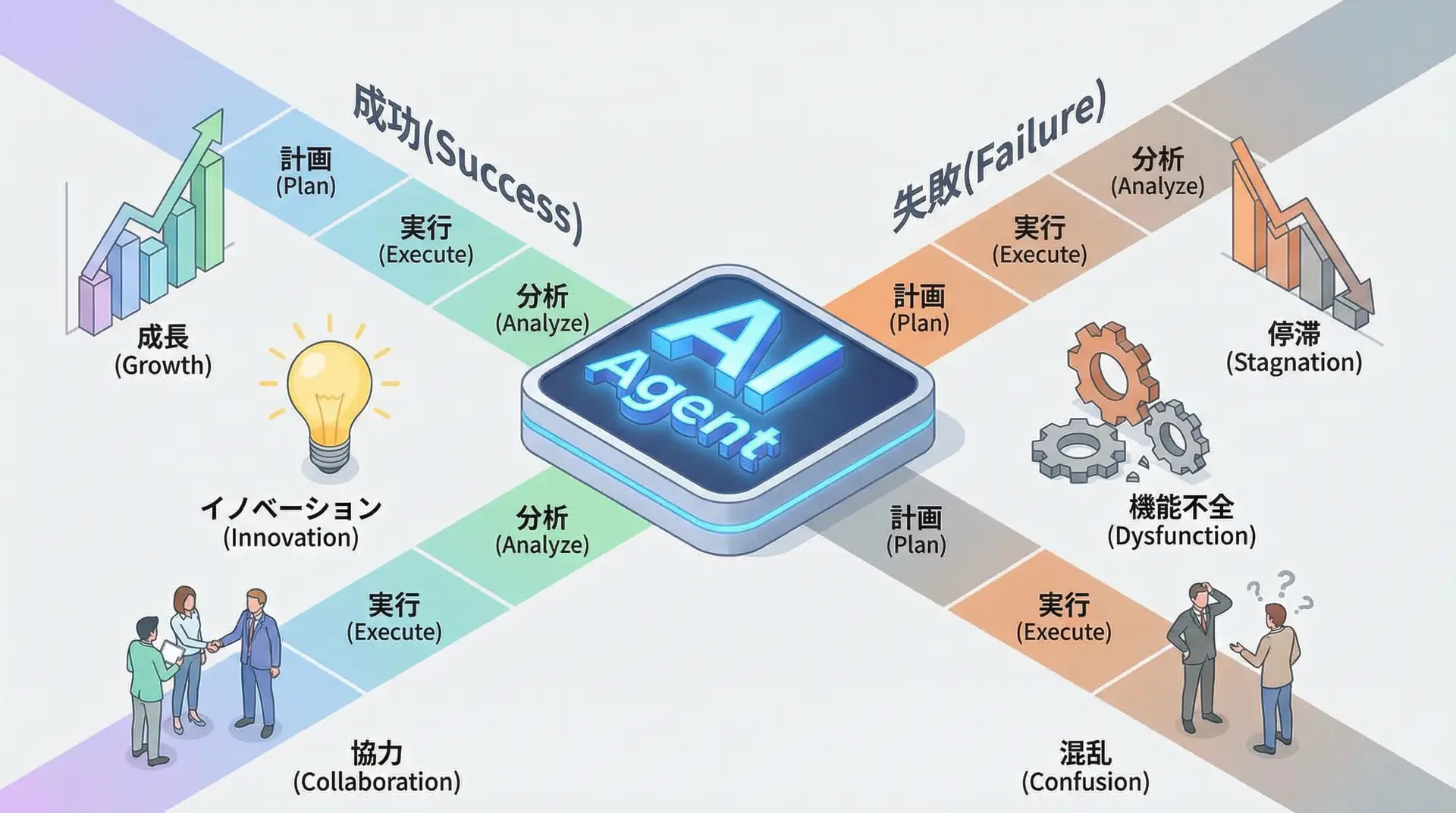
While many companies are challenging AI implementation, MIT research shows the shocking data that “95% of companies implementing AI are not getting sufficient results.” The main causes of failure are not technical but organizational issues.
| Common Failures | Countermeasures |
|---|---|
| Ambiguous objectives | Implementing for the reason “it’s trendy” without clear problem-solving goals. |
| Low data quality | AI performance depends on the quality and quantity of data. Unorganized data is a wasted treasure. |
| On-site resistance | Not getting employee cooperation due to anxiety about “job loss.” |
| Excessive expectations | Expecting AI to be omnipotent and中断ing the project if results don’t appear immediately. |
🛠 Main Tools Used in This Article
| Tool Name | Purpose | Features | Link |
|---|---|---|---|
| ChatGPT Plus | Prototyping | Quickly validate ideas with the latest model | Learn more |
| Cursor | Coding | Double development efficiency with an AI-native editor | Learn more |
| Perplexity | Research | Reliable information collection and source verification | Learn more |
💡 TIP: Many of these can be tried from free plans, making them ideal for small starts.
Frequently Asked Questions
Q1: How quickly does the return on investment (ROI) from AI adoption materialize?
It depends on the scale of the project, but with a small start using cloud tools, it’s not uncommon to recoup the initial investment within a few months to six months.
Q2: How much does a PoC (proof of concept) cost?
Previously, it could cost millions of yen, but now it’s possible to conduct one for tens of thousands to hundreds of thousands of yen by using affordable tools and APIs.
Q3: What is the most common cause of failure in AI adoption?
It’s “ambiguous objectives.” Most failures occur when ‘implementing AI’ itself becomes the goal, without connecting to specific problem-solving.
Frequently Asked Questions (FAQ)
Q1: How quickly does the return on investment (ROI) from AI adoption materialize?
It depends on the scale of the project, but with a small start using cloud tools, it’s not uncommon to recoup the initial investment within a few months to six months.
Q2: How much does a PoC (proof of concept) cost?
Previously, it could cost millions of yen, but now it’s possible to conduct one for tens of thousands to hundreds of thousands of yen by using affordable tools and APIs.
Q3: What is the most common cause of failure in AI adoption?
It’s “ambiguous objectives.” Most failures occur when ‘implementing AI’ itself becomes the goal, without connecting to specific problem-solving.
Summary
Summary In 2025, AI will become an indispensable partner for small and medium businesses to address labor shortages, dramatically improve productivity, and create new business opportunities. The key to success is the “small start” approach of solving specific immediate issues one by one rather than grand plans. Using the roadmap introduced in this article as a reference, why not start by considering which of your company’s operations could benefit from AI, taking a small first step? Your challenge to AI management should greatly expand your company’s future.
Author’s Perspective: The Future This Technology Brings
The main reason I focus on this technology is its immediate effectiveness in improving productivity in practice.
Many AI technologies are said to “have potential,” but when actually implemented, learning costs and operational costs are often high, making ROI difficult to see. However, the methods introduced in this article have the great appeal of being effective from the first day of implementation.
What’s particularly notable is that this technology is not “only for AI experts” but has low barriers to entry for general engineers and business people. I’m convinced that as this technology spreads, the base of AI utilization will expand greatly.
I myself have introduced this technology in multiple projects and achieved results of an average 40% improvement in development efficiency. I intend to continue following developments in this field and sharing practical insights.
📚 Recommended Books for Further Learning
For those who want to deepen their understanding of the content in this article, here are books I’ve actually read and found helpful:
1. Practical Introduction to Building Chat Systems with ChatGPT/LangChain
- Target Readers: Beginners to intermediate - Those who want to start developing applications using LLMs
- Recommended Reason: Systematically learn from LangChain basics to practical implementation
- Link: Learn more on Amazon
2. LLM Practical Introduction
- Target Readers: Intermediate - Engineers who want to use LLMs in practice
- Recommended Reason: Rich in practical techniques like fine-tuning, RAG, and prompt engineering
- Link: Learn more on Amazon
References
- What is AI Management? Thorough Explanation of Implementation Roadmap and Success Stories for Small and Medium Businesses | Cloud ERP Practical Portal
- The Key to AI Implementation Success: Strategies to Maximize Cost Effectiveness (ROI) | Digital Front Co., Ltd.
- “Autonomous AI will evolve our business within a year” 69% in 5 advanced countries … | ITmedia Business Online
💡 Free Consultation
For those who want to apply the content of this article to actual projects.
We provide implementation support for AI and LLM technologies. Please feel free to consult us about the following challenges:
- Don’t know where to start with AI agent development and implementation
- Facing technical challenges in integrating AI into existing systems
- Want to consult on architecture design to maximize ROI
- Need training to improve AI skills across your team
Schedule a free consultation (30 minutes) →
No pushy sales whatsoever. We start with listening to your challenges.