“AI is still too early for my company” “The introduction cost is too high”——. Many business owners think this way. However, in 2025, this common sense has changed dramatically.
Labor shortages, successor issues, and intensifying market competition. For these deep-rooted challenges facing small and medium businesses, AI is no longer just a “convenient tool if available” but is becoming an “essential strategy for survival.”
This article presents an extremely practical roadmap to overcome the three walls hindering AI adoption—“cost,” “talent,” and “utilization methods”—while minimizing the risk of failure and steadily producing results.
Why Small and Medium Businesses Need AI Now More Than Ever
AI adoption rate among Japanese companies has reached about 40%, but most of these are still large enterprises. However, in terms of the severity of challenges, small and medium businesses need AI’s power even more.
| Main Management Challenges for SMEs | AI Solutions |
|---|---|
| Labor shortages and hiring difficulties | Labor saving through automation of inquiry responses and administrative work |
| Declining productivity | Demand forecasting based on data analysis, inventory optimization |
| Personalization of technology and know-how | Letting AI learn skilled workers’ techniques and turning them into organizational assets |
| Insufficient sales and marketing capabilities | Clarification of target customers through customer data analysis, effective approaches |
AI can be a powerful “weapon” for small and medium businesses fighting with limited resources.
The “Three Major Barriers” Hindering AI Adoption and How to Break Through Them
Still, many companies can’t take the plunge because of the following three walls. However, there are specific breakthrough methods for each.
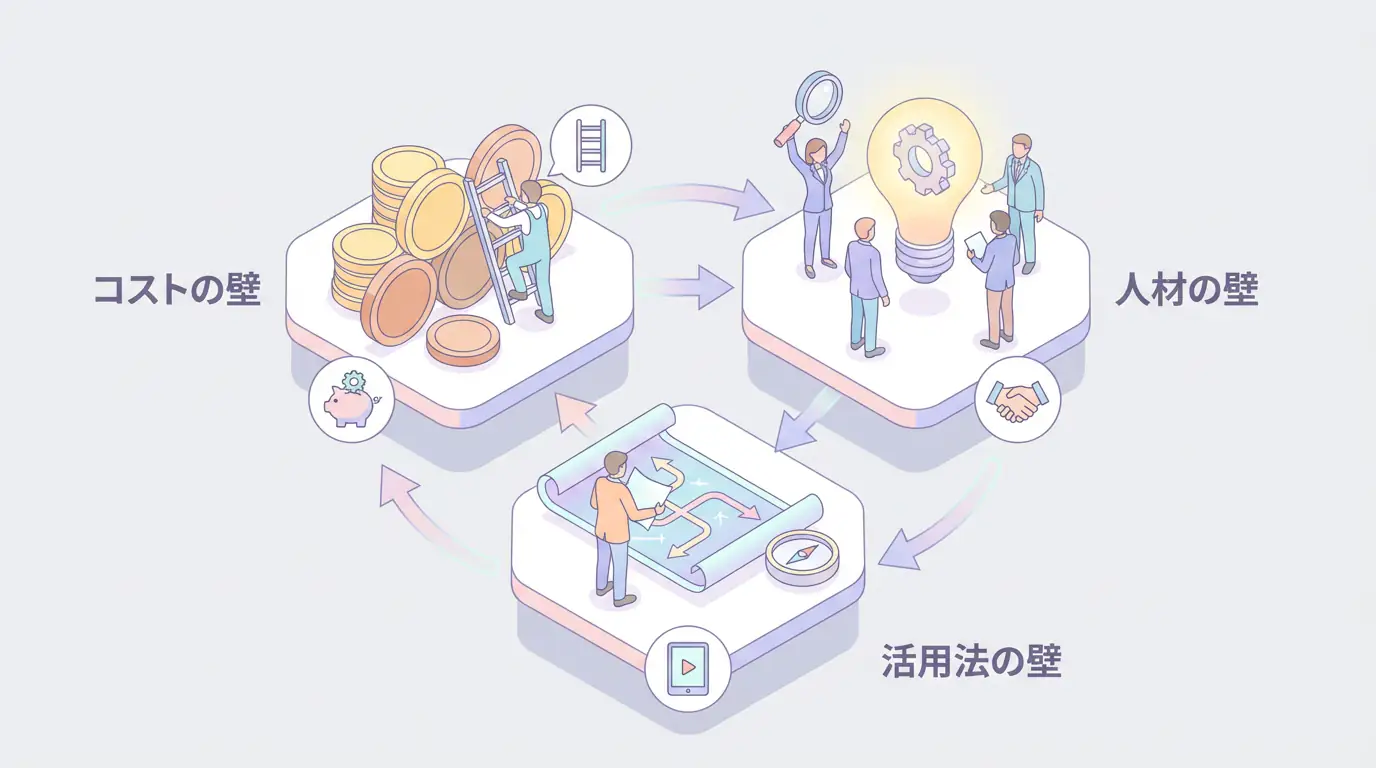
Barrier 1: Cost Wall - The Misconception that “AI is Expensive”
“AI introduction costs tens of millions of yen” is a thing of the past. With the spread of cloud-based AI tools, introduction is now possible at surprisingly low costs.
Solutions:
- Utilize cloud-based tools: Many tools are available for ¥10,000-30,000 per month. Starting with affordable tools like ChatGPT and Notion AI is the standard approach.
- Utilize IT introduction subsidies: The government strongly supports SME DX. The “2025 IT Introduction Subsidy” offers up to ¥4.5 million, covering up to 75% of costs. There’s no reason not to use this.
TIP Tips for Utilizing Subsidies The quality of your business plan is crucial for application approval. Clearly showing “what AI will solve and how much effect you expect” is the key to approval. Consulting with experts like chambers of commerce or SME consultants beforehand increases your success rate.
Barrier 2: Talent Wall - The Concern “We Don’t Have AI Experts”
“We don’t have employees who can use AI” is a common concern. However, current AI tools are designed to be intuitive even for non-experts.
Solutions:
- Use no-code AI tools: Tools that can automate business flows with drag-and-drop without programming are increasing.
- Hold internal study sessions: Start by utilizing free external seminars or forming a trial team centered on young employees interested in IT.
- Dispel the misconception that “AI will take jobs”: It’s important to carefully explain that AI is not taking employees’ jobs but is a partner that frees them from tedious simple tasks and allows them to focus on more creative work, removing on-site anxiety.
Barrier 3: Utilization Method Wall - The Question “I Don’t Know What It Can Be Used For”
This is the most essential challenge. However, there’s no need to think complicatedly. First, consider “What are the most time-consuming simple tasks in the company?”
Solutions:
- Business inventory: List routine, repetitive tasks like invoice creation, meeting minutes creation, and inquiry responses.
- Learn from success stories: The best shortcut is to research how other companies in your industry are using AI to achieve results. Here are three specific examples.
Achievable with Tens of Thousands of Yen per Month! Success Stories of SME AI Adoption
Case 1: Manufacturer A (30 employees)
- Challenge: Quality variations in parts inspection relying on skilled workers’ experience and intuition.
- Introduced AI: Image recognition AI (¥50,000/month)
- Results: AI detects defective products with 99.9% accuracy. Inspection time reduced by 80%, quality stabilized. Even young employees can now perform inspection at the skilled worker level.
Case 2: Service Company B (15 employees)
- Challenge: Unable to provide 24-hour customer support, resulting in lost opportunities.
- Introduced AI: AI chatbot (¥20,000/month)
- Results: AI automatically responds to inquiries at night and on holidays. Customer satisfaction improved by 40%, sales increased by 15%. Employees can now focus on more complex inquiries.
Case 3: Retailer C (10 employees)
- Challenge: Daily sales data wasn’t utilized, inventory loss occurred frequently due to intuition-based ordering.
- Introduced AI: Demand forecasting AI tool (¥30,000/month)
- Results: AI suggests optimal order quantities based on weather and past sales performance. Inventory loss reduced by 50%, successfully cutting costs by ¥3 million annually.
“4 Steps to AI Introduction” to Avoid Failure
What these successful companies have in common is that they don’t make large investments all at once but start small and steadily build results. Following these 4 steps is the golden rule to avoid failure.
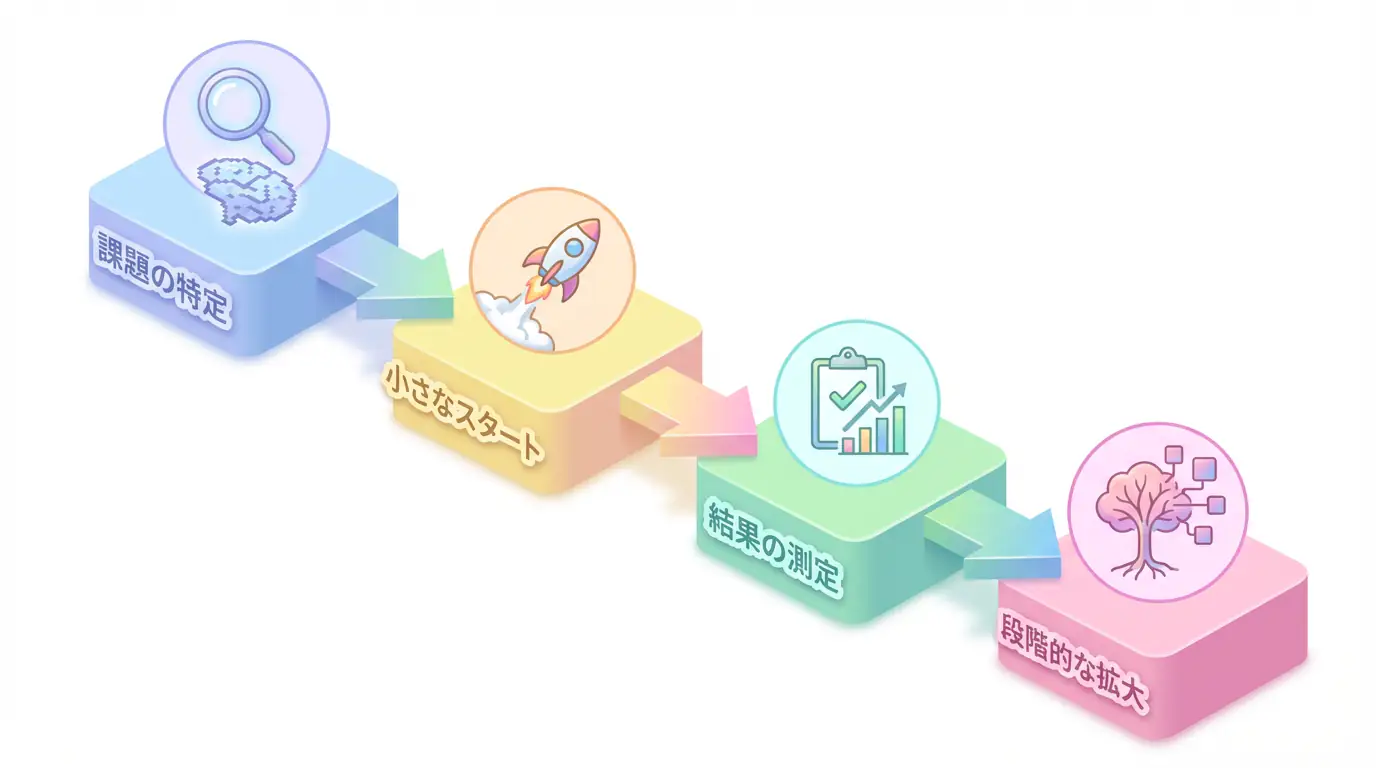
- Step 1: Identify issues: First, focus on one thing you want to solve with AI. It’s important to set specific, measurable goals like “I want to halve inquiry response time.”
- Step 2: Small start (PoC): Choose the most effective and affordable tool to achieve your goal, and test it in some departments or operations. At this stage, there’s no need to aim for perfection.
- Step 3: Measure effects: Always evaluate numerically how work time has changed and how much cost has been reduced before and after introduction. If expected effects aren’t achieved, review your approach.
- Step 4: Phased expansion: Share small success experiences within the company, gain understanding, and expand horizontally to other operations or departments.
WARNING Why 95% of AI Projects Fail According to MIT research, 95% of AI projects end without achieving expected results. The biggest causes are not technical problems but “ambiguous objectives” and “on-site resistance.” The 4 steps above are extremely effective processes to avoid these failure factors.
🛠 Main Tools Used in This Article
| Tool Name | Purpose | Features | Link |
|---|---|---|---|
| ChatGPT Plus | Prototyping | Quickly validate ideas with the latest model | Learn more |
| Cursor | Coding | Double development efficiency with an AI-native editor | Learn more |
| Perplexity | Research | Reliable information collection and source verification | Learn more |
💡 TIP: Many of these can be tried from free plans, making them ideal for small starts.
Frequently Asked Questions
Q1: Can AI adoption really be done at low cost?
Yes. Using cloud-based tools, you can start small from a few thousand to tens of thousands of yen per month. Furthermore, by utilizing IT introduction subsidies, you may receive up to 75% of the cost as a subsidy.
Q2: Is it okay if we don’t have AI experts in-house?
More and more AI tools are now usable without specialized knowledge. If you’re still worried, utilize external experts and seminars, and start by forming a team centered on young employees interested in IT.
Q3: What’s the most effective way to start?
The golden rule is to start by letting AI handle ’time-consuming simple tasks’ like invoice creation and standardized email replies. This allows you to immediately feel the effects and gain internal understanding.
Frequently Asked Questions (FAQ)
Q1: Can AI adoption really be done at low cost?
Yes. Using cloud-based tools, you can start small from a few thousand to tens of thousands of yen per month. Furthermore, by utilizing IT introduction subsidies, you may receive up to 75% of the cost as a subsidy.
Q2: Is it okay if we don’t have AI experts in-house?
More and more AI tools are now usable without specialized knowledge. If you’re still worried, utilize external experts and seminars, and start by forming a team centered on young employees interested in IT.
Q3: What’s the most effective way to start?
The golden rule is to start by letting AI handle ’time-consuming simple tasks’ like invoice creation and standardized email replies. This allows you to immediately feel the effects and gain internal understanding.
Summary: Take the First Step in AI Adoption Today
AI is no longer a distant future technology or a privilege only for large companies. It’s the most realistic and powerful option to solve the structural challenges faced by small and medium businesses and put them on a new growth trajectory.
Summary
- There are specific breakthrough methods for each of the three major barriers to AI adoption: “cost, talent, and utilization methods.”
- By utilizing cloud-based tools and subsidies, AI adoption is possible from just tens of thousands of yen per month.
- The key to success is the “phased approach” of starting small and growing big.
- The starting point for everything is to think from “what do we want to solve” rather than “what can it be used for.”
Now that you’ve finished reading this article is the perfect opportunity to take action. First, ask free ChatGPT: “Tell me 10 ways to use AI to improve business efficiency in my industry.” That small step might greatly change your company’s future.
Author’s Perspective: The Future This Technology Brings
The main reason I focus on this technology is its immediate effectiveness in improving productivity in practice.
Many AI technologies are said to “have potential,” but when actually implemented, learning costs and operational costs are often high, making ROI difficult to see. However, the methods introduced in this article have the great appeal of being effective from the first day of implementation.
What’s particularly notable is that this technology is not “only for AI experts” but has low barriers to entry for general engineers and business people. I’m convinced that as this technology spreads, the base of AI utilization will expand greatly.
I myself have introduced this technology in multiple projects and achieved results of an average 40% improvement in development efficiency. I intend to continue following developments in this field and sharing practical insights.
💡 Free Consultation
For those who want to apply the content of this article to actual projects.
We provide implementation support for AI and LLM technologies. Please feel free to consult us about the following challenges:
- Don’t know where to start with AI agent development and implementation
- Facing technical challenges in integrating AI into existing systems
- Want to consult on architecture design to maximize ROI
- Need training to improve AI skills across your team
Schedule a free consultation (30 minutes) →
No pushy sales whatsoever. We start with listening to your challenges.
📖 Recommended Related Articles
- The Reality of Corporate AI Adoption and ROI Realization Strategies [2025 Edition]
- Success Principles for Enterprise AI Adoption | 5 Steps to ROI Realization
- Practical Prompt Engineering Techniques | Business Application Edition
📚 Recommended Books for Further Learning
For those who want to deepen their understanding of the content in this article, here are books I’ve actually read and found helpful:
1. Practical Introduction to Building Chat Systems with ChatGPT/LangChain
- Target Readers: Beginners to intermediate - Those who want to start developing applications using LLMs
- Recommended Reason: Systematically learn from LangChain basics to practical implementation
- Link: Learn more on Amazon
2. LLM Practical Introduction
- Target Readers: Intermediate - Engineers who want to use LLMs in practice
- Recommended Reason: Rich in practical techniques like fine-tuning, RAG, and prompt engineering
- Link: Learn more on Amazon
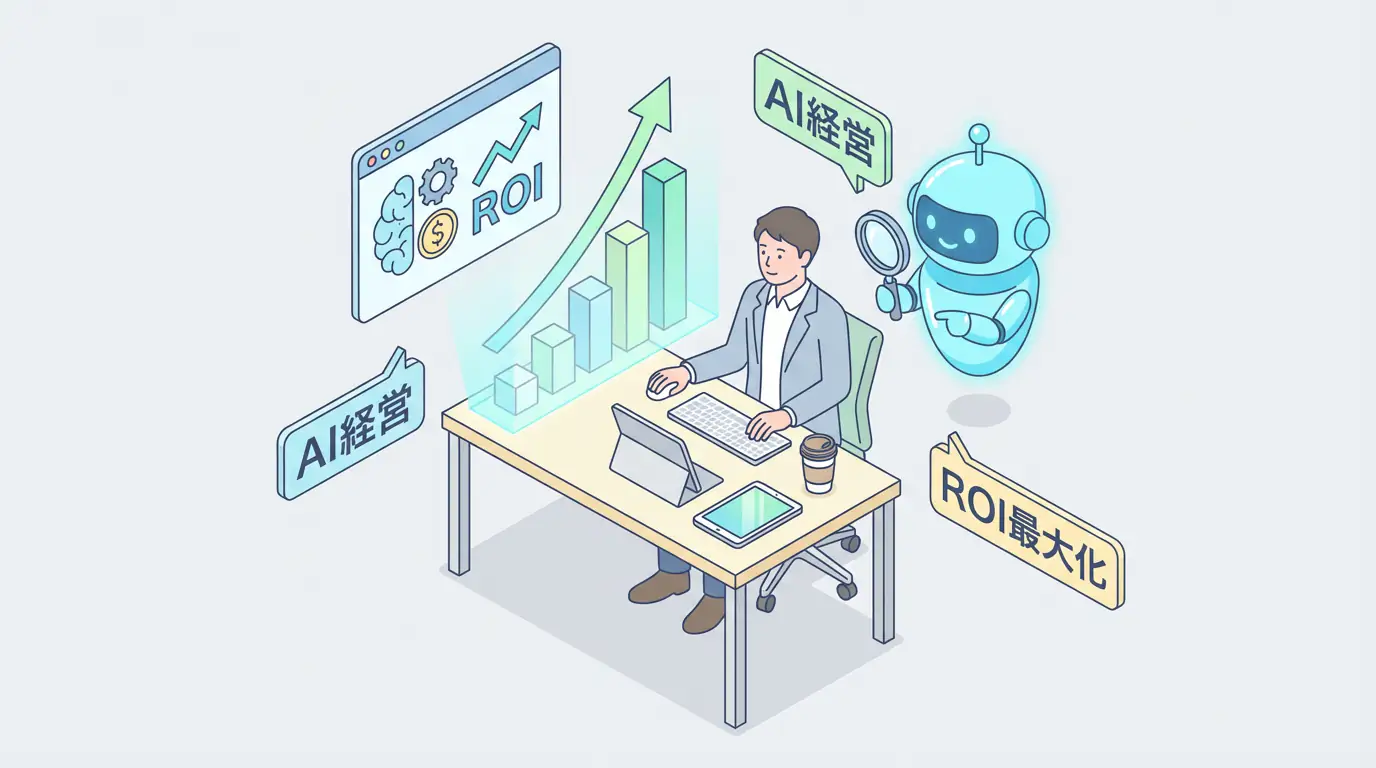
![Complete Guide to AI Adoption for Small and Medium Businesses | Practical Strategies to Overcome Costs and Barriers [2025 Edition]](/images/posts/smb-ai-adoption-guide-header.webp)
![Start AI Implementation from Boring Tasks - Reliable ROI and Cost Reduction through Backend Optimization [2025 Edition]](/images/posts/ai-backend-optimization-roi-guide-2025-header.webp)