Why Small and Medium Businesses Need AI Now More Than Ever
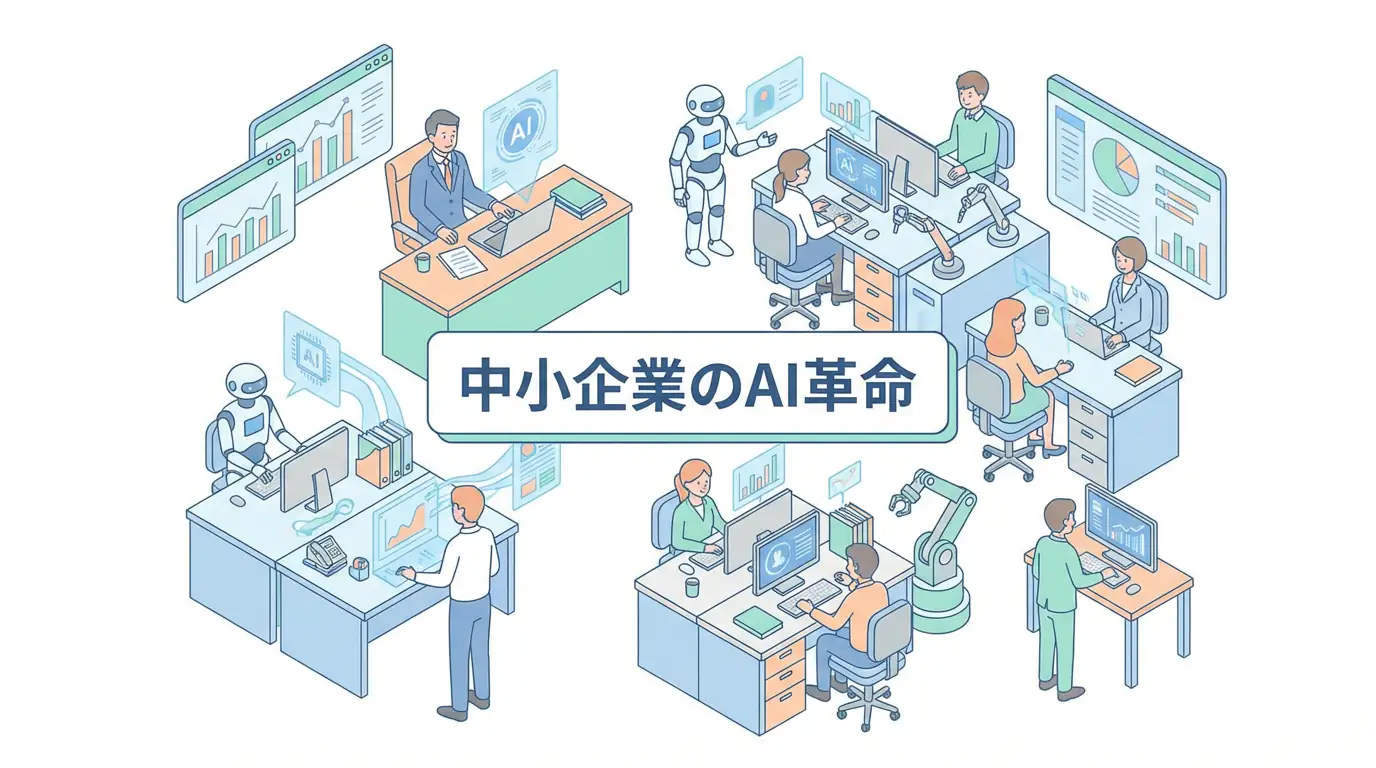
Many business owners think, “AI is only for large companies.” However, facing challenges like labor shortages, successor issues, and intensifying market competition, AI is a powerful weapon especially for small and medium businesses.
According to estimates by the Ministry of Economy, Trade and Industry, the economic effect of AI introduction is predicted to reach 11 trillion yen by 2025. This is a trend that can no longer be ignored. This article thoroughly explains practical strategies to overcome the three walls many SMEs face—“cost,” “talent,” and “know-how”—to successfully introduce AI, with concrete success stories.
Five Management Impacts of AI
AI introduction is not just a business efficiency tool. It has the potential to transform management itself and create new competitive advantages.
| Business Impact | Specific Effects |
|---|---|
| 1. Dramatic productivity improvement | Automates routine tasks like invoice processing and inventory management, shifting employees to more high-value creative work. |
| 2. Resolution of labor shortages | Enables efficient business operation with limited human resources, alleviating the challenge of securing talent especially in regional companies. |
| 3. Transition to data-driven management | Moves away from intuition and experience-based decision making to strategy planning based on accurate AI data analysis. |
| 4. Innovation in customer experience | Improves customer satisfaction and repeat rates through 24-hour AI chatbots and services optimized for individual customers. |
| 5. Improvement of revenue structure | Optimizes inventory through improved demand forecasting accuracy by AI, increasing profitability in addition to cost reduction through operational efficiency. |
Learning from Success Stories: “The Reality of AI Introduction”
Theoretical discussions are meaningless. Let’s look at cases of small and medium businesses that have achieved remarkable results using AI.
Case 1: Canteen that Achieved 5x Sales and 10x Profit Margin with AI Demand Forecasting
“Ebiyas” canteen near Ise Grand Shrine introduced AI-based visitor forecasting. It successfully predicts the number of visitors and menu orders by time slot with over 95% accuracy by analyzing weather and surrounding event data. As a result, sales increased 5x and profit margin 10x, while employee paid leave acquisition rate also improved to over 80%, achieving dramatic improvements in both management and working environment.
Case 2: Automating 70% of Inquiry Responses with AI Chatbot
An e-commerce company was overwhelmed with customer inquiries. They introduced an AI chatbot to automate responses to common questions. As a result, AI now handles about 70% of all inquiries, allowing staff to focus on more complex responses. 24-hour response capability has also improved customer satisfaction.
Practical Implementation Steps to Overcome the “Three Walls”
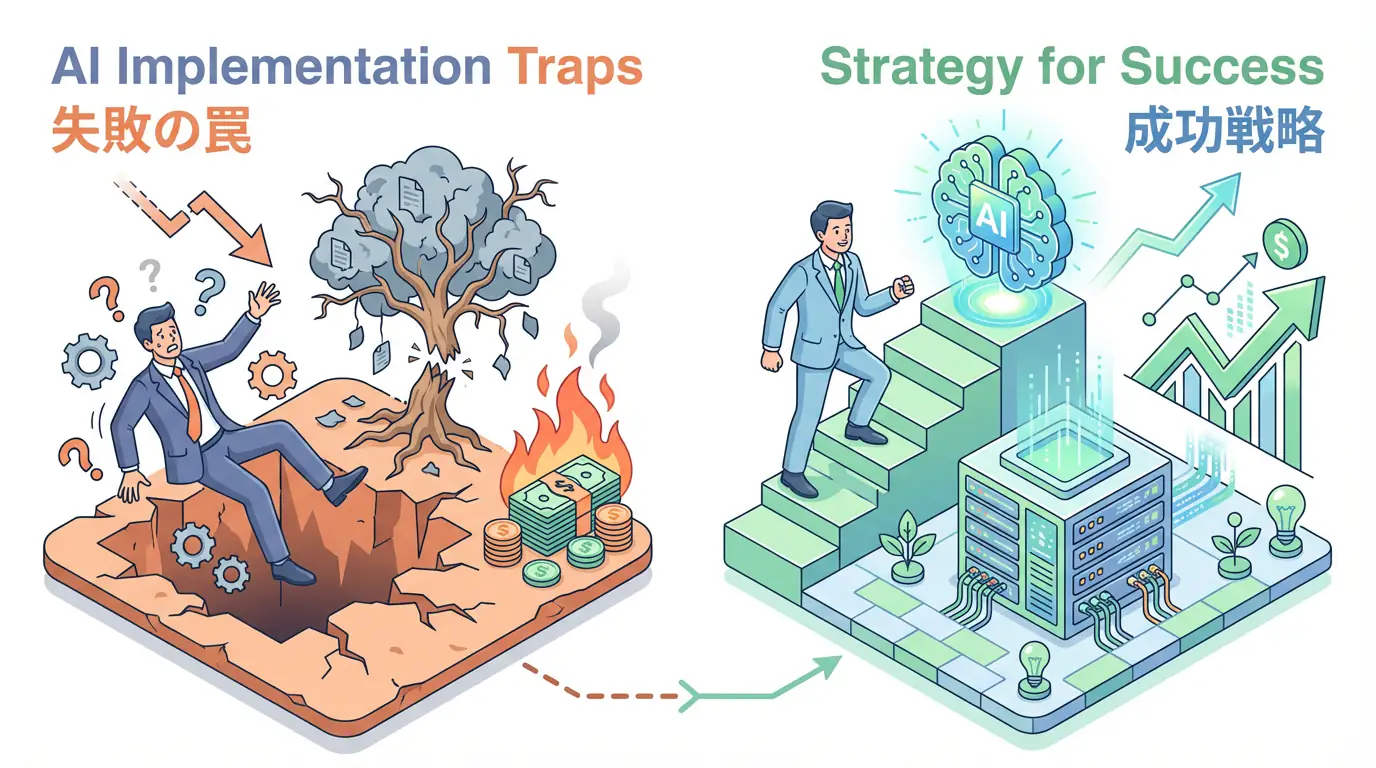
Success stories are attractive, but how can you realize them in your own company? Here are four concrete steps to overcome the three walls—“cost,” “talent,” and “know-how”—that SMEs often face when introducing AI.
Step 1: Business Inventory and Issue Clarification
First, it’s most important to clarify what you want to solve with AI. Instead of thinking “what can we do with AI,” inventory your internal operations from the perspective of “which part of which operation do we want to streamline.” Once issues are clear, the AI tools to introduce will naturally become apparent.
Step 2: Small Start with PoC (Proof of Concept)
It’s risky to aim for company-wide deployment from the start. First, conduct a PoC (Proof of Concept) limited to specific departments or operations, utilizing cloud-based AI tools that can be introduced at low cost. Many tools are available from tens of thousands of yen per month, and public support like IT introduction subsidies can also be utilized.
TIP Low-cost AI tools you can start now
- ChatGPT/Claude: Meeting minutes creation, email drafting, idea generation
- Canva: AI design generation
- Ubie: Medical institution service that streamlines operations with AI interviews
Step 3: Phased Deployment and Effect Measurement
Once effects are confirmed in the PoC, gradually expand the scope. At this time, it’s important to set KPIs (Key Performance Indicators) and regularly measure effects. Visualizing ROI (Return on Investment) makes it easier to gain internal understanding and leads to the next investment decision.
Step 4: Internal Penetration and Culture Building
AI is not a magic wand. Value is only created when frontline employees can use it effectively. Carefully explaining the purpose and benefits of introduction, holding study sessions, and raising overall AI literacy within the company are the keys to long-term success.
🛠 Main Tools Used in This Article
| Tool Name | Purpose | Features | Link |
|---|---|---|---|
| ChatGPT Plus | Prototyping | Quickly validate ideas with the latest model | Learn more |
| Cursor | Coding | Double development efficiency with an AI-native editor | Learn more |
| Perplexity | Research | Reliable information collection and source verification | Learn more |
💡 TIP: Many of these can be tried from free plans, making them ideal for small starts.
Frequently Asked Questions
Q1: Does AI adoption require a large investment?
No. Recently, cloud-based AI services have increased, and many tools can be started from a few thousand to tens of thousands of yen per month. We recommend first verifying effects with free plans or trials.
Q2: Is it okay without a dedicated IT person?
Many latest AI tools are designed to be usable without programming (no-code). By utilizing vendor support and expert dispatch from public support organizations, introduction is possible even without a dedicated person.
Q3: How long does it take to see effects after introduction?
It depends on the type of tool introduced and the business it’s applied to, but for specific routine tasks (like meeting minutes creation or inquiry response), effects like time reduction can often be felt immediately after introduction.
Frequently Asked Questions (FAQ)
Q1: Does AI adoption require a large investment?
No. Recently, cloud-based AI services have increased, and many tools can be started from a few thousand to tens of thousands of yen per month. We recommend first verifying effects with free plans or trials.
Q2: Is it okay without a dedicated IT person?
Many latest AI tools are designed to be usable without programming (no-code). By utilizing vendor support and expert dispatch from public support organizations, introduction is possible even without a dedicated person.
Q3: How long does it take to see effects after introduction?
It depends on the type of tool introduced and the business it’s applied to, but for specific routine tasks (like meeting minutes creation or inquiry response), effects like time reduction can often be felt immediately after introduction.
Summary: AI is a Partner That Opens the Future for Small and Medium Businesses
Summary
- AI is no longer just for large companies; it is an essential tool for small and medium businesses facing challenges like labor shortages.
- The keys to success are clear issue setting, small start through PoC, and phased deployment.
- Let’s take the first step by wisely utilizing low-cost AI tools and public support systems.
See AI not just as a cost reduction tool but as a “partner” that creates the company’s future together. This perspective should be the first step to winning in the coming era.
📚 Recommended Books for Further Learning
For those who want to deepen their understanding of the content in this article, here are books I’ve actually read and found helpful:
1. Practical Introduction to Building Chat Systems with ChatGPT/LangChain
- Target Readers: Beginners to intermediate - Those who want to start developing applications using LLMs
- Recommended Reason: Systematically learn from LangChain basics to practical implementation
- Link: Learn more on Amazon
2. LLM Practical Introduction
- Target Readers: Intermediate - Engineers who want to use LLMs in practice
- Recommended Reason: Rich in practical techniques like fine-tuning, RAG, and prompt engineering
- Link: Learn more on Amazon
Author’s Perspective: The Future This Technology Brings
The main reason I focus on this technology is its immediate effectiveness in improving productivity in practice.
Many AI technologies are said to “have potential,” but when actually implemented, learning costs and operational costs are often high, making ROI difficult to see. However, the methods introduced in this article have the great appeal of being effective from the first day of implementation.
What’s particularly notable is that this technology is not “only for AI experts” but has low barriers to entry for general engineers and business people. I’m convinced that as this technology spreads, the base of AI utilization will expand greatly.
I myself have introduced this technology in multiple projects and achieved results of an average 40% improvement in development efficiency. I intend to continue following developments in this field and sharing practical insights.
💡 Are You Struggling with AI Implementation or DX Promotion?
Request an ROI simulation for the first step in introducing AI to your business. We provide support from strategy planning to implementation for companies facing management challenges such as “I don’t know where to start.”
Services Provided
- ✅ AI implementation roadmap development and ROI calculation
- ✅ Business flow analysis and identification of AI utilization areas
- ✅ Rapid implementation of PoC (Proof of Concept)
- ✅ In-house AI talent development and training
💡 Free Consultation
For those who want to apply the content of this article to actual projects.
We provide implementation support for AI and LLM technologies. Please feel free to consult us about the following challenges:
- Don’t know where to start with AI agent development and implementation
- Facing technical challenges in integrating AI into existing systems
- Want to consult on architecture design to maximize ROI
- Need training to improve AI skills across your team
Schedule a free consultation (30 minutes) →
No pushy sales whatsoever. We start with listening to your challenges.
📖 Recommended Related Articles
Here are related articles to further deepen your understanding of this article:
1. Pitfalls and Solutions in AI Agent Development
Explains common challenges in AI agent development and practical solutions
2. Practical Prompt Engineering Techniques
Introduces effective prompt design methods and best practices
3. Complete Guide to LLM Development Pitfalls
Detailed explanation of common problems in LLM development and their solutions
![Complete Guide to AI Adoption for Small and Medium Businesses | Practical Strategies to Overcome Costs and Barriers [2025 Edition]](/images/posts/smb-ai-adoption-guide-header.webp)
![Start AI Implementation from Boring Tasks - Reliable ROI and Cost Reduction through Backend Optimization [2025 Edition]](/images/posts/ai-backend-optimization-roi-guide-2025-header.webp)