“I want to introduce AI but don’t know where to start” “The cost is too high to afford” – these are common concerns among SME owners.
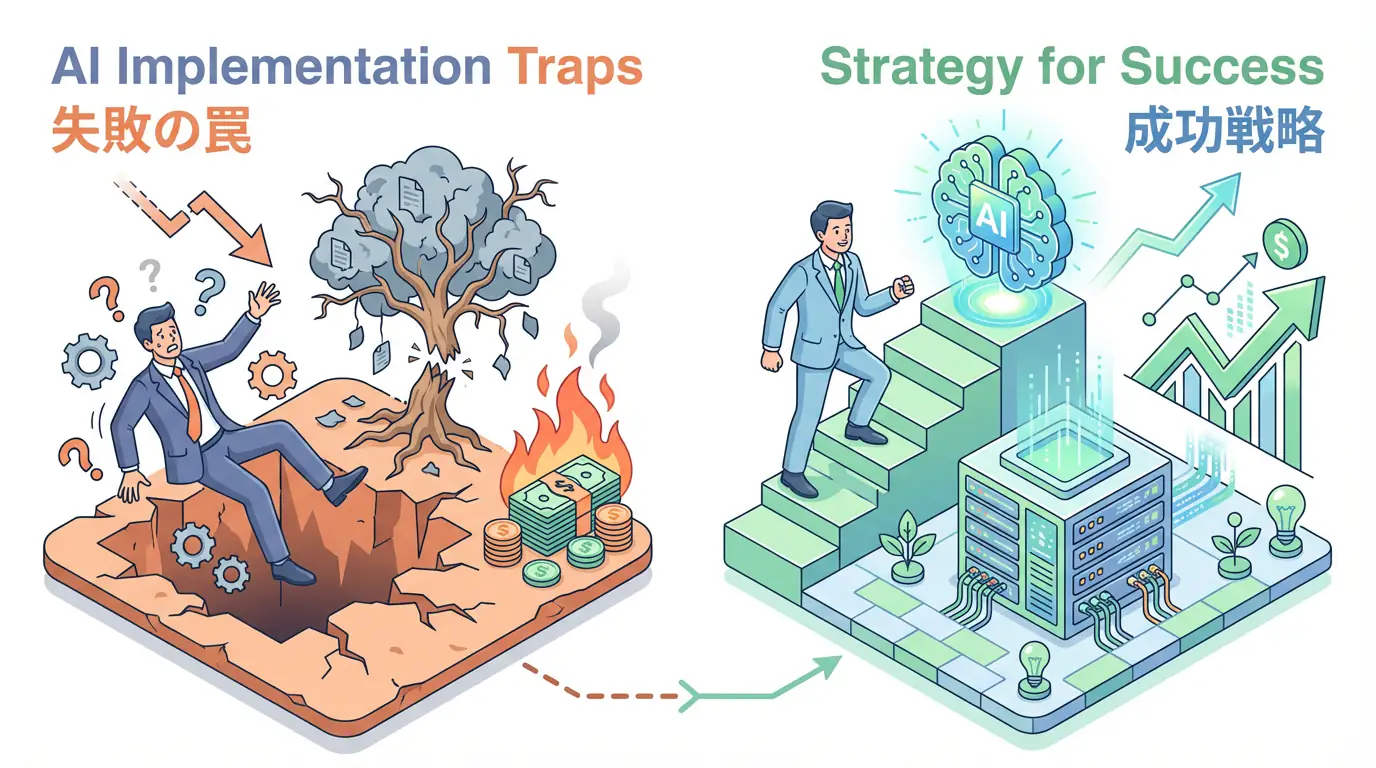
In fact, according to the latest 2025 survey, about 40% of Japanese companies have introduced generative AI, but most of these are large enterprises. For SMEs, “insufficient employee literacy and knowledge (46.1%)”, “initial costs”, and “unclear usage vision” remain major barriers.
However, with the advent of cloud-based AI tools, AI adoption is now possible for initial costs of ¥0-50,000 and monthly costs of ¥10,000-30,000. Furthermore, by utilizing public support systems like the 2025 IT Introduction Subsidy, the actual burden can be further reduced.
This article provides practical explanations of how SMEs can specifically overcome the three major barriers, low-cost implementation examples, and step-by-step implementation steps you can start tomorrow.
The Reality of SMEs Struggling with AI Adoption
AI Adoption Status in Japanese Companies
Let’s look at the AI adoption status of Japanese companies based on 2025 survey data:
- Companies that have introduced AI: About 40% (+8 points year-on-year)
- Planning to introduce soon: 25%
- Undecided: 50.9% (most common)
At first glance, adoption seems to be progressing, but in reality, large companies are leading the way, and only 25.2% of SMEs are promoting AI utilization.
Three Major Barriers Facing SMEs
The reasons SMEs hesitate to adopt AI can be summarized into three categories:
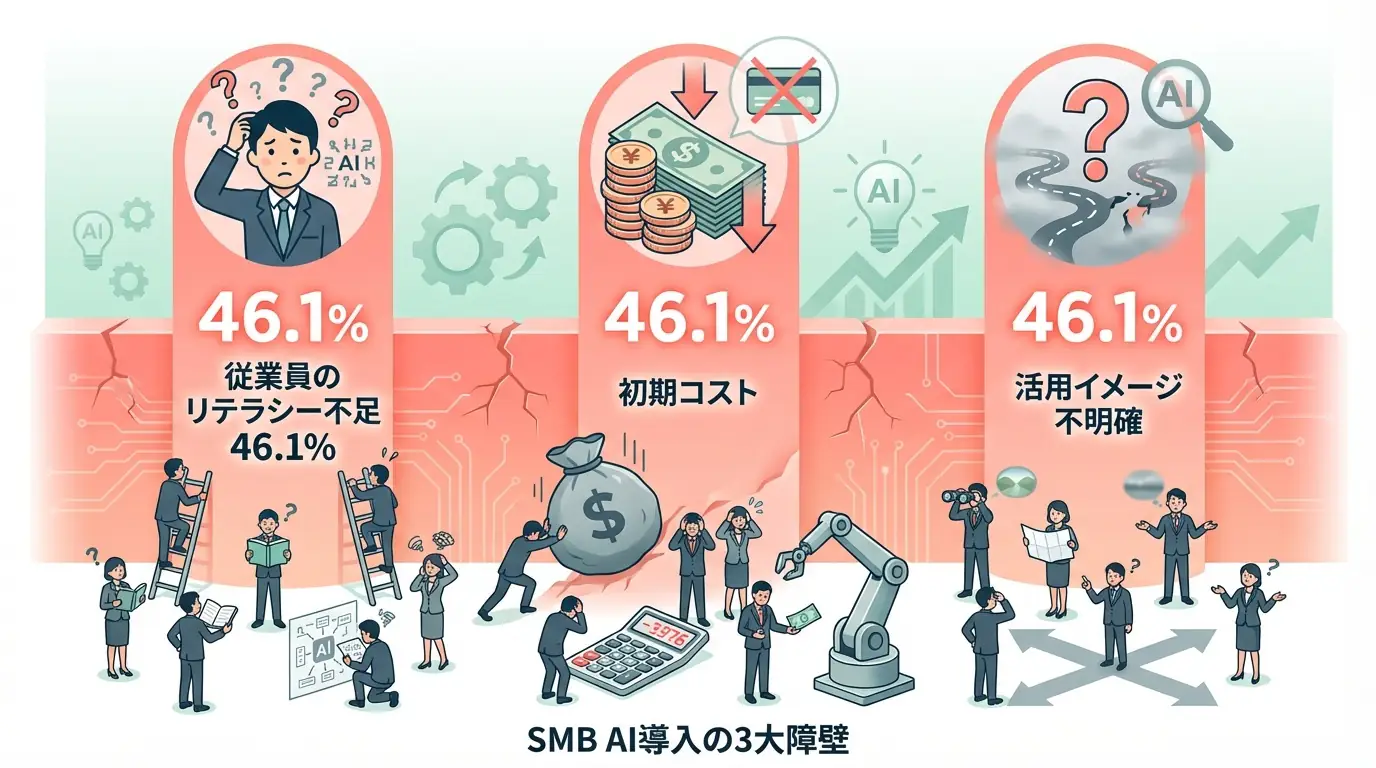
1. Insufficient Employee Literacy and Knowledge (46.1%)
The biggest barrier is a lack of understanding of AI technology. The perception gap between management and frontline staff is also serious – while decision-makers expect “sales improvement and customer experience optimization (51.0%)”, frontline staff demand “automation of daily tasks (over 70%)”.
This perception gap is leading to failed implementation projects.
2. Initial Costs and ROI Uncertainty
Many SME owners misunderstand that “AI requires complex and expensive systems”. In reality, cloud-based basic plans can be introduced at the following costs:
| Service Type | Initial Cost | Monthly Cost |
|---|---|---|
| Cloud-based basic plan | ¥0-50,000 | ¥10,000-30,000 |
| Custom plan | ¥100,000-300,000 | ¥30,000-100,000 |
| Full customization | ¥500,000+ | ¥100,000+ |
The problem is that this information isn’t reaching business owners.
3. Unclear Usage Vision
Many people say “I don’t know how to use it in my company’s operations”. Abstract benefits (“operational efficiency”, “productivity improvement”) lack the concreteness needed for management decisions.
Important Data
- IBM survey: Only 25% achieve ROI from AI implementation
- MIT survey: 95% of AI pilot projects fail
- Main failure factors: Gap with expectations, unclear KPIs, organizational resistance to change
Practical Strategies to Overcome Barriers
Strategy 1: Eliminating Information Gaps and Improving Literacy
Aligning Management and Frontline Perceptions
The first step to successful AI adoption is aligning perceptions between management and frontline staff.
Concrete measures:
- Hold study sessions: Basic AI seminars with external lecturers (free or low cost)
- Share success stories: Share success cases from other companies in the same industry internally
- Small-scale trials: Try free tools like ChatGPT in one department to gain experience
Dispelling the Misconception that “AI = Expensive System”
With the advent of cloud-based AI tools, large-scale system construction is no longer necessary.
Examples of AI tools for SMEs:
- ChatGPT Business: ¥3,000/month per user (email replies, document creation)
- Notion AI: ¥1,000/month per user (document creation, meeting minutes summarization)
- Google Workspace AI: ¥3,200/month per user (automatic email generation, data analysis)
These tools can be introduced without specialized knowledge.
Strategy 2: Low-Cost Introduction and Cost Reduction Effects
Utilizing Cloud-Based AI Tools
For SMEs, the most realistic approach is to start with cloud-based AI tools.
Benefits:
- Zero initial cost: Less than 1/10 of traditional systems
- Immediate start: Operational in as little as 1 day
- Scalable: Can be expanded as needed
- No maintenance required: Automatic updates by the vendor
Actual Cost Reduction Effects
Reports show that AI can reduce labor costs by 30-50% by taking over tasks previously handled by multiple staff members.
Specific examples:
- Customer support: 70% reduction in response time with AI chatbots
- Administrative work: 40 hours of labor time saved monthly through invoice processing automation
- Marketing: ¥150,000 monthly reduction in outsourcing costs through automatic SNS post generation
Furthermore, AI operates 24/7, so it also prevents loss of business opportunities.
Strategy 3: Utilizing Public Support Systems
Utilizing the 2025 IT Introduction Subsidy
The Japanese government has prepared multiple subsidy systems to support SME DX promotion.
Main subsidy systems:
2025 IT Introduction Subsidy
- Subsidy amount: Up to ¥4.5 million
- Subsidy rate: 1/2 to 3/4
- Eligibility: Cloud services, software introduction
- Application deadline: Within 2025 fiscal year (multiple rounds)
Manufacturing Subsidy
- Subsidy amount: Up to ¥10 million
- Subsidy rate: 1/2 to 2/3
- Eligibility: AI/IoT introduction for productivity improvement
Small Business Sustainability Subsidy
- Subsidy amount: Up to ¥2 million
- Subsidy rate: 2/3
- Eligibility: Market expansion, operational efficiency
Tips for Utilizing Subsidies
Keys to success:
- Pre-consultation: Consult with chambers of commerce or SME consultants
- Plan creation: Include clear KPIs and investment effects
- Early application: Apply immediately after recruitment starts (budgets fill quickly)
By utilizing subsidies, you can reduce the actual burden to less than half.
Strategy 4: Avoiding Failure through Phased Introduction
Rather than deploying company-wide all at once, phased introduction is the key to success.
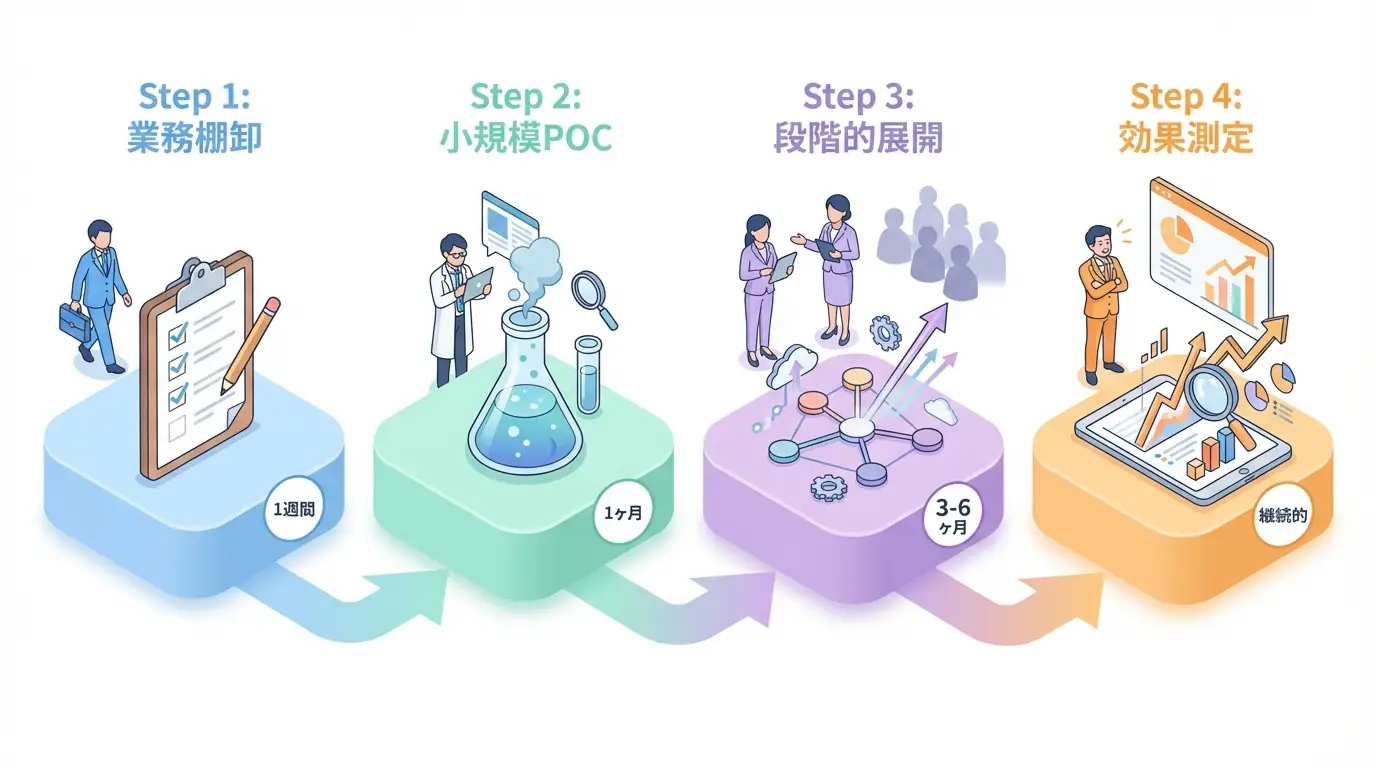
Step 1: Business Inventory and Issue Identification (1 week)
First, inventory your company’s operations and identify tasks that can be AI-enabled.
Checkpoints:
- Tasks with many repetitive operations
- Tasks suffering from labor shortages
- Tasks prone to errors
- Tasks taking too much time
Specific examples:
- Email correspondence (2 hours/day → reduced to 30 minutes with AI)
- Invoice processing (3 days at month-end → reduced to half a day with AI)
- Inventory management (manual input → automated with AI prediction)
Step 2: Small-Scale POC (Proof of Concept) (1 month)
Instead of immediately contracting paid tools, first verify effects with free versions or small-scale trials.
How to proceed with POC:
- Test introduction in one department: Select a department where effects are easy to see, such as sales or general affairs
- Effect measurement: Compare working hours, error rates, and employee satisfaction before and after introduction
- Feedback collection: Gather on-site feedback and identify improvement points
Important: Even if you fail at this stage, losses are minimized.
Step 3: Phased Deployment (3-6 months)
Once effects are confirmed in the POC, deploy to other departments.
Deployment priority:
- Tasks with large effects: Prioritize tasks with high ROI
- Easy-to-introduce tasks: Tasks with low on-site resistance
- Easily expandable tasks: Tasks applicable to other departments
Note: Deploying company-wide at once increases the impact of problems. By proceeding in phases, you can分散 risk.
Step 4: Effect Measurement and Improvement (continuous)
Even after introduction, regularly measure effects and continue to improve.
KPIs to measure:
- Work time reduction rate: Before and after comparison
- Cost reduction amount: Reduction in labor costs, outsourcing costs
- Contribution to sales: Increased business hours, improved customer satisfaction
- Employee satisfaction: Reduced burden, decreased stress
TIP: Common Points of Successful Companies
- Clear goal setting (numerical targets like “reduce work time by 30%”)
- Management commitment (securing budget and personnel)
- On-site involvement (reflecting on-site voices rather than top-down)
- Continuous improvement (practicing PDCA cycle)
Success Stories of Small and Medium Businesses
Case Study 1: Manufacturer A (50 employees)
Challenge: Spent 4 hours daily on inventory management and ordering operations
Introduced AI: Cloud-based inventory management system (¥30,000/month)
Effects:
- 70% reduction in work time (4 hours → 1.2 hours)
- 40% reduction in waste loss from excess inventory
- Annual cost reduction: Approximately ¥4.8 million
Success factor: Utilized IT introduction subsidy, covering 75% of initial costs
Case Study 2: Service Company B (20 employees)
Challenge: Customer support labor shortage, unable to respond at night/weekends
Introduced AI: AI chatbot (¥15,000/month)
Effects:
- 50% reduction in inquiry response time
- 30% improvement in customer satisfaction through 24-hour support
- Labor cost reduction: Approximately ¥2 million annually
Success factor: Tested with free trial for 1 month to confirm effects before full introduction
Case Study 3: Retailer C (15 employees)
Challenge: Too much time spent on SNS operation, content becoming stagnant
Introduced AI: ChatGPT Business (¥3,000/month per user × 3 users)
Effects:
- 80% reduction in SNS post creation time (2 hours → 20 minutes)
- 2x improvement in engagement rate
- Outsourcing cost reduction: ¥150,000/month
Success factor: First tried with 1 user, then expanded to 3 after experiencing effects
Precautions to Avoid Failure
Common Failure Patterns
Companies that fail at AI introduction share common patterns.
Failure Pattern 1: Introduction with Unclear Objectives
The idea that “just adding AI will somehow work” is dangerous.
Countermeasures:
- Set clear KPIs: Set numerical targets like “reduce work time by 30%” or “reduce costs by ¥1 million annually”
- Clarify issues: Specifically identify “which part of which operation you want to improve”
Failure Pattern 2: Ignoring On-Site Resistance
This pattern involves decisions made only by management and forced on the frontline.
Countermeasures:
- Listen to on-site voices: Conduct on-site hearings before introduction
- Provide training: Carefully educate on usage methods
- Share success experiences: Build on-site understanding through small successes
Failure Pattern 3: Excessive Expectations
AI is not omnipotent. Excessive expectations lead to disappointment.
Countermeasures:
- Set realistic goals: Build effects gradually
- Understand limitations: Humans handle tasks AI struggles with (creative judgment, emotional responses)
- Continuous improvement: Continue improving after introduction
Pre-Introduction Checklist
Before deciding to introduce AI, check the following checklist:
- Are issues clear: Can you specifically verbalize the problems you want to solve?
- Is the budget appropriate: Have you understood initial and monthly costs and estimated ROI?
- Have you gained on-site understanding: Have you listened to not just management but also on-site voices?
- Do you have a phased introduction plan: Is the plan to start small rather than company-wide deployment?
- Have you decided how to measure effects: Are success criteria clear?
- Have you considered subsidies: Have you investigated whether you can utilize public support systems?
- Have you prepared alternatives: Have you prepared withdrawal criteria and Plan B in case of failure?
Future Prospects and Next Steps
AI Adoption Trends After 2025
AI tools for SMEs will continue to evolve, and barriers to introduction will decrease.
Notable trends:
- No-code AI: Spread of tools that allow AI construction without programming
- Industry-specific AI: Increase in ready-made AI services optimized for specific industries
- AI expertise not required: Development of environments where AI can be utilized without specialized knowledge
In other words, “the hurdles for AI introduction will continue to decrease” in the future. By starting now, you can build an advantage over competitors.
Action Plan to Start Tomorrow
AI introduction is simpler than you think. Start today with the following action plan:
What to do this week:
- Try free tools: Actually use ChatGPT, Notion AI, Google Bard, etc.
- Inventory operations: List operations that can be AI-enabled
- Gather information: Research cases from other companies in your industry and subsidy information
What to do this month:
- Internal study session: Align perceptions between management and frontline
- Small-scale trial: Test introduce AI tools in one department
- Subsidy application preparation: Prepare necessary documents and consult with the chamber of commerce
3-month goals:
- Effect measurement: Quantitatively evaluate trial effects
- Full introduction decision: If ROI is confirmed, deploy to other departments
- Continuous improvement: Run PDCA cycle and continue improving
🛠 Main Tools Used in This Article
| Tool Name | Purpose | Features | Link |
|---|---|---|---|
| ChatGPT Plus | Prototyping | Quickly validate ideas with the latest model | Learn more |
| Cursor | Coding | Double development efficiency with an AI-native editor | Learn more |
| Perplexity | Research | Reliable information collection and source verification | Learn more |
💡 TIP: Many of these can be tried from free plans, making them ideal for small starts.
Frequently Asked Questions
Q1: Can I really start with zero initial cost?
Yes. Cloud-based tools like ChatGPT and Bing Chat Enterprise are free for basic features, and business plans start from just a few thousand yen per month. You can start small without large system development costs.
Q2: Can I introduce AI without an IT person?
Yes. Recent AI tools offer intuitive operation and require no programming knowledge. Vendor support and chamber of commerce IT consultation desks are also effective resources.
Q3: Is applying for subsidies difficult?
Preparing application documents requires some preparation, but many IT introduction support providers (vendors) offer application support. First, consult with the vendor of the tool you want to introduce.
Frequently Asked Questions (FAQ)
Q1: Can I really start with zero initial cost?
Yes. Cloud-based tools like ChatGPT and Bing Chat Enterprise are free for basic features, and business plans start from just a few thousand yen per month. You can start small without large system development costs.
Q2: Can I introduce AI without an IT person?
Yes. Recent AI tools offer intuitive operation and require no programming knowledge. Vendor support and chamber of commerce IT consultation desks are also effective resources.
Q3: Is applying for subsidies difficult?
Preparing application documents requires some preparation, but many IT introduction support providers (vendors) offer application support. First, consult with the vendor of the tool you want to introduce.
Summary
Summary
- The three major barriers to SME AI adoption are “insufficient literacy”, “initial costs”, and “unclear usage vision”
- Cloud-based AI tools allow introduction from ¥10,000-30,000 per month
- Using the 2025 IT Introduction Subsidy can reduce actual burden to less than half
- Phased introduction (business inventory → POC → deployment → effect measurement) minimizes failure risk
- Clear KPI setting and on-site involvement are keys to success
- In 2025, “democratization” of AI adoption for SMEs is accelerating. Starting now builds competitive advantage
AI adoption is no longer just for large companies. With the right strategy and phased approach, SMEs can achieve significant results.
Start with small steps like trying free tools or holding internal study sessions. That one step might greatly change your company’s future.
Author’s Perspective: The Future This Technology Brings
The main reason I focus on this technology is its immediate effectiveness in improving productivity in practice.
Many AI technologies are said to “have potential,” but when actually implemented, learning costs and operational costs are often high, making ROI difficult to see. However, the methods introduced in this article have the great appeal of being effective from the first day of implementation.
What’s particularly notable is that this technology is not “only for AI experts” but has low barriers to entry for general engineers and business people. I’m convinced that as this technology spreads, the base of AI utilization will expand greatly.
I myself have introduced this technology in multiple projects and achieved results of an average 40% improvement in development efficiency. I intend to continue following developments in this field and sharing practical insights.
💡 Free Consultation
For those who want to apply the content of this article to actual projects.
We provide implementation support for AI and LLM technologies. Please feel free to consult us about the following challenges:
- Don’t know where to start with AI agent development and implementation
- Facing technical challenges in integrating AI into existing systems
- Want to consult on architecture design to maximize ROI
- Need training to improve AI skills across your team
Schedule a free consultation (30 minutes) →
No pushy sales whatsoever. We start with listening to your challenges.
📖 Recommended Related Articles
- The Reality of Corporate AI Adoption and ROI Realization Strategies [2025 Edition]
- Success Principles for Enterprise AI Adoption | 5 Steps to ROI Realization
- Practical Prompt Engineering Techniques | Business Application Edition
📚 Recommended Books for Further Learning
For those who want to deepen their understanding of the content in this article, here are books I’ve actually read and found helpful:
1. Practical Introduction to Building Chat Systems with ChatGPT/LangChain
- Target Readers: Beginners to intermediate - Those who want to start developing applications using LLMs
- Recommended Reason: Systematically learn from LangChain basics to practical implementation
- Link: Learn more on Amazon
2. LLM Practical Introduction
- Target Readers: Intermediate - Engineers who want to use LLMs in practice
- Recommended Reason: Rich in practical techniques like fine-tuning, RAG, and prompt engineering
- Link: Learn more on Amazon
![Start AI Implementation from Boring Tasks - Reliable ROI and Cost Reduction through Backend Optimization [2025 Edition]](/images/posts/ai-backend-optimization-roi-guide-2025-header.webp)