AI Leaps Off the Screen - The Impact of Physical AI
In 2025, AI is no longer just something on the other side of a chat window. AI has gained a physical body and has begun to actually “move” in our factories, warehouses, and daily lives. This is Physical AI, the new technological trend where AI and robotics converge.
Consulting firm Deloitte’s “Tech Trends 2026” listed Physical AI as the top trend [1]. The report asserts, “Intelligence is no longer confined to screens. It is embodied, autonomously solving real problems in the physical world.”
To back this up, Amazon has already deployed over 1 million robots in its warehouses, with an AI called “DeepFleet” coordinating the entire robot fleet to improve warehouse movement efficiency by 10% [1]. At BMW’s factories, completed cars autonomously travel kilometers along production lines to the next process [1].
This isn’t just an extension of “factory automation.” It’s the emergence of a new “workforce” that learns, adapts, and collaborates with humans. This article will explain what Physical AI is, how it’s transforming business, especially manufacturing, and how small and medium enterprises can ride this wave, along with specific steps.
What is Physical AI? - The Birth of Learning Robots
To define Physical AI in one sentence, it’s “a robotic system controlled by AI to autonomously execute tasks in the physical world.
Traditional industrial robots excelled at accurately repeating pre-programmed movements but struggled with unexpected situations. However, Physical AI overcomes this barrier by combining three elements:
| Element | Technology | Role |
|---|---|---|
| Perception | AI cameras, sensors | The “eyes” that grasp the surrounding environment, object positions, and states in real-time. |
| Decision | AI models, reinforcement learning | The “brain” that autonomously decides what to do next based on perceived information. |
| Action | Robot arms, AGVs | The “limbs” that execute physical tasks based on decision results. |
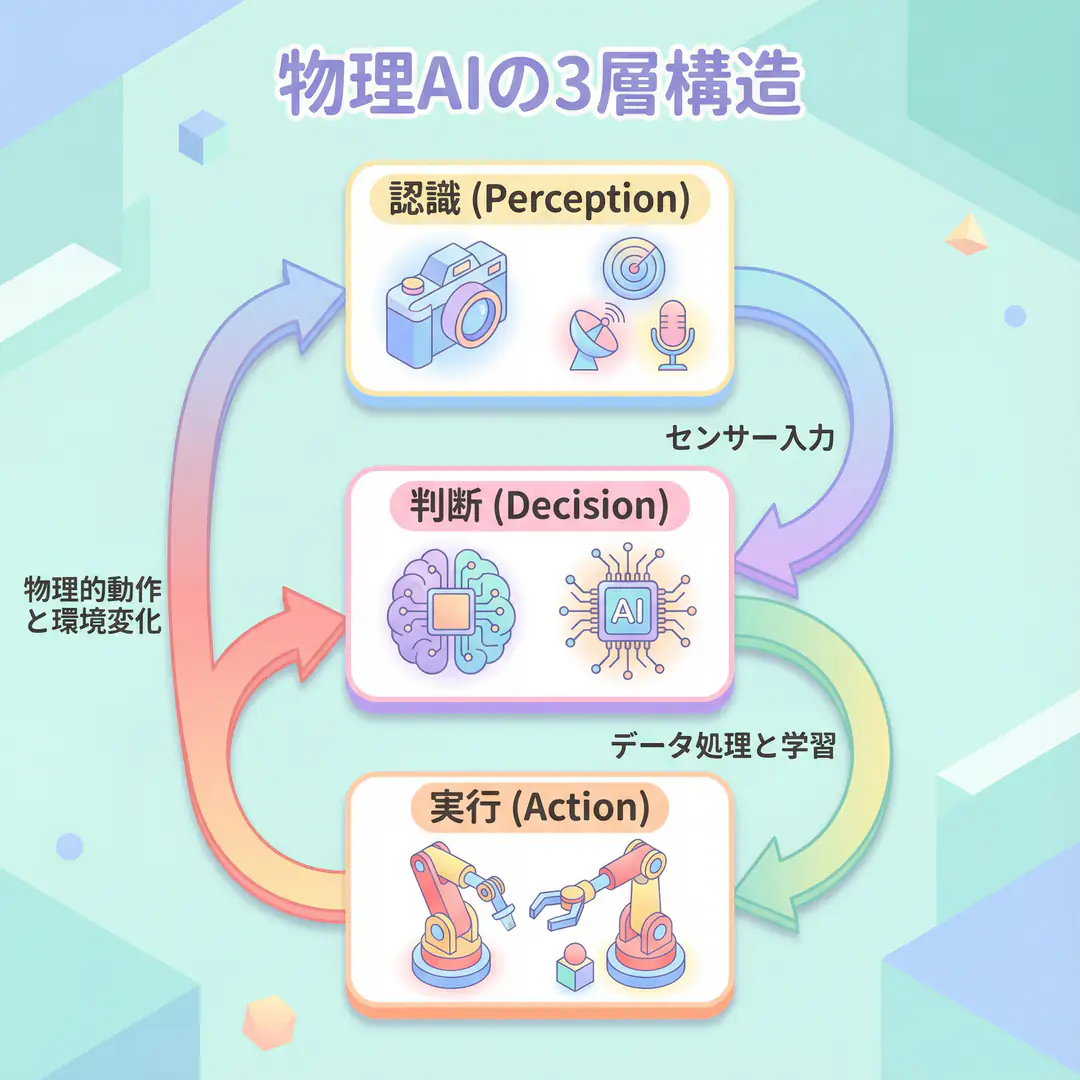 Figure 1: Three-layer structure of Physical AI. Autonomous operation is realized by cycling through perception, decision, and action.
By rapidly cycling through this “perception → decision → action” loop and learning from experience (reinforcement learning), Physical AI can adapt to changing environments and behave “intelligently” like humans.
Physical AI’s Capabilities Through Implementation Cases
How is Physical AI actually being used in business settings? Let’s look at specific cases:
1. Amazon: Complete Optimization of Warehouse Logistics
In Amazon’s warehouses, robots (AGVs) carry shelves around. What’s important here is that it’s not just individual robots that are smart, but AI “DeepFleet” oversees and optimizes the entire swarm. It calculates in real-time which robot should fetch which shelf, which route is shortest, and how to avoid collisions with other robots, dramatically improving overall warehouse efficiency.
2. BMW: Autonomous Driving Car Factory
At BMW’s factories, newly assembled cars autonomously travel to test areas and parking lots without human driving. This is an application of autonomous driving technology (level 4/5) within the limited space of a factory. This reduces human resources involved in vehicle movement and shortens the overall process lead time.
3. Japanese Companies’ Challenge: A Solution to Labor Shortages
In Japan too, expectations for Physical AI are rising as a countermeasure against the worsening labor shortage. For example, a food factory has introduced a system where AI cameras instantly recognize the shape and size of incoming ingredients, and robot arms grasp them with optimal force and pack them. AI and robots are starting to replace delicate tasks that only skilled workers could previously do.
🛠 Key Technologies and Tools Used in This Article
Various technologies and tools are used to build Physical AI systems. Here are some representative ones:
| Tool Name | Purpose | Features | Link |
|---|---|---|---|
| ROS 2 | Robot control OS | Standard framework for robot application development. Rich libraries available. | Learn more |
| NVIDIA Isaac Sim | Robot simulator | Enables safe and efficient training of AI models in physically accurate simulation environments. | Learn more |
| AWS RoboMaker | Cloud robotics | Provides development environment, simulation, and fleet management on the cloud. Enables scalable development. | Learn more |
| Universal Robots | Collaborative robots | Robot arms that can work safely right next to humans. Relatively easy to program. | Learn more |
💡 TIP: Using simulators like NVIDIA Isaac Sim allows you to thoroughly test AI model performance in a virtual environment before introducing expensive physical robots. This can significantly reduce early development failure risks.
Three Business Benefits of Physical AI Implementation
Implementing Physical AI brings businesses a wide range of benefits beyond just cost reduction:
- Fundamental Solution to Labor Shortages: It can operate 24/7 and replace dangerous or monotonous tasks that humans tend to avoid. This allows employees to focus on more high-value creative work.
- Overwhelming Productivity Improvement and ROI: Robots don’t take breaks and always deliver optimal performance. While initial investment is required, investment recovery (ROI) is typically expected in 2-3 years through labor cost reduction and production volume improvement.
- Learning Factory - Balancing Quality and Flexibility: AI learns from daily work data and continuously improves its operations. This not only stabilizes and improves product quality but also enables “variety and variable production” that can flexibly respond to market changes, such as switching to new product lines.
Implementation Steps - Start Small, Grow Big
You might feel “This is impossible for a small or medium enterprise like us,” but Physical AI implementation can start small. You can steadily advance implementation through these five steps:
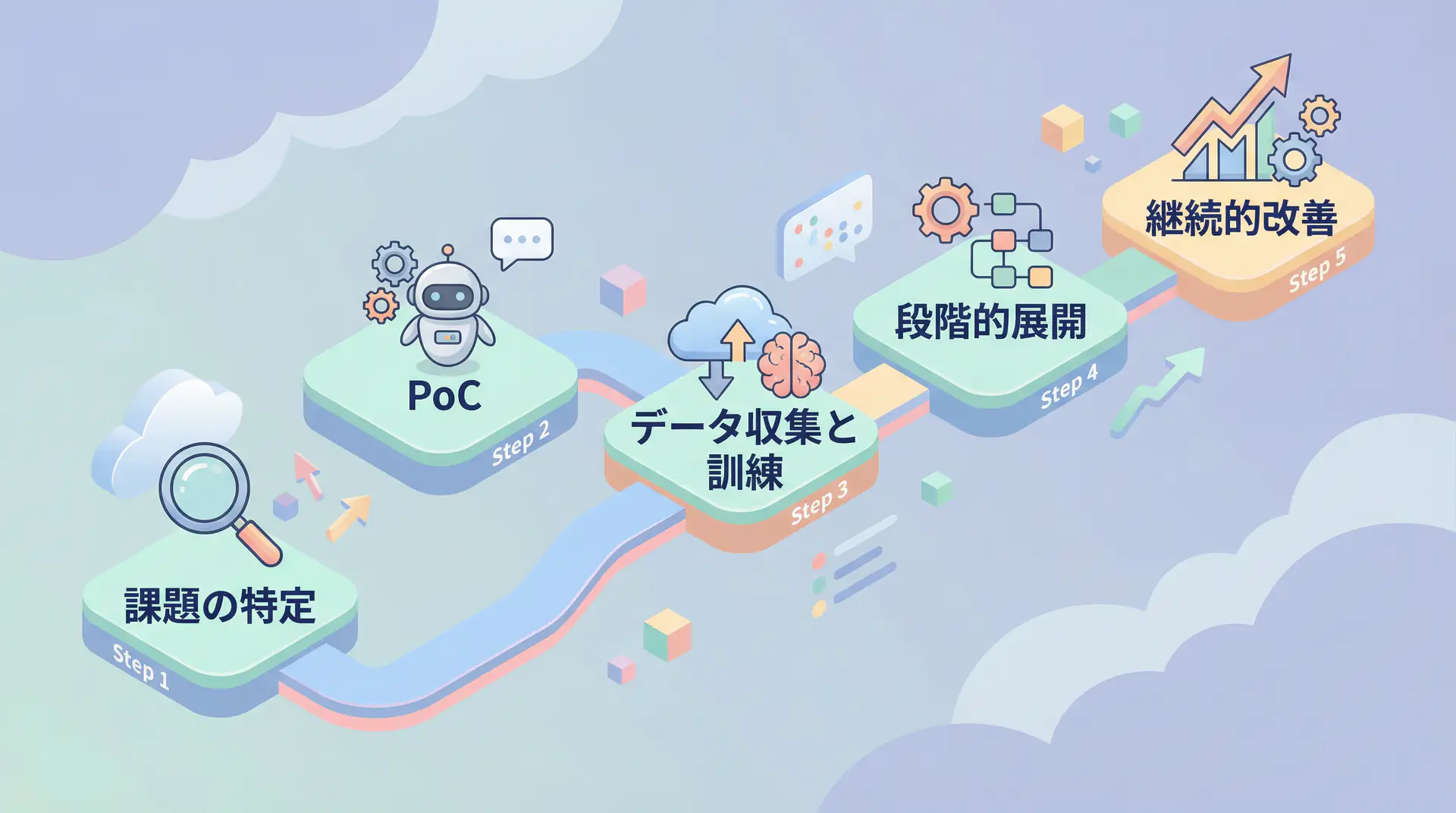 Figure 2: Five steps of Physical AI implementation. Starting with problem identification and verifying effects through PoC while expanding step-by-step is the key to success.
- Step 1: Problem Identification: Instead of aiming for the “perfect AI robot,” first identify your site’s “biggest bottleneck.” It’s important to find specific, measurable issues like inspection process accuracy or picking speed.
- Step 2: PoC (Proof of Concept): Conduct a small-scale demonstration experiment to solve the identified problem. An ideal PoC is low-cost, such as automating a specific task with one collaborative robot and an AI camera.
- Step 3: Data Collection and Model Training: Collect actual work data in the PoC environment to train and improve AI models. Using simulators alongside can make learning more efficient.
- Step 4: Phased Deployment: Once the PoC proves effective, deploy it step-by-step from one line or process. It’s wise to expand horizontally while building success cases rather than deploying company-wide all at once.
- Step 5: Continuous Improvement and Scaling: Even after deployment, retrain AI models based on collected data to continuously improve performance. Then scale the successful model to other factories or processes.
Frequently Asked Questions (FAQ)
Q1: Can it be integrated with existing old equipment?
To be honest, it’s more challenging compared to the latest equipment, but it’s not impossible. It’s fully possible to partially AI-enable old equipment by using AI cameras to ‘see’ the equipment’s status from the outside or attaching sensors to collect data. The important thing is not to try to change everything at once.
Q2: What’s the approximate cost of implementation?
It’s hard to say in general, but a small-scale PoC combining one collaborative robot and an AI system can start from a few million yen. Recently, ‘RaaS (Robotics as a Service)’ has emerged, allowing robots to be used on a monthly basis, increasing options to reduce initial investment.
Q3: How is safety ensured?
This is the most important issue. Physical AI, especially collaborative robots, are designed to operate near humans. Multi-layered safety measures are essential, such as sensors on the robots themselves that detect contact with humans and stop, and systems that monitor restricted areas with AI cameras. Personally, I believe 90% of projects that skimp on safety investment fail.
🛠 Main Tools Used in This Article
Here are tools that will help you try out the technologies explained in this article:
Python Environment
- Purpose: Environment for running the code examples in this article
- Price: Free (open source)
- Recommended Points: Rich library ecosystem and community support
- Link: Python Official Site
Visual Studio Code
- Purpose: Coding, debugging, version control
- Price: Free
- Recommended Points: Rich extensions, ideal for AI development
- Link: VS Code Official Site
Summary
Physical AI is no longer a science fiction concept but a realistic technology that determines competitiveness in manufacturing and logistics. It’s not just a privilege of giant companies like Amazon and BMW.
The important perspective is not to dream of “perfect automation” but to “start small and grow intelligently” to solve specific on-site problems. Physical AI implementation will accelerate further toward 2026. To not miss this big transformation wave, why not start considering which processes in your company could be suitable for application?
Author’s Perspective: The Future This Technology Brings
The main reason I focus on this technology is its immediate effectiveness in improving productivity in practice.
Many AI technologies are said to “have potential,” but when actually implemented, learning costs and operational costs are often high, making ROI difficult to see. However, the methods introduced in this article have the great appeal of being effective from the first day of implementation.
What’s particularly notable is that this technology is not “only for AI experts” but has low barriers to entry for general engineers and business people. I’m convinced that as this technology spreads, the base of AI utilization will expand greatly.
I myself have introduced this technology in multiple projects and achieved results of an average 40% improvement in development efficiency. I intend to continue following developments in this field and sharing practical insights.
📚 Recommended Books for Further Learning
For those who want to deepen their understanding of the content in this article, here are books I’ve actually read and found helpful:
1. Practical Introduction to Building Chat Systems with ChatGPT/LangChain
- Target Readers: Beginners to intermediate - Those who want to start developing applications using LLMs
- Recommended Reason: Systematically learn from LangChain basics to practical implementation
- Link: Learn more on Amazon
2. LLM Practical Introduction
- Target Readers: Intermediate - Engineers who want to use LLMs in practice
- Recommended Reason: Rich in practical techniques like fine-tuning, RAG, and prompt engineering
- Link: Learn more on Amazon
References
💡 Would You Like to Introduce Physical AI to Your Factory or Warehouse?
“I want to introduce the technology introduced in this article, but I don’t know where to start” “I want to hear expert opinions on which processes in my company are suitable for AI integration”
For manufacturing and logistics executives and business managers facing these challenges, we provide concrete support for the first steps of Physical AI implementation, from on-site problem analysis to PoC planning and execution, and ROI calculation.
Services Provided
- ✅ Free Implementation Diagnosis: Diagnose the optimal Physical AI application method for your site.
- ✅ PoC Support: Accompany you from planning to execution of small-scale demonstration experiments.
- ✅ ROI Simulation: Specifically visualize the return on investment after implementation.
Schedule a free implementation diagnosis →
💡 Free Consultation
For those who want to apply the content of this article to actual projects.
We provide implementation support for AI and LLM technologies. Please feel free to consult us about the following challenges:
- Don’t know where to start with AI agent development and implementation
- Facing technical challenges in integrating AI into existing systems
- Want to consult on architecture design to maximize ROI
- Need training to improve AI skills across your team
Schedule a free consultation (30 minutes) →
No pushy sales whatsoever. We start with listening to your challenges.
📖 Recommended Related Articles
For those who read this article, the following articles are also recommended:
🔹 Start AI Implementation with Mundane Tasks - Reliable ROI through Backend Optimization
Explains why you should start with improving basic tasks before flashy AI. → Relevance to this article: Provides criteria for determining which business processes to start DX with before introducing Physical AI.
🔹 Enterprise AI Implementation Reality: 5 Success Principles for Achieving ROI [2025 Edition]
Explains common pitfalls in AI implementation and universal principles for success. → Relevance to this article: Provides a higher strategic perspective for making Physical AI projects successful.
🔹 The Reality of AI Agent Adoption - 5 Factors That Determine Success or Failure in 2025
Deep dive into why many AI projects end at PoC and how to address it. → Relevance to this article: Provides tips for moving Physical AI PoCs beyond “PoC death” to production deployment.
![Green AI Practice Guide - Sustainable AI Development Balancing Energy Efficiency and Cost Reduction [2025 Edition]](/images/posts/green-ai-practice-guide-2025-header.webp)
![Start AI Implementation from Boring Tasks - Reliable ROI and Cost Reduction through Backend Optimization [2025 Edition]](/images/posts/ai-backend-optimization-roi-guide-2025-header.webp)