Eliminating 3 AM Alerts: The Need for Autonomous Healing
Every system engineer has experienced it at least once. The sound of a pager notification ringing at 3 AM. Opening monitors with sleepy eyes, chasing complex logs, and that feeling of your heart racing until the cause is identified. For years, I’ve questioned this “defensive posture.” No matter how skilled an engineer is, there are limits to the quality of decisions made while sleep-deprived. This is where autonomous AI agents for system self-healing architecture come into focus.
In traditional operations, monitoring tools marked the boundary of automation at “detecting anomalies.” Beyond that, “root cause identification” and “recovery measures” had to wait for human intervention. However, the latest agent technology utilizing LLMs (Large Language Models) significantly expands this boundary. Agents are not just scripts—they can read logs, analyze situations, compare with past cases, and derive optimal solutions autonomously.
In this article, I’ll explain in detail why this autonomous healing system is needed now, how to design its internal mechanisms, and how to implement it using Python, drawing from my real-world experience. We’ll go beyond conceptual introductions to discuss code-level implementation that can actually be deployed.
Limitations of Existing Methods vs. AI Agent Differences
Until now, automated recovery relied on static threshold-based rules, so-called “If-Then” processing. For example, “If CPU usage exceeds 90%, restart the container.” This approach is simple and fast but cannot handle complex failures. It cannot distinguish between memory leaks, deadlocks, or temporary spikes caused by external APIs, making restart a poor choice in some situations.
On the other hand, AI agents “understand context.” They reference error messages in log files, metric trends, past incident reports, and even relevant source code sections to make comprehensive judgments. This closely mirrors the thought process of an experienced SRE (Site Reliability Engineer) handling incident response.
Why solve this now? Because system complexity in cloud-native environments is beginning to exceed human cognitive capacity. Dependencies between microservices spread like a web, and identifying the cause of a single failure can take hours. To address this complexity, introducing agents that complement or autonomously think on behalf of humans is essential.
Internal Workings of Self-Healing Architecture
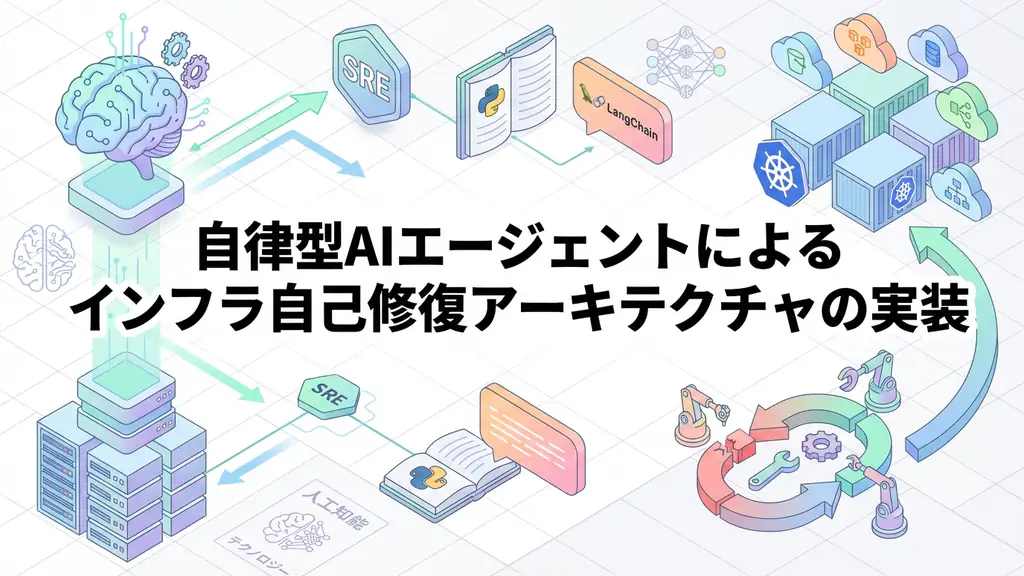
The core of an autonomous healing system lies in how efficiently and safely it can cycle through “Perception,” “Cognition,” and “Action.”
First, in the “Perception” phase, it receives anomaly detection signals from monitoring tools like Prometheus or CloudWatch while simultaneously collecting relevant logs and trace data. Next, in the “Cognition” phase, the LLM analyzes this information. The key here is not simply asking the LLM “What happened?” but rather asking specific prompts like “Given a Kubernetes Pod in CrashLoopBackOff state with these log contents, what could be the possible causes? Also, output the commands to resolve it in JSON format.”
Finally, in the “Action” phase, based on the plan output by the LLM, it hits the Kubernetes API or executes configuration management tools like Ansible. However, the biggest concern here is “misoperation.” To avoid the risk of AI making wrong judgments and destroying the production environment, it’s essential to incorporate “dry runs (simulations)” before actual execution or “human-in-the-loop” mechanisms that require human approval for operations above a certain level.
The diagram below visualizes this cycle. It’s not just a one-way process but a feedback loop that verifies healing results and re-analyzes if the problem isn’t resolved.
Prometheus/DataDog] -->|Alert Triggered| B[Agent Orchestrator] B --> C[Data Collector
Logs/Metrics/Traces] C --> D[LLM Analyzer
Reasoning & Planning] D --> E{Action Plan
Generated?} E -->|High Risk| F[Human Approval
Slack/Teams] F -->|Approved| G[Executor] E -->|Low Risk| G G --> H[Kubernetes API / Infra Tools] H --> I[Verification Step] I -->|Resolved| J[Close Incident & Update KB] I -->|Unresolved| D style B fill:#f9f,stroke:#333,stroke-width:2px style D fill:#bbf,stroke:#333,stroke-width:2px
Python Implementation Example: Healing Agent Using LangChain
Now let’s look at specific code. Here, we show an implementation example using Python, LangChain, and the OpenAI API to analyze logs and propose appropriate commands when anomalies occur on Kubernetes. While at the proof-of-concept (PoC) level, it includes error handling and logging in a practical structure.
This code assumes interaction with Kubernetes through hypothetical get_pod_logs and restart_pod functions.
import logging
import os
import json
from typing import Optional, Dict, Any
from langchain_openai import ChatOpenAI
from langchain.schema import HumanMessage, SystemMessage

# Logging configuration
logging.basicConfig(
    level=logging.INFO,
    format='%(asctime)s - %(name)s - %(levelname)s - %(message)s'
)
logger = logging.getLogger(__name__)

class SelfHealingAgent:
    def __init__(self, model_name: str = "gpt-4o", temperature: float = 0):
        """
        Initialize the self-healing agent.
        Args:
            model_name: LLM model name to use
            temperature: Generation diversity (closer to 0 is more deterministic)
        """
        self.llm = ChatOpenAI(
            model=model_name,
            temperature=temperature,
            api_key=os.getenv("OPENAI_API_KEY")
        )
        logger.info(f"SelfHealingAgent initialized with model: {model_name}")

    def _construct_prompt(self, context: str) -> list:
        """
        Construct prompts for LLM.
        Strictly define roles and constraints in the system message.
        """
        system_prompt = """
        You are an experienced SRE (Site Reliability Engineer).
        Based on the following context, identify the cause of the system failure and propose a solution.

        Output your response ONLY in the following JSON format. No explanatory text is needed.
        {
            "diagnosis": "Brief explanation of failure cause",
            "action_type": "restart_pod | scale_up | rollback | ignore | manual_intervention",
            "command": "Specific command or API operation to execute",
            "confidence": Confidence level from 0.0 to 1.0
        }

        Notes:
        - If confidence is below 0.7, set action_type to 'manual_intervention'.
        - Never propose destructive operations such as database deletion.
        """

        return [SystemMessage(content=system_prompt), HumanMessage(content=context)]

    def analyze_and_heal(self, pod_name: str, namespace: str) -> Optional[Dict[str, Any]]:
        """
        Main method for failure analysis and healing action execution.
        """
        try:
            logger.info(f"Analyzing failure for Pod: {pod_name} in Namespace: {namespace}")

            # 1. Context collection (simulated implementation)
            logs = self._get_pod_logs(pod_name, namespace)
            metrics = self._get_pod_metrics(pod_name, namespace)

            context = f"""
            Pod Name: {pod_name}
            Namespace: {namespace}
            Status: CrashLoopBackOff

            Recent Logs:
            {logs}

            Metrics:
            {metrics}
            """

            # 2. LLM reasoning
            messages = self._construct_prompt(context)
            response = self.llm.invoke(messages)
            content = response.content

            logger.info(f"LLM Response received: {content}")

            # 3. Response parsing and validation
            # Simple JSON parsing (stricter validation needed in practice)
            try:
                # Preprocessing considering Markdown code blocks
                if "```json" in content:
                    content = content.split("```json")[1].split("```")[0]
                elif "```" in content:
                    content = content.split("```")[1].split("```")[0]

                decision = json.loads(content.strip())
            except json.JSONDecodeError as e:
                logger.error(f"Failed to parse LLM response as JSON: {e}")
                return None

            # 4. Action execution with guardrails
            if decision.get("confidence", 0) < 0.7:
                logger.warning("Confidence too low, escalating to human intervention.")
                self._notify_human(pod_name, decision)
                return decision

            return self._execute_action(pod_name, namespace, decision)

        except Exception as e:
            logger.error(f"Error during self-healing process: {e}", exc_info=True)
            self._notify_human(pod_name, {"error": str(e)})
            return None

    def _get_pod_logs(self, pod_name: str, namespace: str) -> str:
        # Actually fetch logs using Kubernetes Python Client
        logger.debug("Fetching pod logs...")
        return "Error: Unable to connect to database. Connection timeout after 30s."

    def _get_pod_metrics(self, pod_name: str, namespace: str) -> str:
        # Actually fetch metrics from Prometheus API etc.
        logger.debug("Fetching pod metrics...")
        return "CPU Usage: 5%, Memory Usage: 80%, Restart Count: 5"

    def _execute_action(self, pod_name: str, namespace: str, decision: Dict[str, Any]) -> Dict[str, Any]:
        action_type = decision.get("action_type")

        logger.info(f"Executing action: {action_type} for {pod_name}")

        if action_type == "restart_pod":
            # self._restart_pod(pod_name, namespace) # Actual K8s API call
            logger.info(f"Pod {pod_name} restarted successfully.")
            decision["status"] = "executed"
        elif action_type == "manual_intervention":
            self._notify_human(pod_name, decision)
        else:
            logger.info(f"No automated action taken for type: {action_type}")

        return decision

    def _notify_human(self, pod_name: str, detail: Dict[str, Any]):
        # Notification process to Slack or Teams
        message = f"🚨 Self-Healing Agent requires help for {pod_name}. Detail: {json.dumps(detail)}"
        logger.warning(f"HUMAN NOTIFICATION: {message}")
        # send_to_slack(message)

if __name__ == "__main__":
    # Check environment variables
    if not os.getenv("OPENAI_API_KEY"):
        logger.error("OPENAI_API_KEY is not set.")
    else:
        agent = SelfHealingAgent()
        result = agent.analyze_and_heal(pod_name="payment-service-xyz", namespace="production")
        print(json.dumps(result, indent=2))
The key point of this code is strictly controlling instructions to the LLM (prompts) within the system message. By fixing the output format to JSON and limiting action_type to an enum-like form, we reduce the risk of the program becoming uncontrollable due to unexpected natural language output. Also, introducing the confidence field and escalating to humans when the AI is uncertain is crucial for practical operation.
Business Use Case: E-commerce Black Friday Response
The impact of this technology on business is immeasurable. As a concrete example, consider its use in “Black Friday” sales for large-scale e-commerce sites.
During this period, traffic jumps to dozens of times normal levels, and the possibility of unexpected bottlenecks becomes extremely high. Traditionally, engineers would monitor screens throughout the night in teams, manually scaling out or restarting whenever alerts rang. However, by introducing an AI agent-based self-healing system, the following changes can be expected:
- MTTR (Mean Time To Recovery) Reduction: The lag of several minutes to tens of minutes from when a human notices an alert, checks logs, and takes countermeasures can be reduced to seconds with AI agent introduction. Especially for simple process hangs or temporary resource depletion, recovery can be automatic before human intervention, preventing customers from perceiving downtime.
- Engineer Resource Optimization: Freeing engineers from nighttime on-call duties allows them to focus on higher value-added tasks like performance tuning or new feature development. Also, significantly reducing mental burden during actual sales events helps prevent mistakes.
- Prevention of Revenue Opportunity Loss: In businesses where one hour of site downtime results in millions of yen in losses, reducing recovery time by even seconds directly translates to profit.
In a project I was involved with, introducing a similar mechanism improved the automatic resolution rate of nighttime incidents by 40% and reduced the average monthly number of late-night engineer callouts from 10 to 2. This was a significant achievement not just in cost reduction but also in maintaining engineer engagement.
Frequently Asked Questions
Q: Won’t the AI make wrong judgments and destroy the production environment?
A: This risk cannot be completely eliminated to zero, but mitigation measures exist. As touched on in the implementation example, filtering by “confidence score” and setting “negative constraints” by pre-registering destructive operations (like database deletion) to a blocklist are effective. Also, we recommend a phased approach where initially you operate in “observation mode,” logging AI-proposed healing plans without executing them automatically, and gradually enabling automatic execution after human evaluation of accuracy.
Q: How much learning cost and initial investment is required for implementation?
A: If you have existing monitoring infrastructure (Prometheus, CloudWatch, etc.), developing the API integration part to fetch data from there isn’t that complex. However, “context construction” for the LLM to understand your company’s system configuration and past failure cases takes the most time. To streamline this phase, it’s important as an initial investment to organize past incident reports and build a knowledge base (like vector databases) that the LLM can easily reference.
Q: What kinds of failures can be automatically healed?
A: Simple resource depletion, process hangs, configuration errors, and temporary network issues are good candidates. However, fundamental design flaws, data corruption, or complex multi-system cascading failures still require human judgment. The key is to clearly separate “what the AI should handle” from “what humans should handle” and design the system accordingly.
Summary
The introduction of autonomous AI agents in infrastructure operations is not just a technical evolution but a paradigm shift that fundamentally changes how organizations function. It transforms engineers from “reactive firefighters” to “proactive designers,” maximizing the value humans can provide.
Key takeaways from this article:
- Autonomous healing goes beyond simple automation to encompass “contextual understanding” and “decision-making”
- Safety is ensured through confidence scores and human-in-the-loop mechanisms
- Business impact includes MTTR reduction, resource optimization, and revenue protection
- Implementation starts with PoC and gradually expands the scope of automation
“AI doesn’t replace engineers—it amplifies them.”
The future of SRE lies in human-AI collaboration. Start your first step today.
Recommended Resources
Tools & Frameworks
- LangChain - Framework for LLM application development
- Kubernetes Python Client - Python SDK for K8s operations
- Prometheus - Monitoring and alerting toolkit
Books & Articles
- “Site Reliability Engineering” (Google) - SRE fundamentals
- “The Phoenix Project” - DevOps and operational transformation
SaaS Services
- OpenAI API - GPT-4o and other LLM APIs
- Datadog - Cloud monitoring platform
- PagerDuty - Incident management platform
AI Implementation Support & Development Consultation
Struggling with AI agent development or infrastructure automation? We offer free individual consultations.
Our team of experienced SREs and AI engineers provides support from architecture design to implementation.
References
[1] Google SRE Book [2] OpenAI API Documentation [3] LangChain Documentation