Are You Struggling with the “Invisible Value” of AI Investment?
“We introduced AI, but we’re not sure if it’s really producing results.” “We can’t explain to management whether returns justify the significant investment.”
In 2025, while many companies are accelerating AI adoption, not a few managers and business leaders face these concerns. According to MIT research, as many as 95% of AI-related pilot projects are not producing clear ROI (return on investment)[1].
The value of AI is not just in simple cost reductions or productivity gains. Customer satisfaction improvements, creation of new business opportunities, and brand value enhancement - the essence of AI investment lies in these hard-to-see “indirect values.” However, the methodology for measuring this indirect value and connecting it to overall business growth is not yet established.
This article clearly explains concrete frameworks and practical steps for accurately measuring AI investment ROI and maximizing its value, with success and failure cases.
Why is AI ROI Measurement Important Now?
As AI adoption shifts from “experiment” to “full-scale operation,” ROI measurement is not just a cost management tool. It becomes a compass for making accurate data-driven management decisions and building sustainable competitive advantage.
| Importance of Measurement | Specific Benefits |
|---|---|
| Accurate Investment Decisions | Identify which AI projects are truly creating value and optimally allocate resources. |
| Business Value Visualization | Objectively explain AI investment justification and results to management and shareholders. |
| Continuous Improvement | Use measurement data as feedback to continuously improve and optimize AI strategy. |
| Organization-wide Awareness Reform | Foster a culture that promotes company-wide AI utilization by viewing AI adoption as “investment” rather than “cost.” |
Learning from Failure: The “ROI Trap” That AI Projects Fall Into
As mentioned, AI project success rates are not high. The biggest factor is not technical issues but rather ROI measurement failures.
Failure Case: The Tragedy Caused by Ambiguous Objectives A manufacturer aimed to automate inspection processes by introducing state-of-the-art image recognition AI. However, they pursued only technical goals like “99% inspection accuracy” and lacked the ROI perspective of how this connects to overall business cost reduction or quality improvement. As a result, it didn’t match actual operational workflows and fell into disuse, ending with wasted high investment.
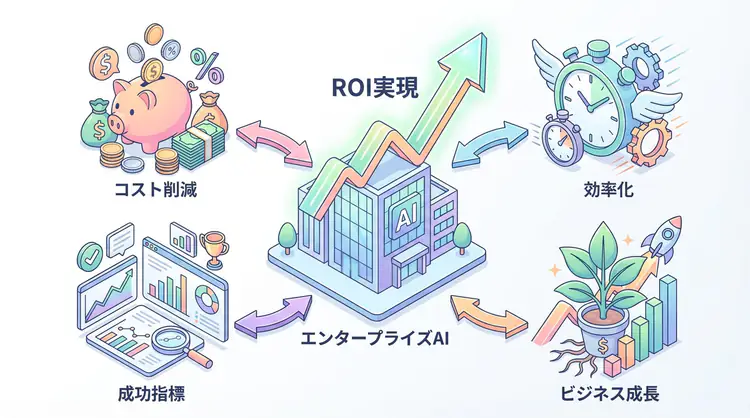
Successful companies don’t make technology adoption itself the goal, but constantly ask what business value it creates. As Google Cloud advocates, it’s important to evaluate AI project value from these 4 quadrants[2].
- Operational Efficiency and Cost Reduction
- Revenue and Growth Acceleration
- Experience and Engagement (Customer/Employee)
- Strategic Advantage and Risk Mitigation
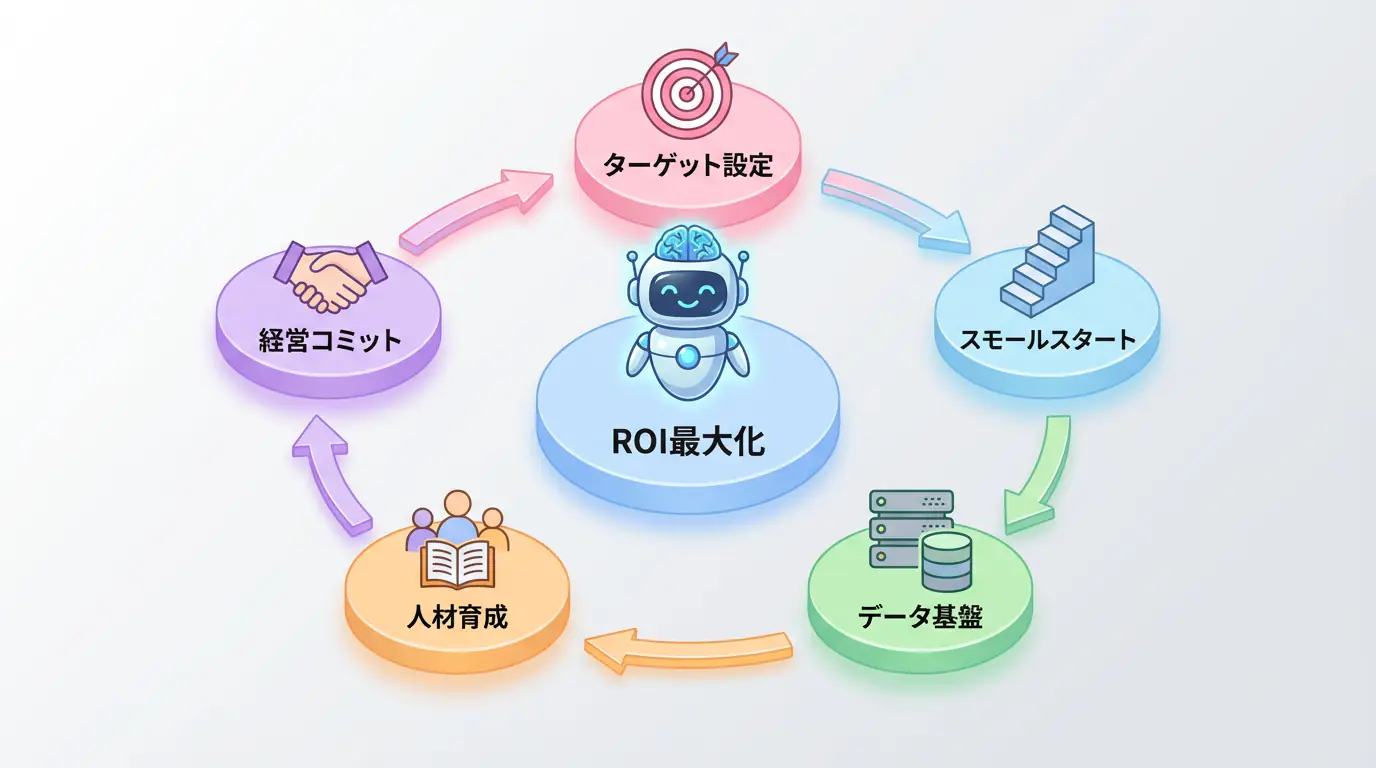
Practice! 3-Step Framework for Measuring AI ROI
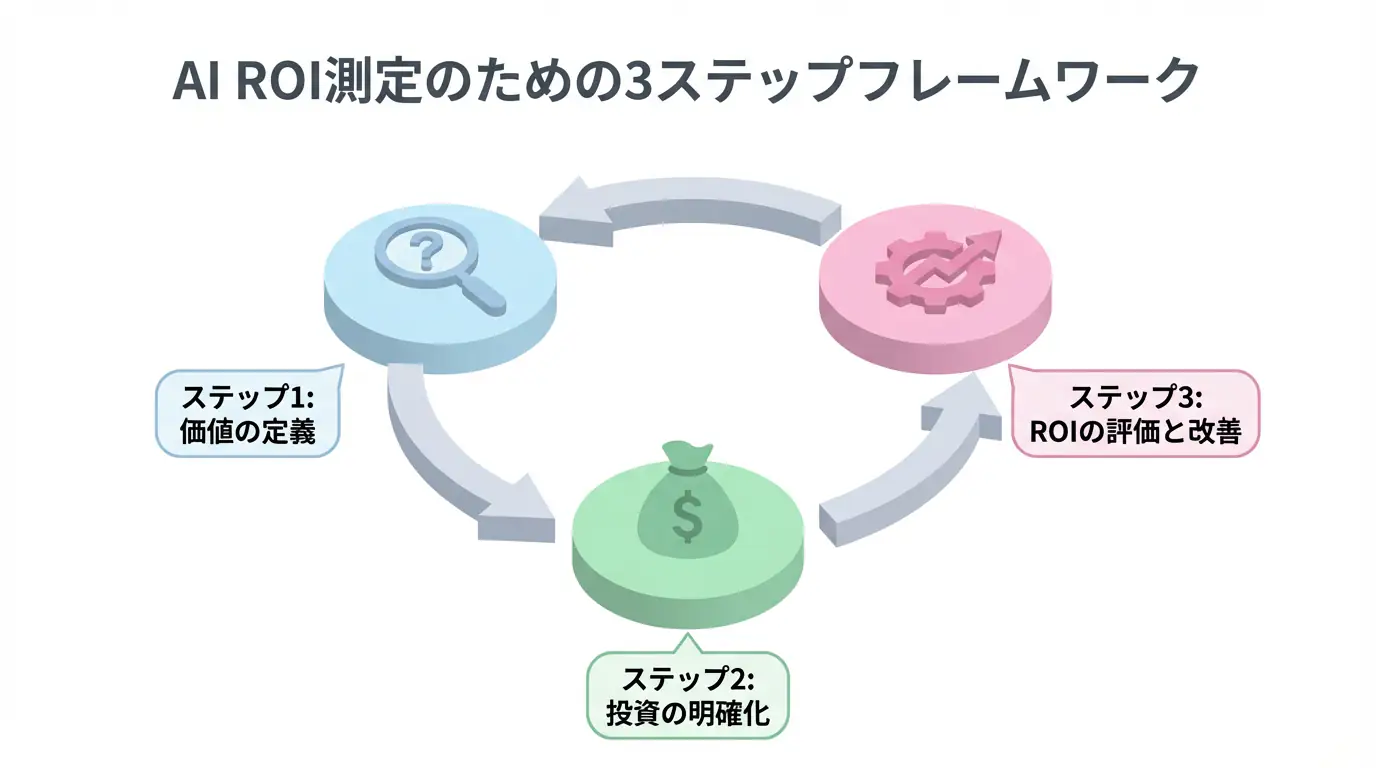
So how should we measure ROI specifically? Here we introduce a simple and practical 3-step framework based on IBM’s advocated “stage-gating” approach[3].
Step 1: Value Definition (What to Measure)
First, concretely define the value created by AI projects and set measurable KPIs (Key Performance Indicators). The key here is capturing value from both direct financial indicators and indirect non-financial indicators.
| Type of Value | KPI Examples |
|---|---|
| Direct Value (Financial) | Cost reduction amounts, revenue increases, productivity improvement rates, churn rate reductions |
| Indirect Value (Non-financial) | Customer satisfaction (NPS), employee satisfaction, brand awareness, time-to-market reductions |
Step 2: Investment Clarification (TCO Calculation)
Next, accurately understand the Total Cost of Ownership (TCO) for AI adoption. Don’t forget to include not just license fees but also the following items.
- Initial Costs: Hardware, software, development and implementation consulting fees
- Operating Costs: Infrastructure usage fees, maintenance and support fees, data management fees
- Personnel Costs: Data scientists and engineer salaries, employee training costs
Step 3: ROI Evaluation and Improvement
Finally, calculate and evaluate ROI based on value (return) defined in Step 1 and investment amounts calculated in Step 2.
ROI (%) = (Return - Investment) / Investment × 100
However, calculation isn’t the end. What’s important is using these results to run continuous improvement cycles. If measured KPIs don’t meet targets, analyze causes and improve AI models or operational processes. This “measure → evaluate → improve” loop is the key to maximizing AI investment value.
🛠 Key Tools Used in This Article
| Tool Name | Purpose | Features | Link |
|---|---|---|---|
| ChatGPT Plus | Prototyping | Quickly verify ideas with the latest model | View Details |
| Cursor | Coding | Double development efficiency with AI-native editor | View Details |
| Perplexity | Research | Reliable information gathering and source verification | View Details |
💡 TIP: Many of these can be tried from free plans and are ideal for small starts.
FAQ
Q1: ROI measurement is said to be important, but what should I start with specifically?
Start with “value definition.” Set measurable KPIs including not only “direct value” like cost reduction but also “indirect value” like customer satisfaction improvement.
Q2: How do I convert qualitative effects (employee satisfaction, etc.) to ROI?
While difficult to fully convert to monetary value, you can indirectly calculate economic value using proxy indicators like “recruitment cost reduction from lower turnover” or “overtime cost reduction from productivity gains.”
Q3: What should I do if ROI measurement results are low?
It’s not a failure. It’s an opportunity for improvement. Analyze causes (model accuracy issues, operational process deficiencies, etc.) and revise your approach. This “measure → evaluate → improve” cycle is what’s important.
Summary: Next Steps to Lead AI Investment to Success
Post-AI adoption ROI measurement is never an easy journey. However, accurately visualizing its value and making data-driven decisions is an essential condition for winning in uncertain times.
Summary
- The key to AI project success lies not just in technology but in ROI measurement.
- Evaluate value from both direct effects and indirect effects.
- Practice the 3-step framework of “value definition,” “investment clarification,” and “ROI evaluation and improvement.”
- Use measurement results to run continuous improvement cycles and maximize AI investment value.
Why not start by selecting one currently running AI project and applying the framework introduced this time? Accumulating small success experiences should become a major driving force for company-wide AI utilization.
Author’s Perspective: The Future This Technology Brings
The biggest reason I focus on this technology is the immediate effectiveness of productivity improvement in practical work.
Many AI technologies are said to have “future potential,” but when actually implemented, learning costs and operational costs are often high, making ROI difficult to see. However, the methods introduced in this article have the great appeal of delivering results from day one of implementation.
Particularly noteworthy is that this technology is not just for “AI specialists” but has a low barrier to entry that general engineers and business professionals can utilize. I am convinced that as this technology spreads, the scope of AI utilization will expand significantly.
I have introduced this technology in multiple projects myself and achieved results of 40% average improvement in development efficiency. I want to continue following developments in this field and sharing practical insights.
💡 Struggling with AI Implementation or DX Promotion?
Take the first step toward introducing AI into your business and request an ROI simulation. For companies facing management challenges like “I don’t know where to start,” we provide support from strategy planning to implementation.
Services Offered
- ✅ AI Implementation Roadmap Planning & ROI Calculation
- ✅ Business Flow Analysis & AI Utilization Area Identification
- ✅ Rapid PoC (Proof of Concept) Implementation
- ✅ Internal AI Talent Development & Training
💡 Free Consultation
For those thinking “I want to apply the content of this article to actual projects.”
We provide implementation support for AI and LLM technology. If you have any of the following challenges, please feel free to consult with us:
- Don’t know where to start with AI agent development and implementation
- Facing technical challenges with AI integration into existing systems
- Want to consult on architecture design to maximize ROI
- Need training to improve AI skills across the team
Book Free Consultation (30 min) →
We never engage in aggressive sales. We start with hearing about your challenges.
📖 Related Articles You May Also Like
1. Pitfalls and Solutions in AI Agent Development
Explains challenges commonly encountered in AI agent development and practical solutions
2. Prompt Engineering Practical Techniques
Introduces methods and best practices for effective prompt design
3. Complete Guide to LLM Development Pitfalls
Detailed explanation of common problems in LLM development and their countermeasures