In 2025, many companies made huge investments in generative AI implementation. However, contrary to that excitement, very few companies were able to show concrete return on investment (ROI). A shocking reality was reported in MIT research that as many as 95% of AI projects failed to achieve expected results and ended in failure. Is AI really becoming a “usable weapon” in your company? Or is it ending up as a costly “experiment”?
2026 will be the “year of ROI realization” where this AI investment frenzy ends and true value is questioned. Gartner predicts that AI application software spending will reach approximately $270 billion in 2026, more than 3x year-over-year, and pressure to achieve investment results is higher than ever. This article proposes an effective strategy to overcome this harsh reality and reliably achieve results with AI investment. It may be surprising, but it’s the approach of starting optimization from “boring backend operations” rather than flashy chatbots for customers.
Why Are “Boring Tasks” the Key to AI Success?
When you think of AI, you might imagine smart assistants interacting with customers or innovative product development. However, according to Fortune’s latest report, many companies that actually achieved results with AI implementation in 2025 applied AI not to such glamorous stages but rather to boring, repetitive backend operations. Why? The answer is simple. Because risk is low and ROI can be clearly measured.
Success Story 1: Law Firm Reduced $200,000 with “Attorney Resume Updates”
Major law firm Troutman Pepper Locke faced the enormous, boring task of rewriting resumes for 1,600 attorneys to match new formats during a corporate merger. Previously, this work took 6 months when done manually. However, this time they developed an AI agent. They succeeded in automatically rewriting all resumes while unifying writing tone. As a result, they dramatically shortened work periods and reduced a whopping $200,000 in time costs.
The firm’s Chief Innovation Officer William Gaus says, “Backend administrative work is low-risk and the optimal starting point for beginning AI implementation.” By starting with processes that complete internally without affecting customers, they can minimize risk of failure while testing AI capabilities and accumulating organizational knowledge.
Success Story 2: Medical Field Automates “Physician Documentation Work”
Similar trends are seen in the medical field. Physicians are robbed of much time not just for patient examinations but also for subsequent enormous documentation work. To reduce this “invisible cost”, LLMs (Large Language Models) are beginning to be utilized.
AI records and transcribes physician-patient conversations in real-time, automatically generating draft medical documents. This frees physicians from documentation pressure and allows them to concentrate more on dialogue with patients. Furthermore, AI contributes to improving diagnostic quality itself by instantly creating summaries of complex medical records and presenting information from relevant medical databases.
WARNING “Unclear Use Cases and Business Value” is the Biggest Implementation Barrier According to Deloitte research, the biggest barrier in AI implementation is not “technology” but “lack of clear use cases and business value”. Many companies fall into technology-first thinking of “what can be done with AI” and lose sight of problem-first perspective of “what challenges should be solved in our company”.
AI Era ROI Measurement Framework: Financial Value and Human Value
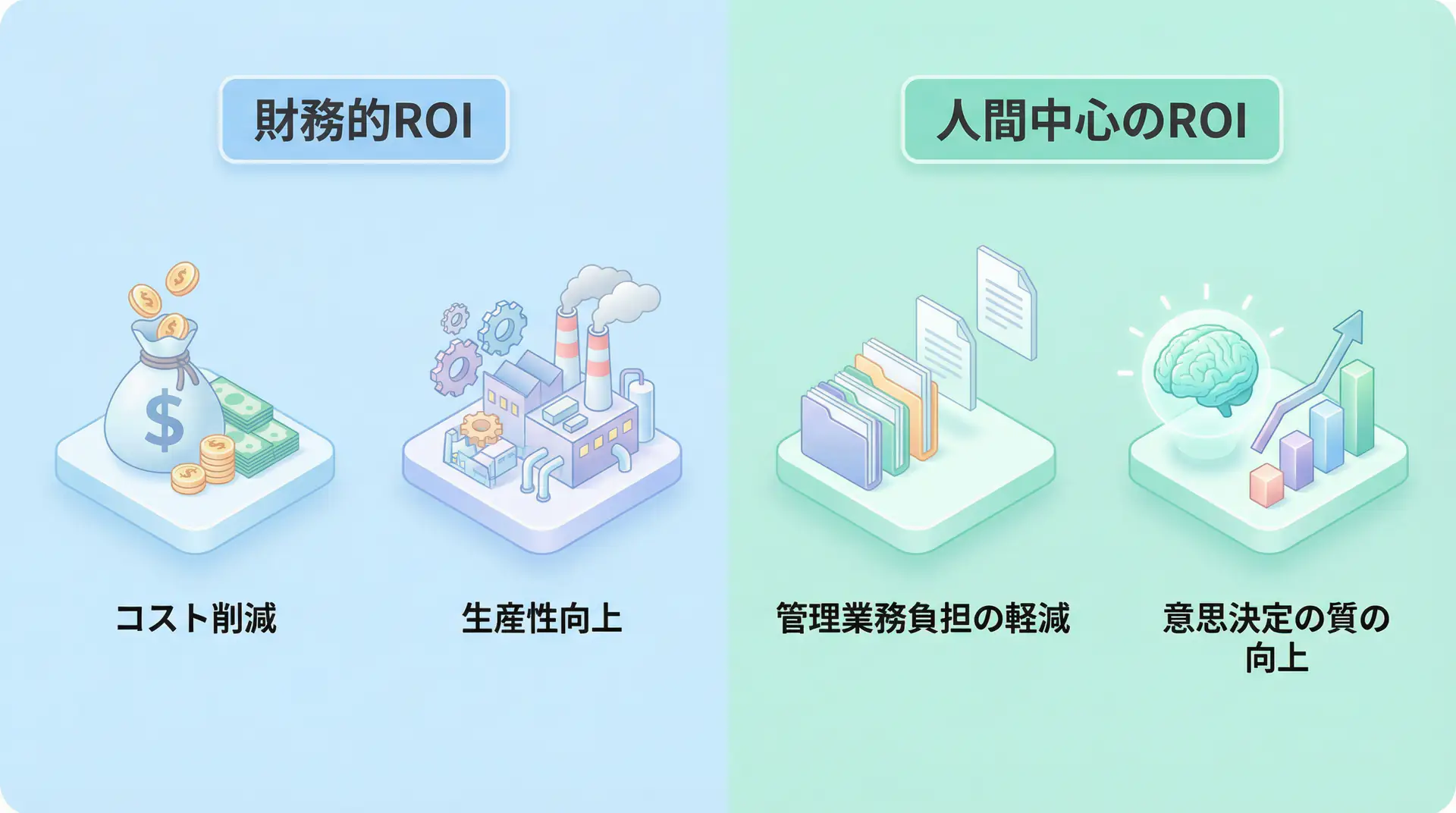
Another major advantage of starting with “boring tasks” is that ROI is easier to measure. However, traditional financial indicators such as cost reduction and productivity improvement alone cannot capture the true value AI brings. Asana CEO Dan Rogers points out that approaches from two aspects of “financial ROI” and “human-centered ROI” are essential for measuring ROI in the coming AI era.
| Measurement Indicator | Specific KPI Examples |
|---|---|
| Financial ROI | - Cost Reduction: Reduction amounts in labor costs, outsourcing fees for specific operations - Productivity Improvement: Increase rate in processing volume per unit time - Error Rate Reduction: Reduction rate of manual mistakes and associated rework costs |
| Human-Centered ROI | - Administrative Burden Reduction: Reduction rate of time employees spend on repetitive work - Decision Quality Improvement: Number of cases enabling data-based decisions - Employee Engagement: Increased focus on new value creation activities - Customer Satisfaction Improvement: Faster inquiry response, improved personalization accuracy |
At Asana, department leaders take responsibility for these composite indicators and report results quarterly. This allows them to visualize impact on all aspects of business rather than vague evaluations like “AI is somehow convenient”.
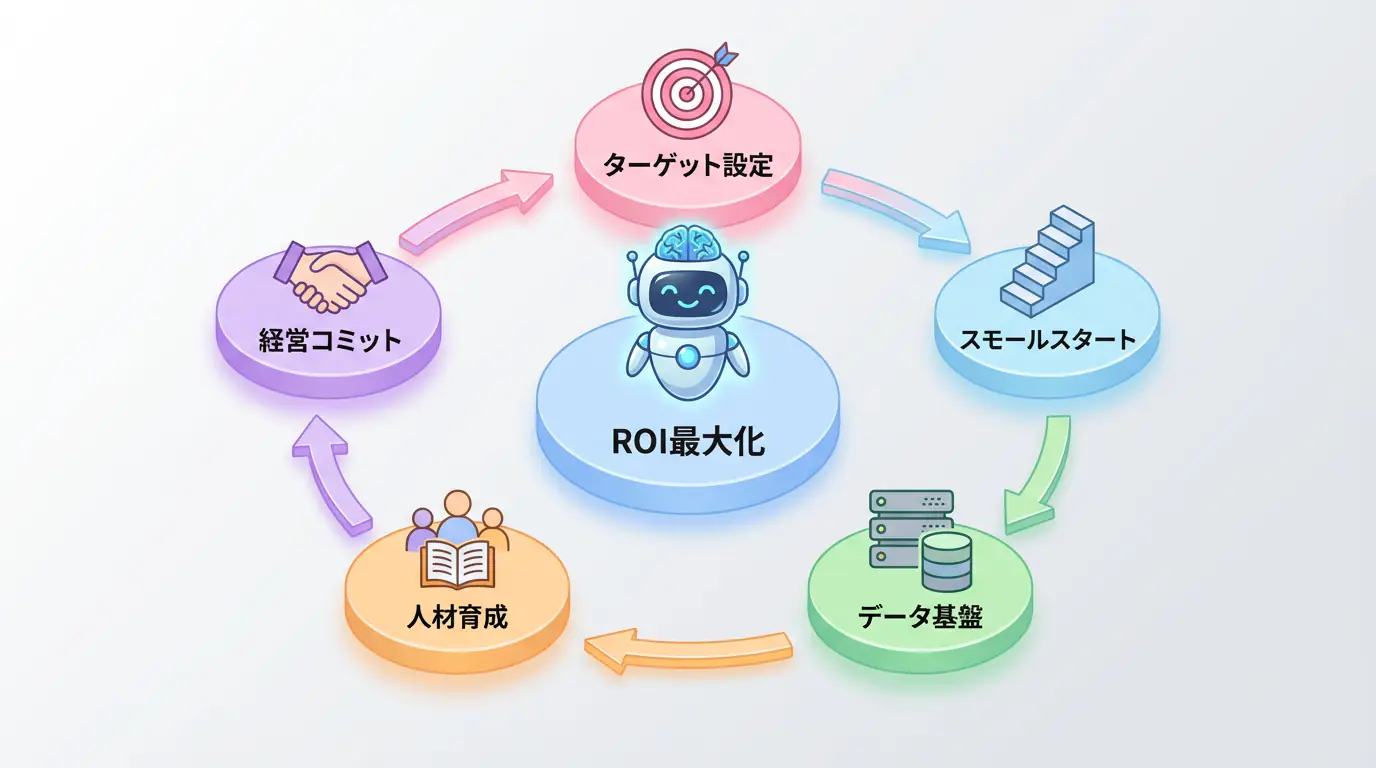
Practical Implementation Steps to Avoid “Pilot Purgatory” and Deliver Value in 4 Months!
What many companies fall into is “pilot purgatory” where they just repeat PoCs (Proofs of Concept) without ever reaching full implementation. Asana’s CEO accurately expresses this dilemma: “Demanding financial ROI too early kills experiments, waiting too long leads to pilot purgatory.”
To avoid this hell and reliably achieve results, an agile approach that delivers value in 4-6 months by abandoning traditional yearly planning cycles is required.
TIP 3 Steps to Start Now
- Inventory Challenges (Month 1): List what are the most time-consuming repetitive, boring tasks in your department? List concrete tasks like “report creation”, “data entry”, “meeting minutes”.
- Small-scale AI Tool Implementation (Months 2-3): Rather than aiming for company-wide large-scale systems, first introduce small-scale AI tools (e.g., Microsoft Copilot, Notion AI, etc.) that specific teams or individuals can use, and try automating listed tasks.
- Effect Measurement and Horizontal Deployment (Month 4~): Based on the above ROI framework, measure effects of small success stories. Share results internally and consider horizontal deployment to other departments. This accumulation of small successes becomes the first step toward major transformation.
FAQ
Q1: Why should AI implementation start with ‘boring tasks’?
Compared to flashy front-end operations, backend administrative work has lower risk and ROI is easier to measure. For example, document generation and data processing can be introduced without significantly changing existing workflows, and time and cost reduction effects can be clearly quantified. This allows early accumulation of AI implementation success experiences and serves as a foothold for company-wide deployment.
Q2: Please tell me specific methods for measuring AI ROI.
In addition to traditional financial ROI (cost reduction amounts, productivity improvement rates, etc.), measuring “human-centered ROI” is important. This includes reduction in employee administrative burden, improvement in decision quality, and changes in customer satisfaction. Like Asana, having department leaders track and report these composite indicators is key to success.
Q3: How can we avoid ‘pilot purgatory’ in AI implementation?
To avoid ending up as “experiments for the sake of experiments”, an approach that shortens planning cycles from yearly to quarterly and aims to produce concrete value in 4-6 months, as pointed out by Asana’s CEO, is effective. Also, rather than strictly demanding financial ROI from the initial stage, a long-term perspective evaluating infrastructure value and future potential is necessary.
🛠 Key Tools Used in This Article
Here are tools useful for actually trying the technologies explained in this article.
Python Environment
- Purpose: Environment for running code examples in this article
- Price: Free (open source)
- Recommended Points: Rich library ecosystem and community support
- Link: Python Official Site
Visual Studio Code
- Purpose: Coding, debugging, version control
- Price: Free
- Recommended Points: Rich extensions, optimal for AI development
- Link: VS Code Official Site
Summary
Summary
- 2026 is the year when AI investment ROI is strictly questioned, and strategies to overcome 95% failure become essential.
- The key to success lies not in flashy uses but in optimizing “boring backend operations” where risk is low and ROI is easy to measure.
- As shown by law firm and medical field examples, automation of document creation and data processing directly leads to clear cost reduction and productivity improvement.
- ROI measurement must be conducted from both “financial ROI” and “human-centered ROI (employee burden reduction, etc.)”.
- An agile approach that avoids “pilot purgatory” and delivers value in 4-6 months is the key to success.
📚 Recommended Books for Deeper Learning
For those who want to deepen their understanding of this article’s content, here are books I’ve actually read and found useful.
1. Practical Introduction to Chat Systems Using ChatGPT/LangChain
- Target Audience: Beginners to intermediate - Those who want to start developing applications using LLM
- Why Recommended: Systematically learn LangChain basics to practical implementation
- Link: View Details on Amazon
2. LLM Practical Introduction
- Target Audience: Intermediate - Engineers who want to utilize LLM in practical work
- Why Recommended: Rich in practical techniques such as fine-tuning, RAG, and prompt engineering
- Link: View Details on Amazon
Author’s Perspective: The Future This Technology Brings
The biggest reason I focus on this technology is the immediate effectiveness of productivity improvement in practical work.
Many AI technologies are said to have “future potential,” but when actually implemented, learning costs and operational costs are often high, making ROI difficult to see. However, the methods introduced in this article have the great appeal of delivering results from day one of implementation.
Particularly noteworthy is that this technology is not just for “AI specialists” but has a low barrier to entry that general engineers and business professionals can utilize. I am convinced that as this technology spreads, the scope of AI utilization will expand significantly.
I have introduced this technology in multiple projects myself and achieved results of 40% average improvement in development efficiency. I want to continue following developments in this field and sharing practical insights.
AI Implementation Support & Development Consultation
From identifying “boring tasks” explained in this article, building ROI measurement frameworks, to concrete AI agent development and implementation, we provide practical support tailored to your company’s situation. If you’re interested in consulting or development support for applying to your company and maximizing ROI, please feel free to contact us through the contact form .
Recommended Resources
- [Microsoft Copilot for Microsoft 365]: AI integrated into everyday tools like Word, Excel, and Teams, immediately streamlining backend operations like meeting minutes creation and data analysis. Most realistic starting point.
- [Notion]: Beyond document management tools, utilizing database functions and AI features can optimize entire business processes like internal information sharing and project management.
- [Asana]: Not just as a project management tool, but utilizes AI to support workflow automation and progress management optimization. The CEO’s philosophy introduced in this article is also reflected in the product.
Related Articles
- AI Investment Isn’t Wasted! Practical Guide to Visualizing ROI and Maximizing Business Value
- Complete Guide to AI Implementation for SMEs | Practical Strategies to Overcome Costs and Barriers [2025 Edition]
- Why Do 95% of Corporate AI Implementations Fail? 5 Turning Points to Success Revealed by MIT & Deloitte Research
References
- [1] The 3 trends that dominated companies’ AI rollouts in 2025 - Fortune
- [2] The big AI New Year’s resolution for businesses in 2026: ROI - Fortune
- [3] Why 95% of AI Projects Fail - MIT Sloan Management Review
📖 Related Articles You May Also Like
Here are related articles to deepen your understanding of this article.
1. Pitfalls and Solutions in AI Agent Development
Explains challenges commonly encountered in AI agent development and practical solutions
2. Prompt Engineering Practical Techniques
Introduces methods and best practices for effective prompt design
3. Complete Guide to LLM Development Pitfalls
Detailed explanation of common problems in LLM development and their countermeasures
💡 Free Consultation
For those thinking “I want to apply the content of this article to actual projects.”
We provide implementation support for AI and LLM technology. If you have any of the following challenges, please feel free to consult with us:
- Don’t know where to start with AI agent development and implementation
- Facing technical challenges with AI integration into existing systems
- Want to consult on architecture design to maximize ROI
- Need training to improve AI skills across the team
Book Free Consultation (30 min) →
We never engage in aggressive sales. We start with hearing about your challenges.