Reading time: Approximately 12 minutes
Why is the role of engineers being reexamined now?
The reason is clear. AI has started automating the act of “writing code” to an unprecedented level. Tools like GitHub Copilot are no longer just completion features. They’ve evolved into “AI agents” that autonomously present implementation proposals including test code when you explain specifications.
This is similar to how the industrial revolution brought weaving machines and changed craftsmen’s work. The value of writing code line by line manually has relatively decreased, while the value of the ability to define “what, why, and how to build” and manage the entire process has skyrocketed.
The wave of change is coming faster than we think. Whether you can adapt to this change now will greatly influence your career in 5 years.
- Key Point 1: AI-driven code automation means engineers’ “jobs disappear” but rather their “roles change.”
- Key Point 2: The source of value shifts from “writing code” to “asking the right questions, designing systems, and mastering AI.”
- Key Point 3: The key to survival lies in a “π-shaped skill set” that combines technical expertise with business understanding and AI management ability.
The “π (Pi)-shaped” Skill Set Required in 2026
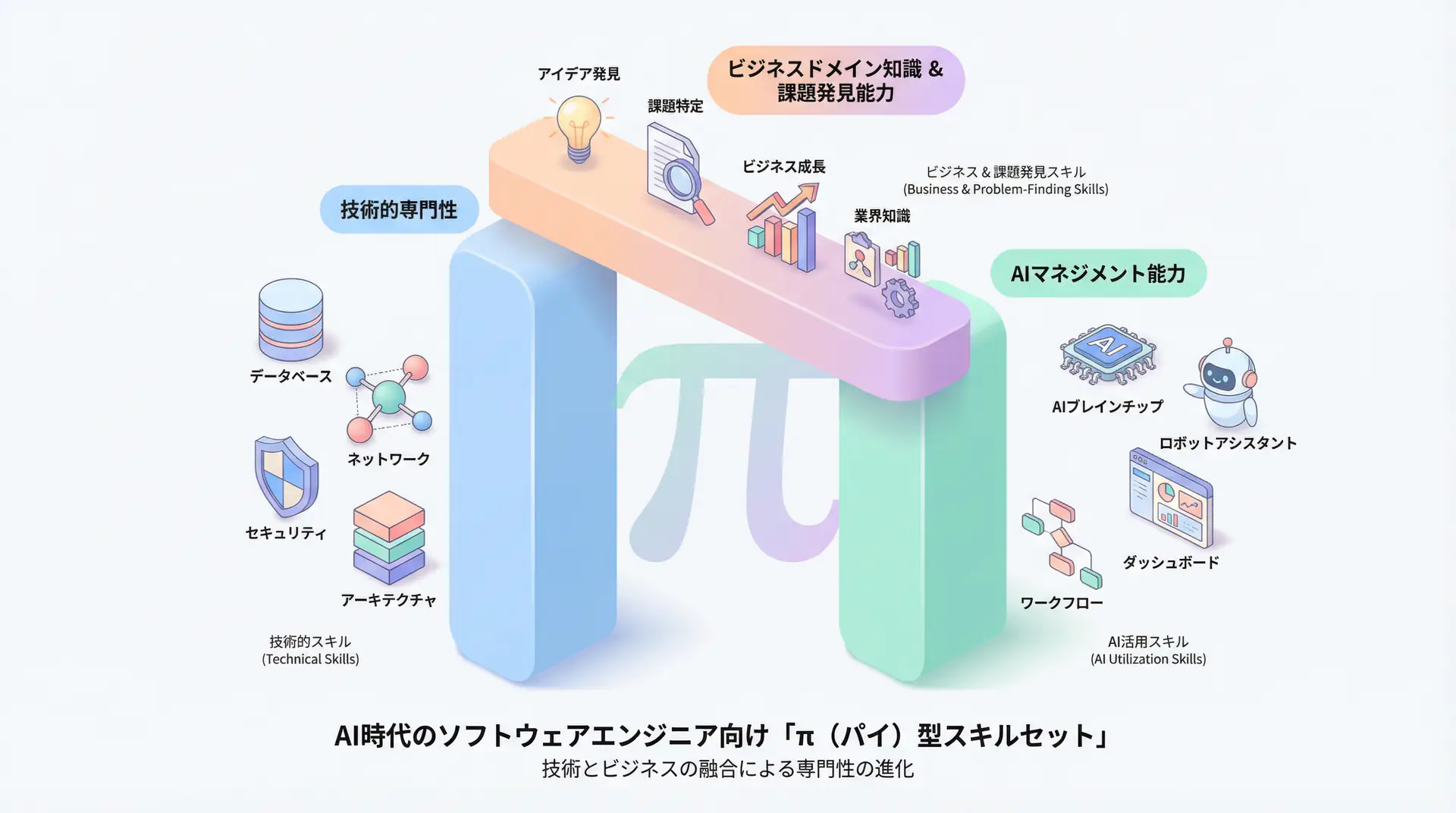
For engineers of the future, a single deep expertise (I-shaped) is insufficient. To master AI as a powerful tool and connect it to business value, at least two specialized areas and broad knowledge connecting them are required. This is the “π-shaped skill set.”
 (This image will be generated later)
First Pillar: Deepening Technical Expertise
Precisely because AI can write general-purpose code, the value of niche, deep expertise actually increases.
- Low-Level Performance Optimization: Deep knowledge of OS, databases, and networks. Ability to identify and improve performance bottlenecks in AI-generated code.
- Advanced Security: Ability to find vulnerabilities in AI-generated code and design secure systems.
- Complex System Architecture Design: Ability to design large-scale systems that AI alone can’t design, such as microservices, distributed systems, and event-driven architecture.
Second Pillar: AI Management Ability
Skills for using AI as a “subordinate” or “colleague.”
- Advanced Prompt Engineering: The technique of giving accurate, effective instructions that maximize AI’s capabilities. It’s important to provide roles and context, not just “do this.”
- AI Agent Design & Operation: Ability to design and build workflows (agents) that combine multiple AI models and tools to automate specific tasks (e.g., LangChain, CrewAI).
- LLMOps / AI Observability: Operational techniques for monitoring AI application performance and continuously improving it.
Beam: Business Domain Knowledge and Problem Discovery Ability
This part connects the two pillars and converts them into business value. “No matter how excellent the code AI writes, if the problem to be solved is wrong, the value is zero.”
- Deeply understand business processes in your industry (finance, healthcare, manufacturing, etc.).
- Discover users’ true pain points and translate them into technical specifications to solve them.
- Balance technical possibilities with business requirements and make proposals that maximize ROI (Return on Investment).
🛠 Tools & Platforms to Accelerate Skill Development [Monetization Element]
There are tools and platforms you should use to efficiently acquire these skills.
| Tool Name | Purpose | Recommended Points | Link |
|---|---|---|---|
| GitHub Copilot | AI pair programmer | Perfect first step to master Agent Mode and develop the sense of “making AI work.” | Official Site |
| LangChain / CrewAI | AI agent development | Ideal for learning to build workflows that coordinate multiple AIs. | LangChain , CrewAI |
| Hugging Face | AI model hub | Learn to try various open-source models and select the optimal model for specific tasks. | Official Site |
💡 My Opinion: The shortest path is to first thoroughly use GitHub Copilot and learn through experience what constitutes a “good instruction.” Then, I strongly recommend using a framework like CrewAI to create your own small business automation agent. Small successes become great motivation for further learning.
Three Action Plans to Start Tomorrow
“Easier said than done.” Here are three steps to turn this into concrete action.
1. Repeat “Why?” Five Times
When given a task, don’t immediately start coding (or instructing AI). Stop and ask yourself “Why is this feature necessary?” and “Whose problem does it solve?” at least five times. Develop the habit of understanding the fundamental purpose of the task. This is the simplest training to develop “problem discovery ability.”
2. Have AI Review Your Code
Paste your code into Copilot Chat or ChatGPT and ask, “Please list 10 improvements for this code, especially from security and performance perspectives.” You can learn perspectives you didn’t notice and patterns where AI excels.
3. Read Code Unrelated to Work for 15 Minutes a Day
Spend just 15 minutes a day reading code you don’t normally touch in your work, like GitHub Trending or source code of libraries you use. AI-generated code is influenced by the diverse code in its training data. Being exposed to a wide range of design ideas and patterns helps you correctly evaluate and guide AI’s output.
📚 Recommended Books for Deeper Learning [Monetization Element]
Books to learn universal software engineering principles that have value especially in the AI era.
| Book | Target Reader | Recommendation Reason |
|---|---|---|
| Software Architecture Basics | Intermediate+ | Systematically learn design ability to define “what” to make for AI. |
| Unit Testing Concepts/Usage | All engineers | The last bastion to guarantee the quality of AI-generated code is testing. Learn effective testing strategies. |
| Increase Resolution - The Technique of “Verbalization” to Clarify Ambiguous Thinking | All business professionals | A good book to develop “verbalization ability” essential for problem discovery and instructing AI. |
Frequently Asked Questions (FAQ)
Q1: What skills do I need to avoid having my job taken by AI?
In addition to technical skills, problem discovery ability, system design ability, and “AI management ability” to effectively utilize AI are becoming important. This is explained in detail in the main text.
Q2: Is it too late to start learning programming now?
No, not at all. However, the way you learn changes. Understanding computer science fundamentals and architecture design principles becomes more important than writing code itself.
Q3: Is being a “prompt engineer” insufficient?
Prompt engineering is one important skill, but it’s insufficient on its own. Creating business value requires comprehensive skills that can see from upstream problem setting to downstream system operation.
Summary
AI is not a threat that takes away software engineers’ jobs. Rather, it’s the best “partner” in history that frees us from boring simple tasks and allows us to focus on more creative, essential work.
What’s important is to ride the wave of change and continuously update your skill set.
- The source of value shifts from “implementation” to “design” and “questions.”
- Aim to be a “π-shaped talent” with both deep expertise and AI management ability.
- Small actions accumulated from tomorrow will make a big difference in 5 years.
Engineers who can enjoy this change will be the ones leading the AI era.
💡 Want to Discuss Your Career Strategy with an Expert?
“I’m worried about my market value” “I can’t envision my next career step” “I want objective advice on what skills to acquire”
We offer career consulting specialized in the IT/AI industry. We analyze your experience and strengths, and design the optimal career path to shine in the AI era together.
First, book a 30-minute free career consultation →
Your secrets are strictly protected. Feel free to consult.
📖 Related Articles You Might Like [Internal Link Enhancement]
For those who read this article, the following articles about AI and the future of developers are also recommended.
🔹 GitHub Copilot Agent Mode Complete Guide: Transforming Development Experience in VS Code and Implementation Tips
Explains specific tools and techniques for “making AI work” → Relevance to this article: Learn the first steps to practice the “AI management ability” mentioned in this article.
🔹 DevEx (Developer Experience) Improvement Strategy - Why Google and Amazon are Investing in DevEx Now?
Explains the importance of DevEx as the key to productivity improvement and specific improvement measures → Relevance to this article: Learn how AI utilization improves not just individual productivity but the entire team’s developer experience.
🔹 7 Pitfalls in AI Agent Development and How to Avoid Them - Practical Guide for 2025
Explains common failures when developing AI agents in-house → Relevance to this article: Gain practical knowledge to move from being an AI user to becoming a “creator.”