AI Agent Adoption is Rapidly Expanding - 35% of Companies in Just 2 Years
“Do AI agents really help businesses?” “Can we expect return on investment?”
To business owners with such questions, I have shocking data to share. As of December 2025, the latest research shows that 35% of companies have adopted AI agents, with an additional 44% planning implementation soon.
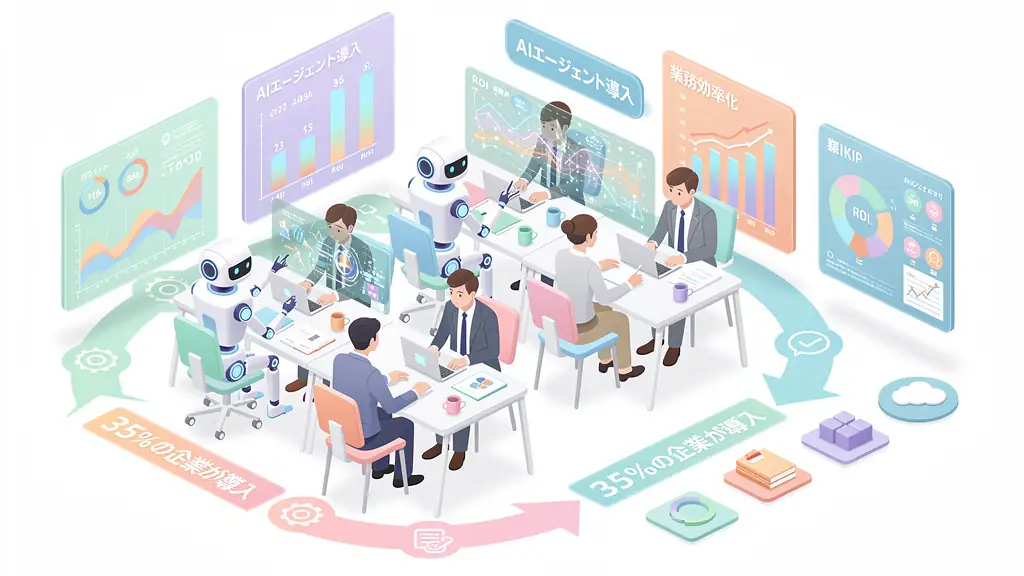
What this number shows is that AI agents have spread faster than traditional AI (72% in 8 years) or generative AI (70% in 3 years) in just 2 years since their introduction. Why are so many companies now focusing on AI agents and actually proceeding with implementation?
Key Points of This Article
- What AI agents are and why they’re attracting attention now
- Success cases and specific numbers from major companies like Softbank, Aeon, and MUFG
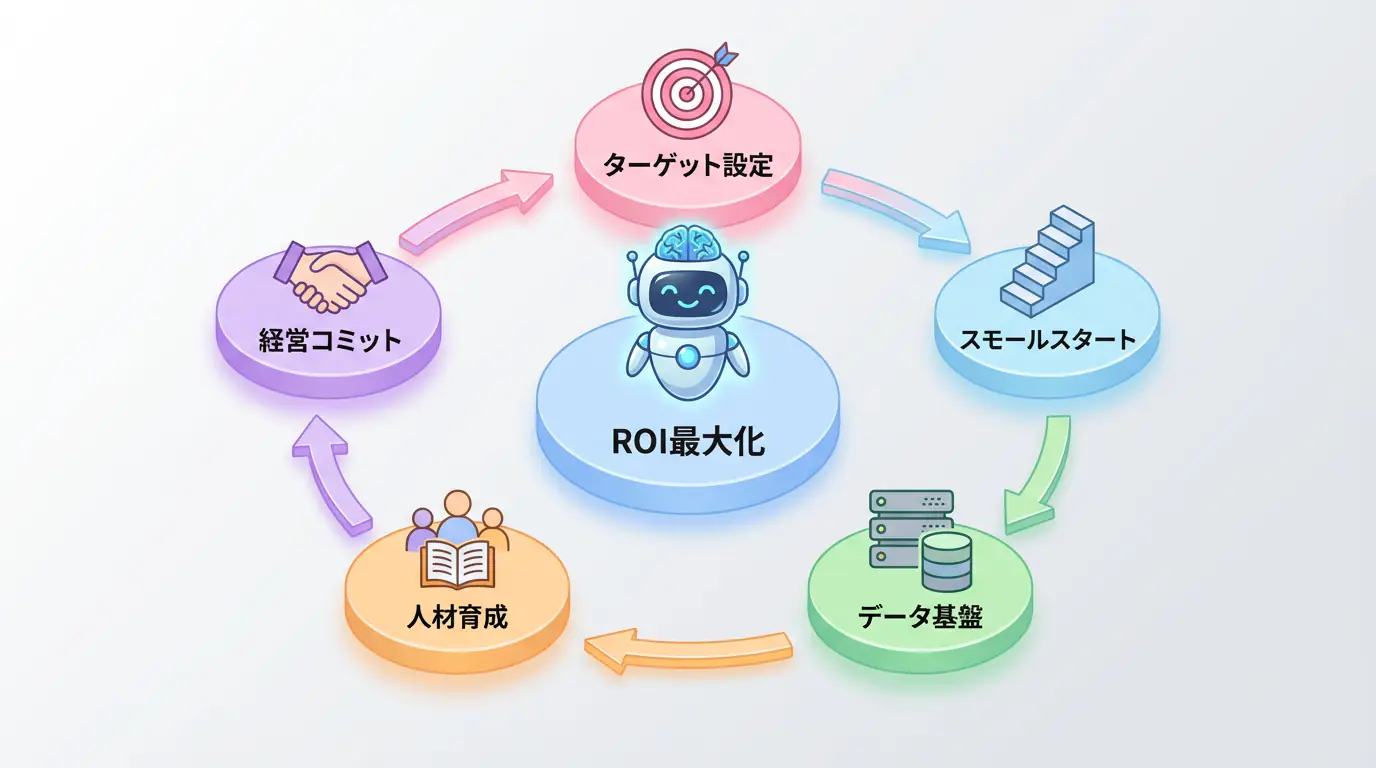
- Three implementation steps for ROI realization
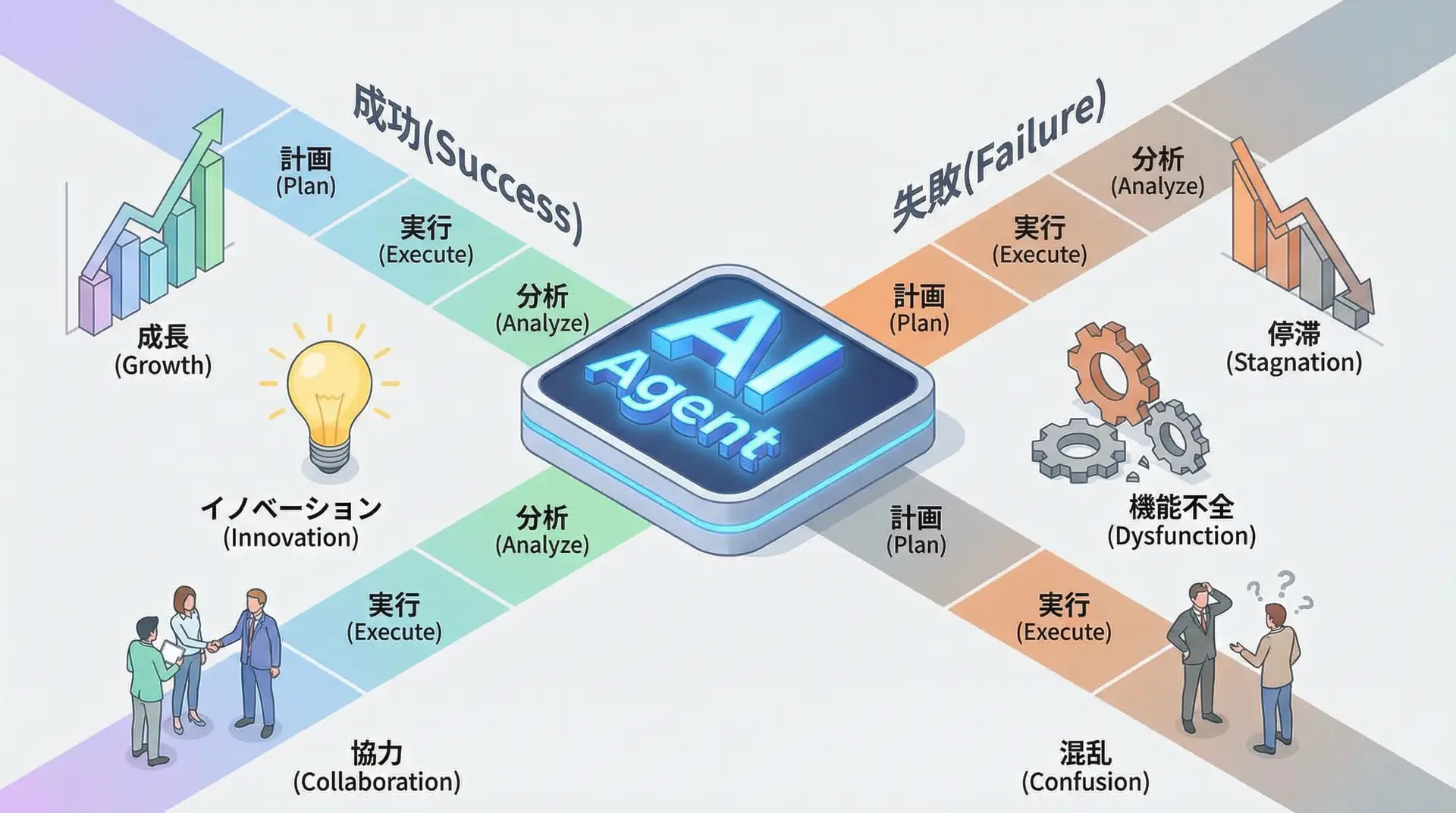
- Common failures and how to avoid them
What are AI Agents? The Decisive Difference from Traditional AI
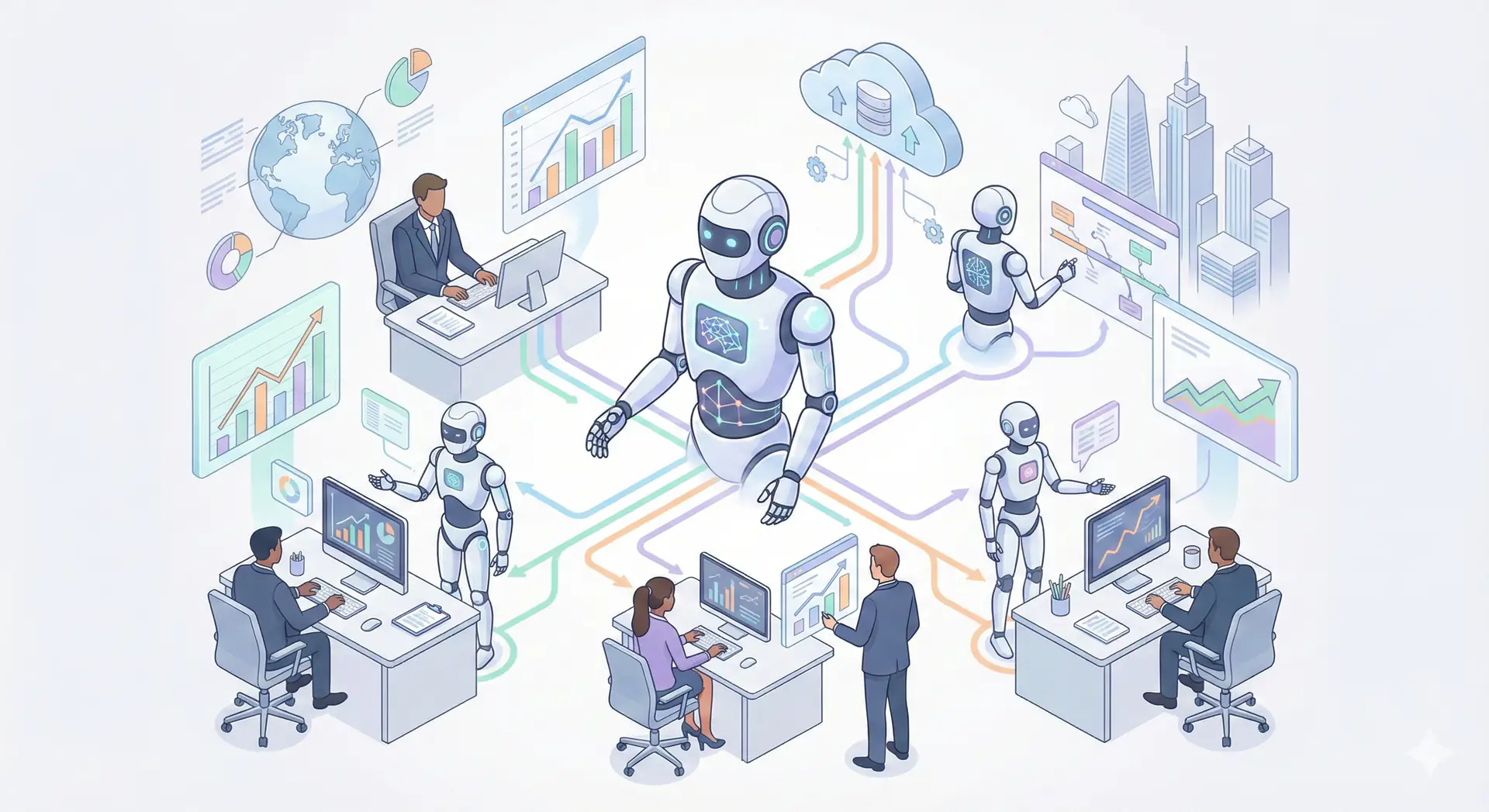
AI agents are AI systems that can autonomously make decisions and execute multiple tasks. While traditional AI (chatbots or RPA) only “executes what is instructed,” AI agents have the following capabilities:
Three Features of AI Agents
Autonomous Judgment and Planning
- When given a goal, automatically plans steps to achieve it
- Example: “Create presentation materials for next week” → automatically executes data collection → analysis → slide creation → review
Integrated Use of Multiple Tools
- Operates across multiple tools like email, calendar, CRM, and databases
- Example: Retrieves customer information from CRM, creates and sends email, registers appointment in calendar
Continuous Learning and Improvement
- Learns from execution results as feedback to produce better results next time
- Example: Automatically improves email content if response rate is low
If traditional RPA is “automation of fixed procedures,” AI agents can be considered “autonomous business support systems that think and act.”
Success Cases from Major Companies - Business Impact in Numbers
AI agents are no longer in the experimental stage. Major companies have actually implemented them and achieved clear results.
Case 1: Softbank - Creating 2.5 Million AI Agents in 2.5 Months
In June 2025, Softbank prepared an environment where all employees could use generative AI and set the mission for “all employees to create 100 AI agents each.”
Results:
- Created over 2.5 million AI agents in 2.5 months
- Achieved thousands of hours of work time reduction annually through operational efficiency
- Employee AI literacy dramatically improved
Keys to Success:
- Implementation of company-wide education program
- Commitment from top management
- Setting clear numerical goals (100 per person)
Case 2: Aeon Retail - Introducing “AI Assistant” to 390 Stores
In June 2025, Aeon Retail introduced the generative AI “AI Assistant” to 390 stores. This system uses LLMs trained on operational manuals and laws to immediately answer store staff questions via voice and chat.
Results:
- 90% reduction in manual search time (average 5 minutes → 30 seconds)
- 40% reduction in new employee training period
- 85% improvement in staff satisfaction
Implementation Points:
- Design reflecting voices from store frontlines
- Emphasis on usability with both voice and chat support
- Phased deployment (pilot stores → all store deployment)
Case 3: MUFG Bank - Targeting 220,000 Hours of Labor Reduction Monthly
MUFG Bank has introduced generative AI, aiming for 220,000 hours of labor reduction per month.
Application Areas:
- Contract review and summarization
- Email creation support for customer responses
- Internal document search and summarization
- Automatic generation of risk analysis reports
Expected Effects:
- Approximately ¥2.6 billion in annual cost reduction (based on labor time reduction)
- Shift of employees to creative work
- Improved customer response speed
Case 4: Panasonic Connect - 186,000 Hours Reduction Annually
Panasonic Connect achieved 186,000 hours of labor time reduction annually through company-wide deployment of generative AI.
Main Use Cases:
- Automatic creation of meeting minutes
- Proposal creation support
- Automatic generation of data analysis reports
- Multilingual translation
ROI:
- Investment recovery period: approximately 9 months
- Cost reduction: approximately ¥1.2 billion annually
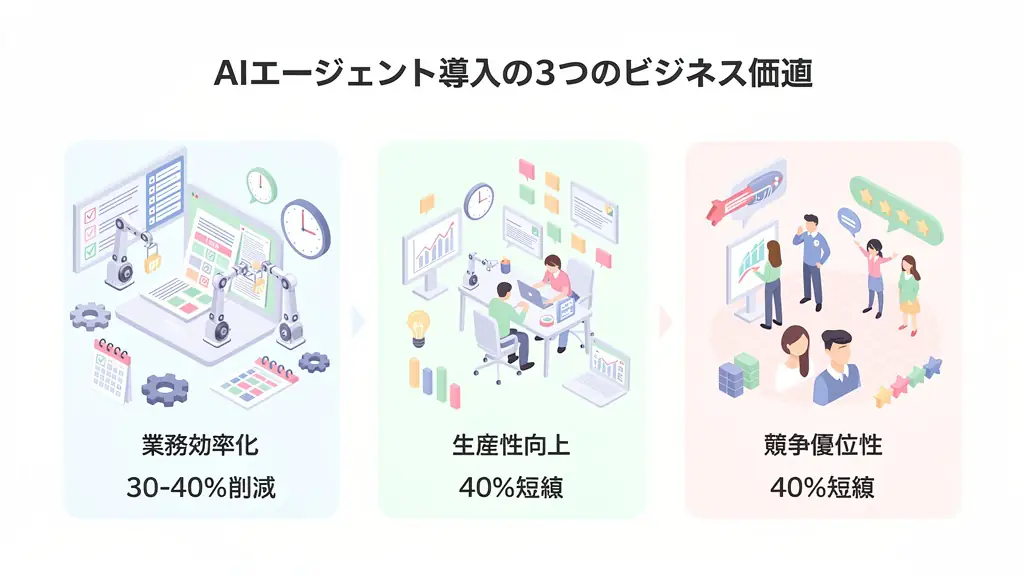
Three Business Values Gained from AI Agent Implementation
From these success cases, the business value brought by AI agent implementation can be summarized in three points.
1. Direct Cost Reduction through Operational Efficiency
- Automation of routine tasks: Email creation, data entry, schedule coordination, etc.
- Significant reduction in search time: Instant access to internal documents and manuals
- Reduction effect: Average 30-40% reduction in work time
2. Employee Productivity Improvement and Shift to Creative Work
- Liberation from simple tasks allows focus on strategic thinking and customer service
- Reduction in new employee training period (average 40%)
- Improved employee satisfaction (reduced turnover rate)
3. Securing Competitive Advantage
- Improved customer response speed (average 50% faster)
- Realization of data-driven decision making
- Quick response to market changes
Three Implementation Steps for ROI Realization
Here are three steps derived from successful companies’ practices to ensure ROI realization.
Step 1: Set Clear KPIs and Build Effect Measurement Mechanisms
Common Traits of Failing Companies:
- Vague goals like “just making work easier”
- No mechanism to measure effects
Practices of Successful Companies:
- Set specific numerical goals
- Example: “Reduce email creation time by 50%” “Reduce manual search time by 90%”
- Clarify measurement indicators (KPIs)
- Reduced man-hours (time)
- Cost reduction amount
- Changes in customer satisfaction
- Employee satisfaction
- Baseline measurement
- Understand current state with numbers before implementation
TIP: Specific KPI Setting Examples
- Customer support: Reduce average response time by 30%
- Sales department: Reduce proposal creation time by 40%, improve order rate by 5%
- Back office: Reduce expense processing time by 50%
Step 2: Phased Implementation and Pilot Projects
Recommended Implementation Flow:
Phase 1: Pilot Introduction (1-2 months)
- Trial operation in limited departments/tasks
- Effect measurement and feedback collection
- Investment: ¥1-5 million
Phase 2: Departmental Deployment (3-6 months)
- Sequential deployment from departments with success cases
- Internal knowledge accumulation
- Investment: ¥5-20 million
Phase 3: Company-wide Deployment (6+ months)
- Company-wide standardization and optimization
- Continuous improvement cycle
- Investment: ¥20 million+ (depending on company size)
Learning from Aeon’s Success Case:
- Started with 10 stores for pilot introduction
- 3 months of effect measurement and improvement
- Then 390 stores deployed in phases
- Result: High implementation success rate and employee satisfaction
Step 3: Change Management and Organizational Culture Transformation
The biggest barrier to AI agent implementation is not technology but organizational resistance to change.
Initiatives of Successful Companies:
Management Commitment
- CEO or CIO leads utilization from the front
- Sharing of usage cases in company-wide meetings
Employee Education Programs
- Implementation of AI literacy training
- Practical workshops
- Formation of internal communities
Incentive Design
- Recognition of excellent AI utilization cases
- Reflection in evaluation systems for operational efficiency
Continuous Support System
- Consultation desk by specialized team
- Regular follow-ups
Softbank’s Practice:
- Implemented AI literacy training for all employees
- Recognized excellent AI agent cases in internal contests
- Management led by example in using AI agents and shared results
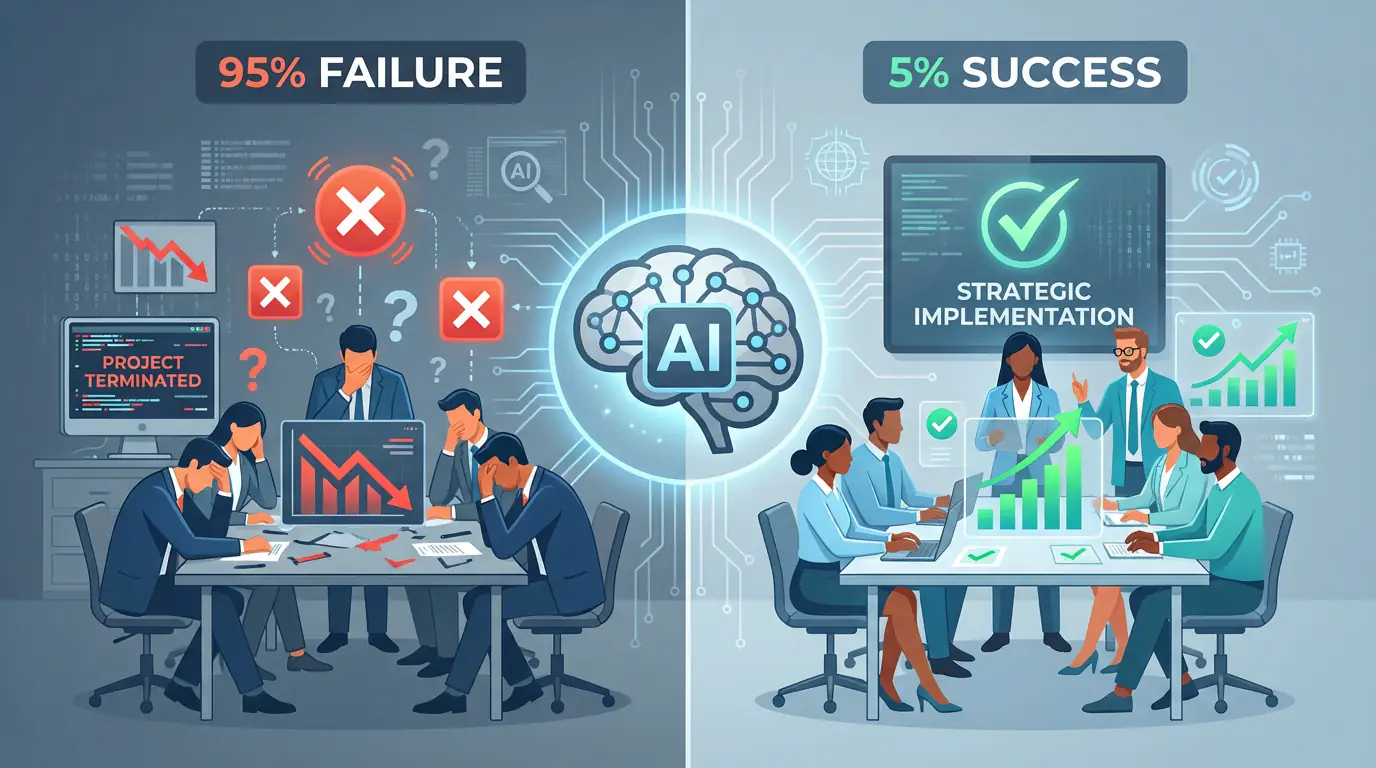
Common Failure Patterns and Avoidance Methods
In actual implementation sites, the following failures are common. Knowing them in advance can help avoid risks.
Failure Pattern 1: The Trap of “Just Implementing”
Symptoms:
- Implementation without clear purpose
- Only increasing unused tools
- Unable to recover investment
Avoidance Method:
- Clarify business issues before implementation
- Prioritize “what should be automated”
- Start small and demonstrate effects
Failure Pattern 2: The Trap of Cost Opacity
Symptoms:
- Initial costs balloon beyond expectations
- Operational costs (API calls, licenses) are unclear
- Unable to measure ROI
Avoidance Method:
- Measure costs in detail during PoC (Proof of Concept) phase
- Predict monthly usage and conduct cost simulation
- Compare multiple vendors
WARNING: Cost Estimation Pitfall Operational costs for AI agents can be 2-3 times the initial implementation cost. Estimate API call volume, storage, and maintenance costs in advance.
Failure Pattern 3: Overlooking Security and Compliance
Symptoms:
- Risk of confidential information leakage
- Compliance violations
- Inadequate audit response
Avoidance Method:
- Develop security policies before implementation
- Clarify data access permissions
- Regular audits and log management
- Formulate internal AI guidelines
Failure Pattern 4: Employee Resistance and Underutilization
Symptoms:
- Anxiety about “job loss”
- Not used due to lack of understanding
- Utilization rate decreases after implementation
Avoidance Method:
- Carefully explain implementation purpose (efficiency, not employment reduction)
- Implement practical training programs
- Build confidence through early success case sharing
Future of the AI Agent Market - Outlook for 2026 and Beyond
Following the rapid spread in 2025, the AI agent market is predicted to expand further in the future.
2026 Predicted Trends
Cooperative Operation Between Agents
- Multiple AI agents collaborate to execute complex tasks
- Full-scale multi-agent systems
Appearance of Industry-Specific Agents
- Agents optimized for each industry like finance, healthcare, manufacturing
- Solutions with built-in regulatory compliance and domain knowledge
Standardization of Human-in-the-Loop
- Incorporating human approval processes into AI decisions
- Ensuring risk management and accountability
Decreasing Implementation Costs
- Spread of SaaS-type AI agents
- Price ranges accessible to small and medium enterprises
Market Size Forecast:
- 2025: 35% of companies have adopted
- 2026: 60-70% of companies will adopt (research company prediction)
- 2030: AI agent market size expected to reach ¥5 trillion
🛠 Key Tools Used in This Article
| Tool Name | Purpose | Features | Link |
|---|---|---|---|
| ChatGPT Plus | Prototyping | Quickly verify ideas with the latest model | View Details |
| Cursor | Coding | Double development efficiency with AI-native editor | View Details |
| Perplexity | Research | Reliable information gathering and source verification | View Details |
💡 TIP: Many of these can be tried from free plans and are ideal for small starts.
Frequently Asked Questions
Q1: What is the current adoption status of AI agents?
As of 2025, about 35% of companies have already adopted AI agents, with an additional 44% planning implementation. Adoption is progressing faster than traditional AI or generative AI.
Q2: What is the difference between AI agents and traditional RPA?
While RPA only automates fixed procedures, AI agents autonomously make decisions, utilize multiple tools, and learn from results to improve.
Q3: What are the key points to avoid failure in implementation?
It’s important to avoid “casual implementation,” set specific numerical goals (KPIs), and proceed from pilot projects to company-wide deployment in stages.
Author’s Perspective: The Essential Change Brought by AI Agent “Democratization”
Looking at the 35% adoption rate in 2025, I’m convinced that “the phase has finally changed.” Previously, AI utilization was a “heavy project” where data scientists and specialized teams spent months building models. However, with the advent of AI agents, “bottom-up transformation” is now possible where non-engineers on the frontlines can automate their own work themselves.
What I’ve felt from supporting AI agent implementation at multiple sites is that the most important factor is not “technical sophistication” but “business resolution.”
No matter how high-performance the LLM, if the prompt is ambiguous, the agent will wander. Conversely, prompts written by frontline people who understand business flows better than anyone else produce surprisingly high ROI. I believe the essential reason Softbank’s “all-employee agent creation” initiative is successful is not because they provided tools, but because they gave all employees “an opportunity to objectively redesign their own work.”
In 2026, not only advanced multi-agents but also “micro-agents” that perform specific single tasks (only calendar coordination, only translation) with extremely high accuracy will flood the market like smartphone apps. The success or failure for companies depends on “how quickly they can integrate these small agents into their unique business processes (secret sauce).”
Companies that think “it’s okay to wait and see” will see an irreparable productivity “wall” between themselves and competitors who master AI by the end of 2026.
Summary: Actions to Start Now
AI agents are no longer “future technology.” Already 35% of companies have adopted them and achieved clear results. To maintain competitive advantage, you need to start acting now.
Summary: Three Actions to Start Today
- Current Status Analysis: Write down 3 “boring tasks” you repeat every day
- Pilot Project: Use tools like ChatGPT or Cursor intensively for personal work for one week
- Organizational Deployment: Share small success stories (e.g., reduced man-hours by X minutes) within the team to lower psychological barriers
AI agent implementation is not just about adding tools. It’s about “securing a sanctuary for humans to focus on high-value work that only humans can do.” In 2025, to not miss this big wave, take the first step from automating familiar tasks.
AI agent implementation is not just about introducing efficiency tools. It’s a strategic investment to transform work styles and create an environment where employees can focus on more creative work.
Just as Softbank created 2.5 million agents in 2.5 months and Aeon realized business reform in 390 stores, with the right approach, you can definitely achieve ROI.
In 2025, the wave of AI agent implementation has already begun. Now is the time for your company to move to the next stage.
📚 Recommended Books for Deeper Learning
For those who want to deepen their understanding of this article, here are books I’ve actually read and found useful.
1. Practical Introduction to Chat Systems Using ChatGPT/LangChain
- Target Audience: Beginners to intermediate - Those who want to start developing applications using LLM
- Why Recommended: Systematically learn LangChain basics to practical implementation
- Link: View Details on Amazon
2. LLM Practical Introduction
- Target Audience: Intermediate - Engineers who want to utilize LLM in practical work
- Why Recommended: Rich in practical techniques such as fine-tuning, RAG, and prompt engineering
- Link: View Details on Amazon
References
- 35% of Companies Have Adopted AI Agents, Surpassing Generative AI Speed - ZDNet Japan
- Creating Over 2.5 Million AI Agents in Just 2.5 Months - Softbank News
- 2025 Latest AI Business Utilization 25 Cases and Complete Explanation of Implementation Success Points
- How to Maximize AI ROI in 2025 - IBM
- A Must-See for Companies Hesitating About Business Use of Generative AI! Rakuten AI for Business
💡 Struggling with AI Implementation or DX Promotion?
Take the first step toward introducing AI into your business and request an ROI simulation. For companies facing management challenges like “I don’t know where to start,” we provide support from strategy planning to implementation.
Services Offered
- ✅ AI Implementation Roadmap Planning & ROI Calculation
- ✅ Business Flow Analysis & AI Utilization Area Identification
- ✅ Rapid PoC (Proof of Concept) Implementation
- ✅ Internal AI Talent Development & Training
💡 Free Consultation
For those thinking “I want to apply the content of this article to actual projects.”
We provide implementation support for AI and LLM technology. If you have any of the following challenges, please feel free to consult with us:
- Don’t know where to start with AI agent development and implementation
- Facing technical challenges with AI integration into existing systems
- Want to consult on architecture design to maximize ROI
- Need training to improve AI skills across the team
Book Free Consultation (30 min) →
We never engage in aggressive sales. We start with hearing about your challenges.
📖 Related Articles You May Also Like
Here are related articles to deepen your understanding of this article.
1. Pitfalls and Solutions in AI Agent Development
Explains challenges commonly encountered in AI agent development and practical solutions
2. Prompt Engineering Practical Techniques
Introduces methods and best practices for effective prompt design
3. Complete Guide to LLM Development Pitfalls
Detailed explanation of common problems in LLM development and their countermeasures