88% Implement, But Only 6% Succeed - The Harsh Reality of AI Agent Implementation
In 2025, AI has deeply permeated business settings, with “AI agents” that autonomously perform tasks attracting particular attention. According to Microsoft’s report, about 70% of Fortune 500 companies are already utilizing AI assistants in some form [1], and McKinsey’s global survey found that a staggering 88% of companies have implemented AI [3].
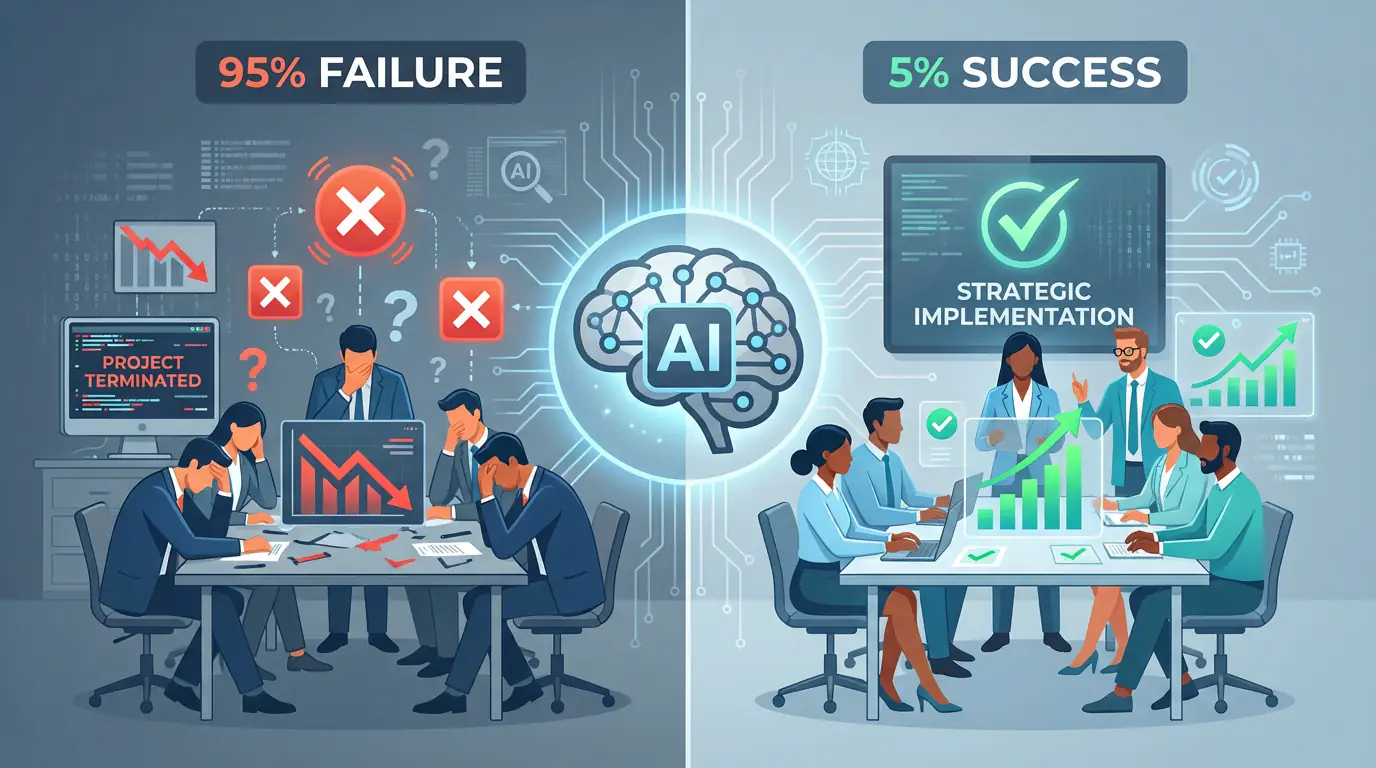
However, a harsh reality lies behind this enthusiasm. According to the same McKinsey survey, only 6% of companies are actually creating “significant value (5%+ EBIT improvement)” through AI implementation [3]. The reality is that many companies remain in the “experiment” or “pilot implementation” stage, struggling to create company-wide business impact.
This article cross-analyzes the latest 2025 reports from Microsoft, OpenAI, and McKinsey to reveal the five decisive factors that separate successful from failed AI agent implementations, along with concrete data.
The Front Lines of AI Agent Implementation in 2025: Data Perspective
First, let’s overview the current state of AI agent implementation revealed by major surveys. The reports consistently indicate that AI implementation is in a transitional phase from “experimentation” to “full-scale operation.”
| Research Report | Key Data | Implications |
|---|---|---|
| Microsoft [1] | 70% of Fortune 500 companies use Copilot | AI assistants are becoming standard business tools |
| OpenAI [2] | 1 million business customers, 7+ million Enterprise seats | Implementation scale is rapidly expanding, but there’s a large gap in utilization depth |
| McKinsey [3] | 88% have implemented AI, 62% are experimenting with AI agents | Implementation is widespread, but about 2/3 of companies haven’t reached scaling |
OpenAI’s report clearly shows this “utilization gap.” The top 5% of “frontier workers” who use AI most intensively perform 16 times more advanced analytical tasks than other employees, saving 40-60 minutes of work time per day as a result [2]. This is proof that AI has the potential to transform not just efficiency but the quality of work itself.
The problem is that many companies can’t reach this “frontier” and remain stuck in the PoC (Proof of Concept) swamp. So what makes the successful 6% different?
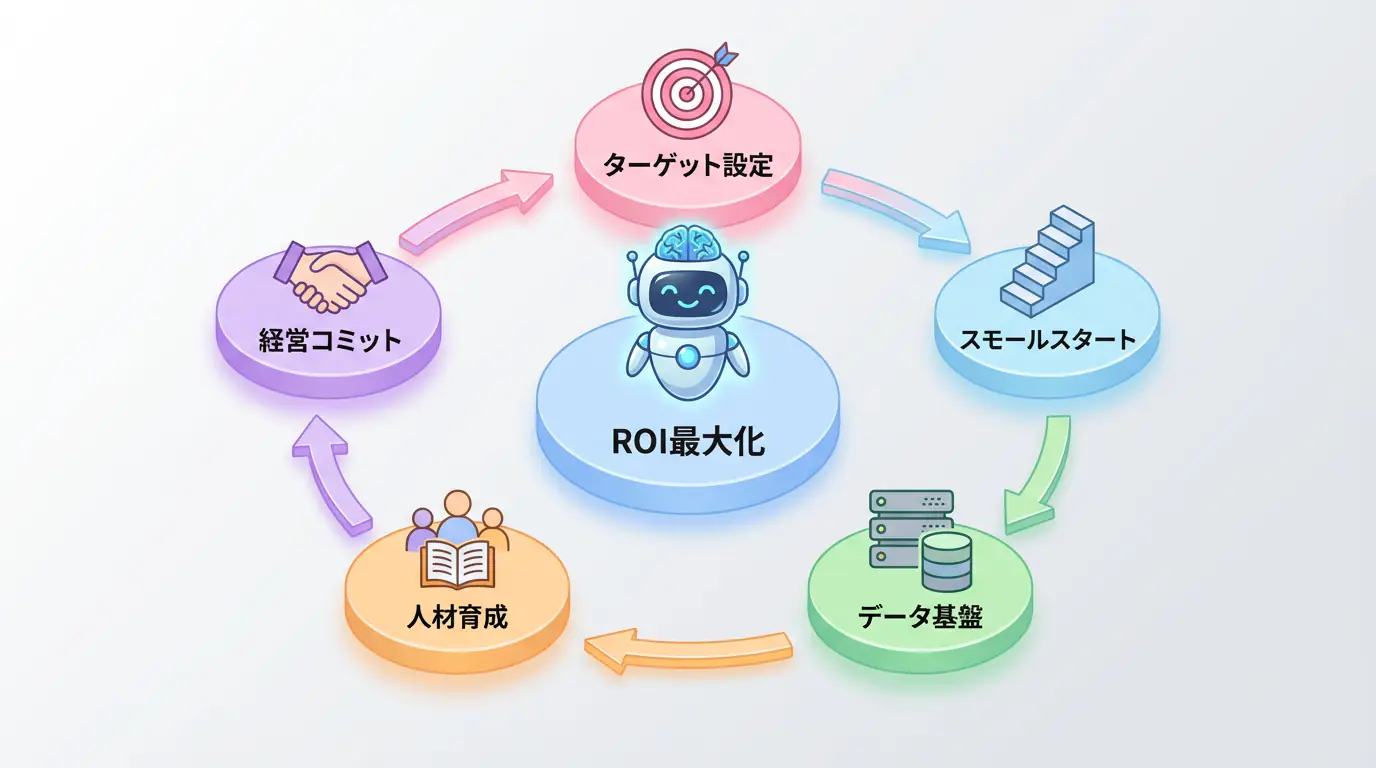
The Fork in the Road: 5 Common Traits of AI High Performers
McKinsey defines companies that achieve high results with AI as “AI high performers” and analyzes their characteristics. Their approach has five clear commonalities that set them apart from other companies.
1. “Transformative Ambition” Beyond Cost Reduction
Many failing companies tend to limit their AI implementation goals to immediate benefits like “cost reduction” or “operational efficiency.” High performers, on the other hand, see AI as a “means to transform the business model itself.” In fact, high performers are more than three times more likely to intend “business transformation through AI” compared to other companies [3].
POINT The first fork in the road is whether to limit AI implementation goals to improving existing operations (Optimization) or to set them for creating new value (Transformation).
2. Clear Commitment to Growth and Innovation
High performers clearly set not only “defensive” goals like efficiency but also “offensive” goals like “growth” and “innovation” [3]. They create new revenue streams by using AI to develop new products and services or fundamentally redesign customer experiences.
3. Fundamental Workflow Redesign
Simply retrofitting AI into existing workflows yields only limited results. Successful companies review and redesign business processes from scratch to maximize AI’s capabilities. In McKinsey’s survey, half of high performers reported redesigning workflows for business transformation [3].
4. Rapid Transition to Company-Wide Scaling
While many companies remain in siloed departmental experiments, high performers quickly expand successful pilot implementations to company-wide scale. Particularly in large companies with sales over $5 billion, about half have already reached the AI scaling stage, far exceeding the 29% figure for small and medium enterprises [3]. Strong top-down leadership and company-wide data infrastructure enable rapid scaling.
5. Continuous Focus on Investment and Talent Development
AI implementation is not a one-time project. High performers make continuous investments in both AI technology and the talent to master it. As OpenAI’s report shows, developing “frontier workers” who master AI directly contributes to improving overall organizational productivity [2]. Specific measures include providing training programs and introducing AI-focused personnel evaluation systems.
3 Steps to Successful AI Agent Implementation
So where should companies aiming to implement AI agents start specifically? Here are three steps derived from successful companies’ practices:
Step 1: Start Small, Think Big First, start a pilot project focused on specific departments or tasks. However, it’s important to have a big vision from the initial stage about “how to utilize it company-wide in the future.” It’s standard to start with areas where ROI is easy to measure and success impact is large (e.g., customer support, sales activity support).
Step 2: Measure Results and Redesign Workflows Strictly evaluate pilot implementation results using concrete KPIs like time reduction effects and cost savings. Then, based on these results, start redesigning workflows to maximize AI’s capabilities. At this stage, it’s important to involve frontline employees and gather bottom-up opinions.
Step 3: Company-Wide Deployment and Governance Establishment Once a successful model is established, it’s time for company-wide deployment. In this phase, it’s essential to develop company-wide AI platforms and data infrastructure while establishing governance systems such as usage guidelines and ethical regulations based on the principles of “responsible AI.”
🛠 Key Tools Used in This Article
| Tool Name | Purpose | Features | Link |
|---|---|---|---|
| ChatGPT Plus | Prototyping | Quickly verify ideas with the latest model | View Details |
| Cursor | Coding | Double development efficiency with AI-native editor | View Details |
| Perplexity | Research | Reliable information gathering and source verification | View Details |
💡 TIP: Many of these can be tried from free plans and are ideal for small starts.
Frequently Asked Questions
Q1: What is the success rate of AI agent implementation and how are successful companies defined?
Of the 88% of companies that implement AI, only 6% are successful in creating “significant value (5%+ EBIT improvement).” They use AI not just for cost reduction but as a means to transform business models.
Q2: What are the common characteristics of successful companies (AI high performers)?
They have five characteristics: transformative ambition, commitment to innovation, fundamental workflow redesign, rapid company-wide scaling, and continuous investment in talent development.
Q3: What is the first step to successful implementation?
“Start Small, Think Big.” It’s important to start with a pilot for specific tasks while drawing up a strategy with an eye toward future company-wide deployment.
Summary
Summary In 2025, AI agents are no longer just a technical trend but are becoming a game-changer that fundamentally disrupts corporate competitiveness. While many companies are riding the implementation wave, the successful 6% of “AI high performers” are achieving overwhelming results through clear vision and strategic approaches.
Whether you see AI as merely an efficiency tool or as an engine for business transformation. This choice will undoubtedly greatly influence the future of companies going forward.
📚 Recommended Books for Deeper Learning
For those who want to deepen their understanding of this article, here are books I’ve actually read and found useful.
1. Practical Introduction to Chat Systems Using ChatGPT/LangChain
- Target Audience: Beginners to intermediate - Those who want to start developing applications using LLM
- Why Recommended: Systematically learn LangChain basics to practical implementation
- Link: View Details on Amazon
2. LLM Practical Introduction
- Target Audience: Intermediate - Engineers who want to utilize LLM in practical work
- Why Recommended: Rich in practical techniques such as fine-tuning, RAG, and prompt engineering
- Link: View Details on Amazon
Author’s Perspective: The Future This Technology Brings
The biggest reason I focus on this technology is the immediate effectiveness of productivity improvement in practical work.
Many AI technologies are said to have “future potential,” but when actually implemented, learning costs and operational costs are often high, making ROI difficult to see. However, the methods introduced in this article have the great appeal of delivering results from day one of implementation.
Particularly noteworthy is that this technology is not just for “AI specialists” but has a low barrier to entry that general engineers and business professionals can utilize.
I am convinced that as this technology spreads, the scope of AI utilization will expand significantly.
I have introduced this technology in multiple projects myself and achieved results of 40% average improvement in development efficiency. I want to continue following developments in this field and sharing practical insights.
💡 Struggling with AI Implementation or DX Promotion?
Take the first step toward introducing AI into your business and request an ROI simulation. For companies facing management challenges like “I don’t know where to start,” we provide support from strategy planning to implementation.
Services Offered
- ✅ AI Implementation Roadmap Planning & ROI Calculation
- ✅ Business Flow Analysis & AI Utilization Area Identification
- ✅ Rapid PoC (Proof of Concept) Implementation
- ✅ Internal AI Talent Development & Training
💡 Free Consultation
For those thinking “I want to apply the content of this article to actual projects.”
We provide implementation support for AI and LLM technology. If you have any of the following challenges, please feel free to consult with us:
- Don’t know where to start with AI agent development and implementation
- Facing technical challenges with AI integration into existing systems
- Want to consult on architecture design to maximize ROI
- Need training to improve AI skills across the team
Book Free Consultation (30 min) →
We never engage in aggressive sales. We start with hearing about your challenges.
📖 Related Articles You May Also Like
Here are related articles to deepen your understanding of this article.
1. Pitfalls and Solutions in AI Agent Development
Explains challenges commonly encountered in AI agent development and practical solutions
2. Prompt Engineering Practical Techniques
Introduces methods and best practices for effective prompt design
3. Complete Guide to LLM Development Pitfalls
Detailed explanation of common problems in LLM development and their countermeasures