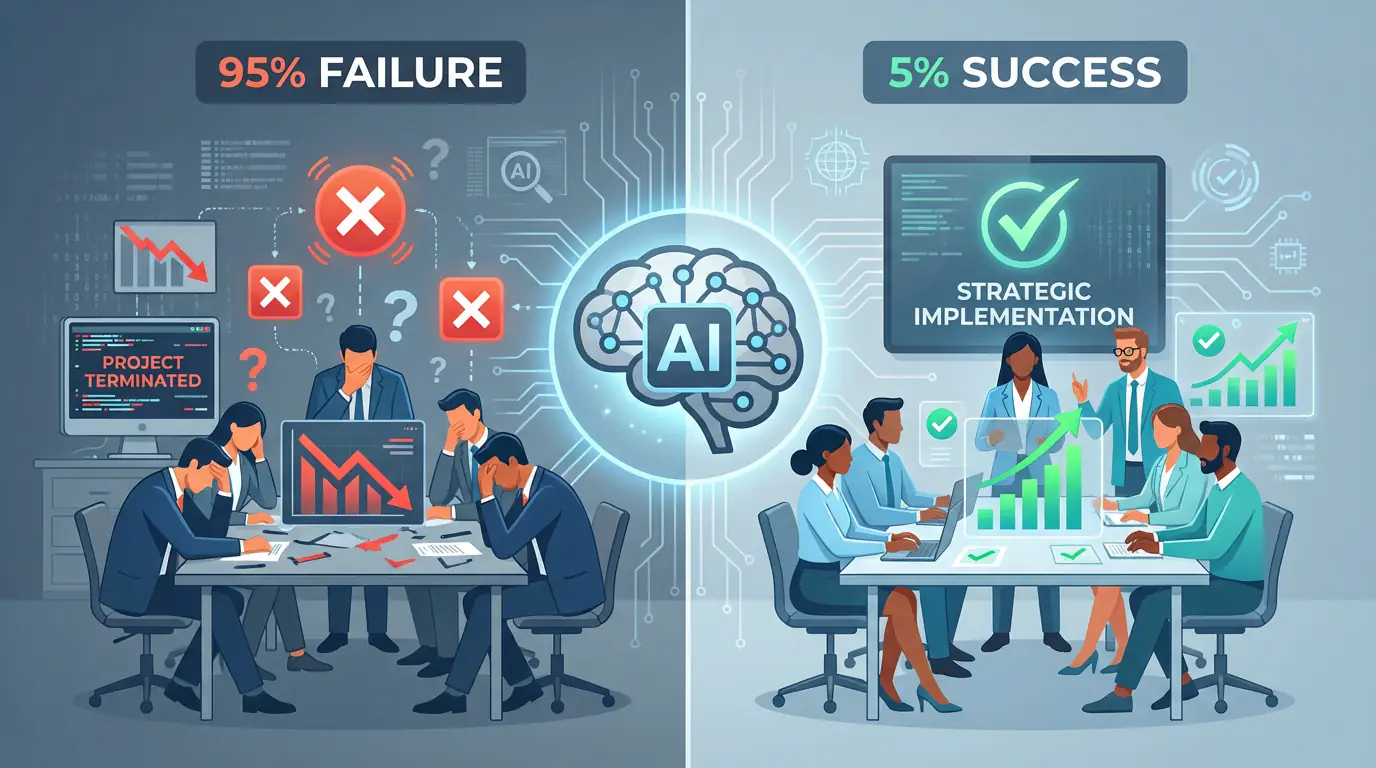
In 2025, a shocking survey result was announced regarding AI adoption. According to a survey conducted by MIT (Massachusetts Institute of Technology) targeting over 300 companies, 95% of corporate AI adoption projects failed, with return on investment (ROI) being zero. There is a reality where massive investments of $30-40 billion (approximately 4.5-6 trillion yen) have not produced substantial results.
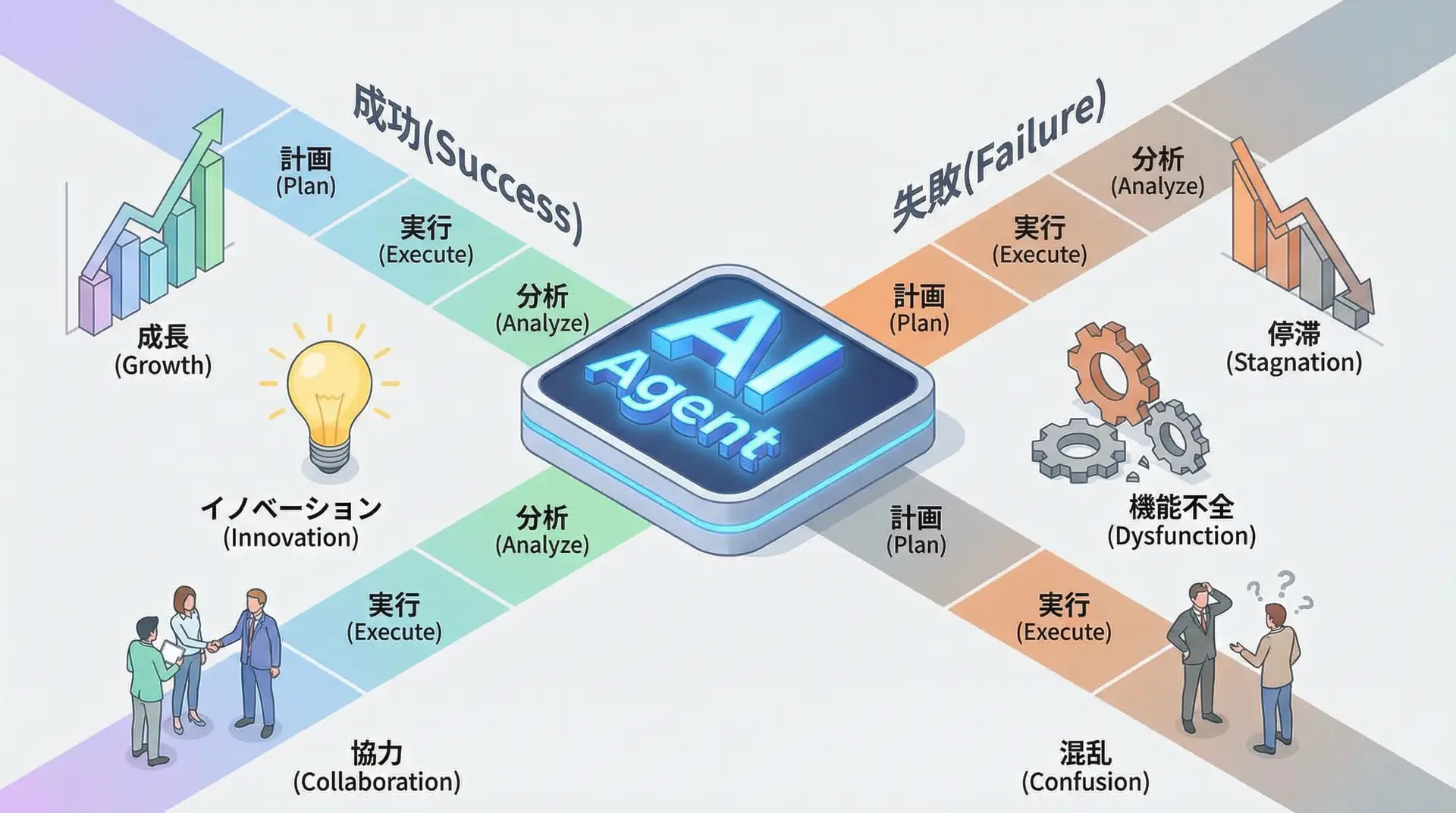
However, on the other hand, only 5% of companies have succeeded in large-scale workflow integration, achieving dramatic operational efficiency improvements and cost reductions. What is the decisive difference that separates successful companies from failed ones? This article thoroughly explains the essential causes of failure revealed by MIT research and the 5 strategies practiced by successful companies, along with specific case studies from Japanese companies.
Reality of AI Adoption: Shocking Data of 95% Failure Rate
Truth Revealed by MIT Survey “State of AI in Business 2025”
The “State of AI in Business 2025” report published by MIT NANDA (National AI Development Alliance) initiative gave a major shock to the AI industry. The survey is based on over 300 public adoption cases, over 150 executive interviews, and investment data of $30-40 billion, making its reliability extremely high.
The main points of the survey results are as follows. While 40% of organizations responded that they have introduced AI tools, only 5% have actually succeeded in large-scale workflow integration. The remaining 95% have fallen into a state called “Pilot Purgatory,” unable to break out of the experimental stage and wasting their investments. This phenomenon is named “GenAI Divide (Generative AI Divide),” indicating that a serious divide is occurring between successful and failed companies.
Harsh Reality Supported by Other Surveys
Not only the MIT survey, but other major research institutions have reported similar results. The IBM CEO Study 2025 revealed that only 25% of AI projects achieved expected ROI over the past three years. In other words, 75% of projects have failed.
McKinsey’s 2025 AI survey showed that while 88% of companies have adopted AI, only 39% have actually realized profits. Even more serious is the fact that only about 6% of companies have achieved cost reductions of 5% or more. These data indicate that AI adoption is not just a technical challenge but a complex management challenge involving organizational transformation.
Particularly for Japanese companies, according to Snowflake’s survey, AI investment ROI is at 30%, the lowest level among surveyed countries. Compared to higher levels like Canada at 43% and France, the severity of challenges facing Japanese companies becomes apparent. The main challenges pointed out are lack of use cases and employee skill shortages.
Essential Causes of Failure: Why AI Adoption Fails
Cause 1: The “Confidently Wrong” Problem
The biggest cause of AI adoption failure lies in the characteristic that AI systems are “confidently wrong.” Tanmai Gopal, CEO of PromptQL, calls this problem the “Verification Tax.”
Many current AI systems cannot properly communicate uncertainty. Since users cannot judge whether AI-generated answers are correct or wrong, humans need to verify all outputs. This verification work takes enormous time, making it impossible to achieve the original goal of efficiency improvement through AI.
Gopal points out that “if the system is not always accurate, even if it’s only 1%, you need to know when it’s inaccurate. Otherwise, work that takes minutes will balloon to hours, and ROI will disappear.” In regulated industries or high-risk industries, one wrong answer causes greater loss of trust than ten correct answers.
Cause 2: Learning Gap
Another important cause of failure pointed out by the MIT survey is the “learning gap.” Most enterprise AI tools have the characteristic of not retaining feedback, not adapting to workflows, and not improving over time.
Even if users correct AI output, that correction is not utilized for future improvements, so the same mistakes are repeated. This causes users to lose motivation to invest in improving AI systems, and as a result, the entire AI adoption project stagnates.
Gopal states that “if you don’t know whether the result is wrong due to ambiguity, lack of context, outdated data, or model mistakes, you won’t be motivated to invest in making it successful.”
Cause 3: Failure in Workflow Integration
The third cause of failure for many companies is the inability to integrate AI tools into actual business processes. Even if AI is introduced as an independent tool like a chatbot, without linkage with existing workflows, employees will stop using it.
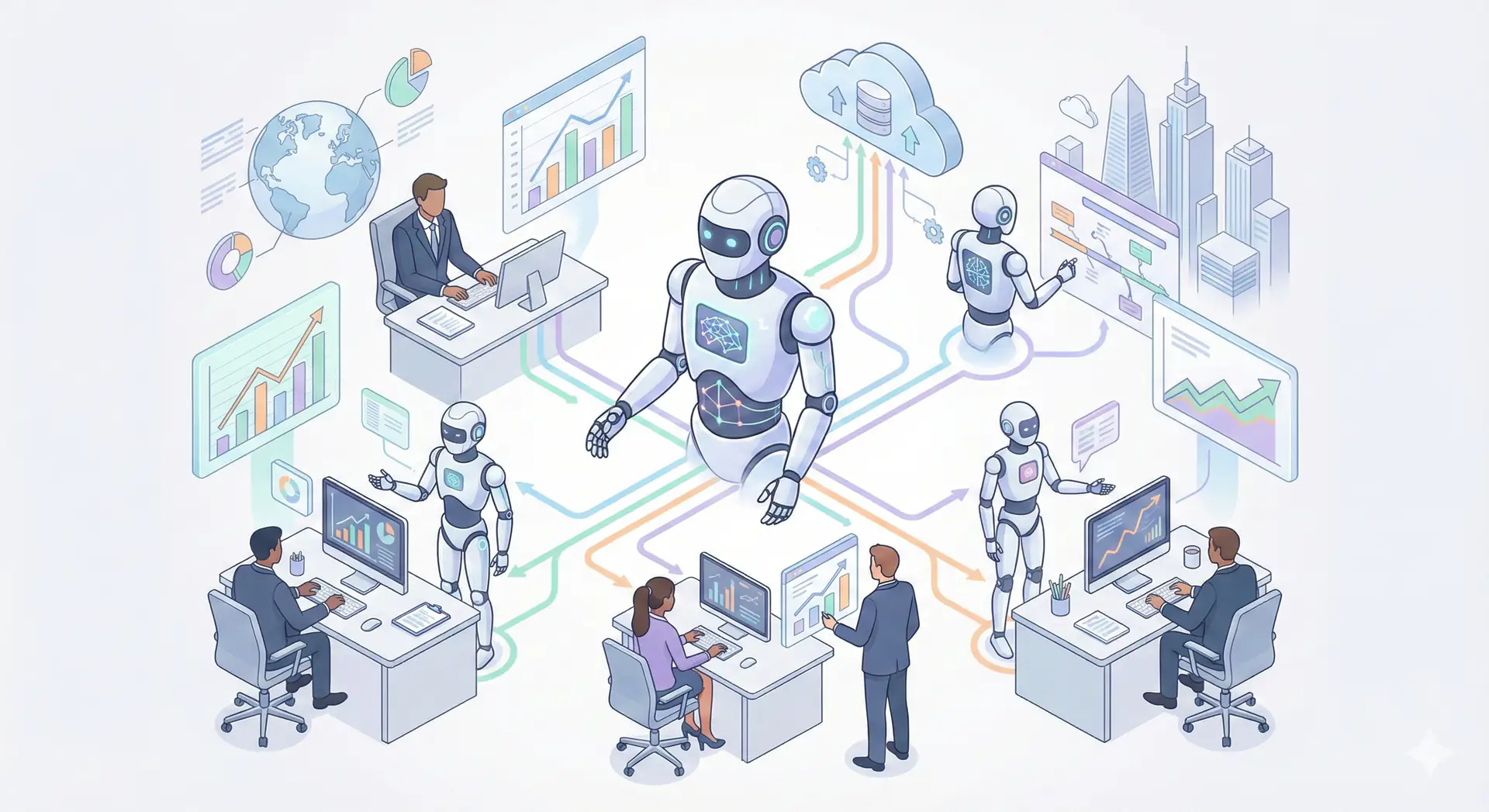
Successful AI adoption requires deeply embedding AI into actual business processes such as contract management, engineering, procurement, and customer support. However, this requires significant modifications to existing systems or redesign of business processes, causing many companies to give up at the pilot stage.
Success Stories of Japanese Companies: What the 5% Winners Practice
Toyota Motor Corporation: Revolution in Internal Document Search
Toyota Motor Corporation, a representative Japanese manufacturing company, developed its own dialogue-type AI system specialized for internal documents to address the challenge of utilizing enormous technical documents and know-how. It is a system where employees can simply ask questions in natural language to instantly find related documents and accurately summarize and present their contents.
Through this initiative, engineers have been able to significantly reduce time spent on research and focus on their original creative work. They have simultaneously achieved three results: reduction in document search time, reduction in report creation man-hours, and promotion of technical knowledge succession.
Panasonic Connect: Copilot Introduction to 10,000 Employees Company-wide
Panasonic Connect is a pioneering company that was among the first in Japan to introduce “Copilot for Microsoft 365” for approximately 10,000 employees company-wide. With generative AI integrated into everyday applications like Word, Excel, PowerPoint, and Teams, employees have been able to streamline various tasks.
It has become possible to summarize and transcribe Teams meeting content in real-time, and create presentation drafts with simple instructions. Through company-wide adoption, they have raised the productivity of the entire organization and created time for employees to work on higher value-added tasks.
Hitachi: Improving Software Development Productivity
At Hitachi, they are introducing “GitHub Copilot” on a large scale to strengthen software development capabilities across the group. Since AI suggests context-appropriate code in real-time, developers can not only shorten coding work time but also get hints for new implementation methods.
Furthermore, they are developing a code review support system utilizing generative AI, aiming to ensure quality and accelerate the entire development process. They have achieved two effects: improved development speed through automatic code generation and suggestions, and efficiency in code review.
KDDI: Revolution in Call Center Response Quality
KDDI is promoting the utilization of generative AI to advance call center operations. They have introduced a system that analyzes customer inquiries in real-time and presents optimal response proposals to operators’ screens from internal manuals and past response history.
Through this initiative, even inexperienced operators can provide smooth and accurate responses comparable to veterans, achieving improved customer satisfaction and standardization of response quality. They have simultaneously achieved three results: reduction in average response time (AHT), early deployment of new operators, and standardization of response quality.
Obayashi Corporation: 50% Reduction in Construction Site Documentation Time
Obayashi Corporation, a major construction company, has introduced generative AI for specialized documentation work that had become a major burden for site workers. AI automatically generates drafts for documents related to the Industrial Safety and Health Act and daily work plans that require specialized knowledge and time to create.
By learning from past excellent document data, they have become able to create high-quality documents compliant with laws and company standards in a short time. They have achieved maximum 50% reduction in documentation time, improved document quality, and standardization. This is attracting attention as a case study solving industry-specific challenges by creating an environment where site engineers can focus on construction management and safety management that they should originally concentrate on.
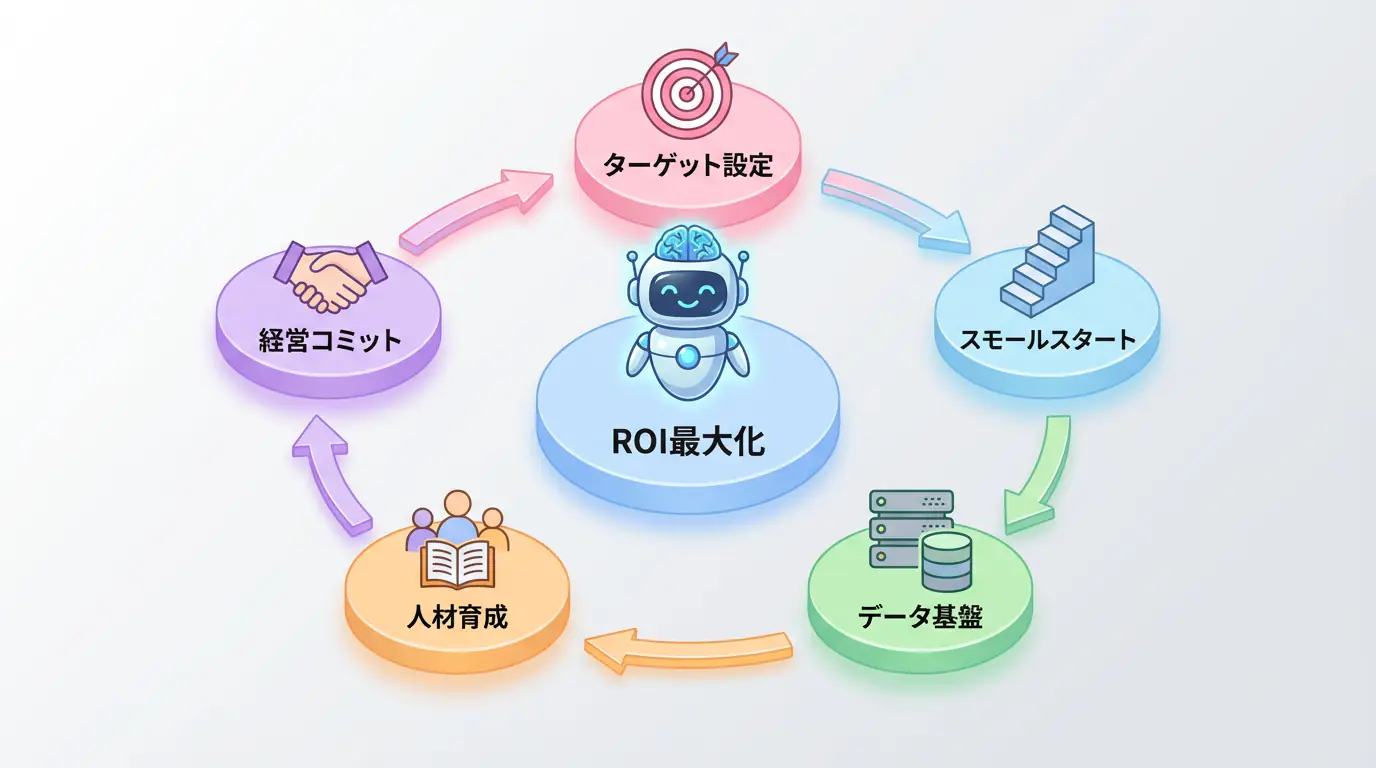
5 Strategies Practiced by the 5% of Successful Companies
Strategy 1: Visualization of Uncertainty and Ensuring Transparency
The first characteristic of successful companies is that they appropriately visualize the uncertainty of AI systems. They have introduced mechanisms that assign confidence scores to each answer and explicitly state “I don’t know” when the system is uncertain.
Advanced AI platforms like PromptQL explicitly show reasons why answers are not trustworthy (insufficient data, ambiguity, lack of context, etc.). This allows users to accurately judge where verification is needed and reduce wasted verification work. To solve the “confidently wrong” problem, it is important for AI to be “tentatively right.”
Strategy 2: Clear KPI Setting and ROI Measurement
Successful companies clearly set the purpose and KPIs (Key Performance Indicators) for AI adoption. Instead of vague goals like “operational efficiency improvement,” they set specific and measurable goals like “reduce document search time by 50%” or “shorten call center average response time by 30 seconds.”
They also continuously measure return on investment and run improvement cycles. They quantitatively understand initial investment amounts, operating costs, reduced labor costs, sales increases due to productivity improvements, etc., and utilize them for management decisions. While many Japanese companies struggle with ROI measurement, successful companies have clear measurement frameworks.
Strategy 3: Phased Adoption (POC→Pilot→Production Deployment)
Successful companies adopt a phased approach rather than immediate company-wide deployment. First, they verify technical feasibility with POC (Proof of Concept), then measure effects in a limited range with pilot projects, and finally proceed to production deployment.
This phased approach allows them to accumulate learning while minimizing risk. They utilize feedback obtained at the pilot stage for the next deployment and gradually overcome organizational transformation resistance. “Small start” is also emphasized as a key to success in the MIT survey.
Strategy 4: Deep Integration into Workflows
Successful companies deeply embed AI into actual business processes rather than as independent tools like chatbots. They integrate AI functions into systems that employees use daily, such as contract management systems, engineering tools, procurement platforms, and customer support systems.
This allows employees to naturally benefit from AI without needing to learn how to use new tools. Panasonic Connect’s Microsoft 365 Copilot introduction is a typical example of this strategy. They have created an environment where they can utilize AI’s power without significantly changing existing workflows.
Strategy 5: Building Continuous Learning and Feedback Loops
The most important characteristic of successful companies is that they have mechanisms for AI systems to continuously learn and improve. They utilize user corrections and feedback as learning data, and system accuracy improves over time.
This is called the concept of “Accuracy Flywheel,” where AI refrains from uncertain answers (Abstain) → User corrects → AI learns → Accuracy improves, and this cycle continues to rotate. Rather than aiming for perfection, building a loop of continuous improvement is the key to long-term success.
Risks and Countermeasures: What You Need to Know to Avoid Failure
Trap of Cost Opacity
One of the major risks in AI adoption is cost opacity. Various hidden costs occur, not just initial investment, but operating costs, training costs, maintenance costs, etc. Especially for cloud-based AI services that charge based on usage, unexpected cost increases may occur.
As a countermeasure, it is important to estimate Total Cost of Ownership (TCO) in detail in advance and establish budget management mechanisms. It is also necessary to measure actual costs at the pilot stage and accurately calculate budgets for production deployment.
Organizational Transformation Resistance
AI adoption involves not only technical challenges but also organizational culture transformation. Some employees may have anxiety that their jobs will be taken by AI. There is also resistance to learning how to use new tools.
As a countermeasure, it is essential to incorporate Change Management processes into adoption projects. Effective measures include messaging from management, training for employees, sharing success stories, and phased adoption to reduce anxiety. In successful cases of company-wide adoption like Panasonic Connect, meticulous Change Management is being implemented.
Data Quality and Privacy Challenges
AI system accuracy heavily depends on the quality of training data. AI trained on inaccurate or biased data may make wrong judgments. Also, when handling customer data or confidential information, privacy protection and security measures become extremely important.
As a countermeasure, it is necessary to establish data governance frameworks and conduct continuous monitoring and improvement of data quality. It is also necessary to comply with regulations such as GDPR (EU General Data Protection Regulation) and Japan’s Personal Information Protection Act, and implement appropriate security measures.
WARNING Shocking Results from MIT Survey
95% of corporate AI adoption projects fail, and $30-40 billion in investment is wasted. However, this harsh reality shows not that “AI is failing” but that “the wrong kind of AI is failing.” AI with transparent uncertainty communication, tight workflow integration, and continuous improvement capabilities is certainly succeeding.
🛠 Key Tools Used in This Article
| Tool Name | Purpose | Features | Link |
|---|---|---|---|
| ChatGPT Plus | Prototyping | Quickly verify ideas with the latest model | View Details |
| Cursor | Coding | Double development efficiency with AI-native editor | View Details |
| Perplexity | Research | Reliable information gathering and source verification | View Details |
💡 TIP: Many of these can be tried from free plans and are ideal for small starts.
Frequently Asked Questions
Q1: Why do 95% of corporate AI adoption projects fail?
The main causes are increased verification costs due to AI being “confidently wrong”, learning gaps (mistakes not being improved), and failure to integrate into existing workflows. Many companies are stuck in “Pilot Purgatory”.
Q2: What are the common strategies practiced by the 5% of successful companies?
Visualizing AI uncertainty, setting clear KPIs and ROI measurement, phased adoption (POC→Pilot→Production), deep integration into workflows, and building continuous improvement cycles.
Q3: What is the status of AI adoption in Japanese companies?
Japan’s AI investment ROI is the lowest among surveyed countries at 30%, with challenges in use case shortages and skill shortages. However, there are also successful cases of company-wide adoption like Toyota Motor Corporation and Panasonic Connect.
Frequently Asked Questions (FAQ)
Q1: Why do 95% of corporate AI adoption projects fail?
The main causes are increased verification costs due to AI being “confidently wrong”, learning gaps (mistakes not being improved), and failure to integrate into existing workflows. Many companies are stuck in “Pilot Purgatory”.
Q2: What are the common strategies practiced by the 5% of successful companies?
Visualizing AI uncertainty, setting clear KPIs and ROI measurement, phased adoption (POC→Pilot→Production), deep integration into workflows, and building continuous improvement cycles.
Q3: What is the status of AI adoption in Japanese companies?
Japan’s AI investment ROI is the lowest among surveyed countries at 30%, with challenges in use case shortages and skill shortages. However, there are also successful cases of company-wide adoption like Toyota Motor Corporation and Panasonic Connect.
Summary: 3 Steps to Start Now
Success in AI adoption depends on appropriate strategy and execution. The 95% failure rate revealed by the MIT survey does not indicate the limitations of AI technology itself. Rather, by learning and executing the strategies practiced by the 5% of successful companies, your organization can also become one of the AI adoption success stories.
Step 1: Clear Goal Setting and KPI Definition First, clearly define the specific business challenges you want to solve through AI adoption. Instead of vague goals like “operational efficiency improvement,” set measurable goals like “reduce document search time by 50%” or “shorten call center response time by 30 seconds.”
Step 2: Small Start and Pilot Implementation Rather than immediate company-wide deployment, implement pilot projects in a limited range. Verify technical feasibility with POC, measure actual effects with pilots, and then proceed to production deployment. This phased approach allows you to accumulate learning while minimizing risk.
Step 3: Building Continuous Improvement Cycles AI adoption is not a one-time project but a continuous improvement process. Collect user feedback, improve system accuracy, and discover new use cases. Successful companies have established this improvement cycle as organizational culture.
Summary
In 2025, the reality surrounding AI adoption is harsh. The 95% failure rate revealed by the MIT survey, 75% failure rate from the IBM survey, and the fact that only 39% are realizing profits from McKinsey tell the difficulty of AI adoption. However, success stories from Japanese companies like Toyota Motor Corporation, Panasonic Connect, Hitachi, KDDI, and Obayashi Corporation prove that AI adoption can certainly produce results with appropriate strategy and execution.
The keys to success lie in five strategies: visualization of uncertainty, clear KPI setting, phased adoption, workflow integration, and continuous learning. By practicing these strategies, your organization can also join the ranks of the successful 5%.
Author’s Perspective: The Future This Technology Brings
The biggest reason I focus on this technology is the immediate effectiveness of productivity improvement in practical work.
Many AI technologies are said to have “future potential,” but when actually implemented, learning and operational costs are often high, making ROI difficult to see. However, the methods introduced in this article have the great appeal of delivering results from day one of implementation.
Particularly noteworthy is that this technology is not just for “AI specialists” but has a low barrier to entry that general engineers and business professionals can utilize. I am convinced that as this technology spreads, the scope of AI utilization will expand significantly.
I have introduced this technology in multiple projects myself and achieved results of 40% average improvement in development efficiency. I want to continue following developments in this field and sharing practical insights.
💡 Free Consultation
For those thinking “I want to apply the content of this article to actual projects.”
We provide implementation support for AI and LLM technology. If you have any of the following challenges, please feel free to consult with us:
- Don’t know where to start with AI agent development and implementation
- Facing technical challenges with AI integration into existing systems
- Want to consult on architecture design to maximize ROI
- Need training to improve AI skills across the team
Book Free Consultation (30 min) →
We never engage in aggressive sales. We start with hearing about your challenges.
📖 Related Articles You May Also Like
- Enterprise AI Adoption ROI Realization Guide
- AI Agent Framework Deep Comparison - LangGraph, CrewAI, AutoGen
- 2025 Edition Reality of AI Adoption and ROI Realization Strategy
📚 Recommended Books for Deeper Learning
For those who want to deepen their understanding of this article, here are books I’ve actually read and found useful.
1. Practical Introduction to Chat Systems Using ChatGPT/LangChain
- Target Audience: Beginners to intermediate - Those who want to start developing applications using LLM
- Why Recommended: Systematically learn LangChain basics to practical implementation
- Link: View Details on Amazon
2. LLM Practical Introduction
- Target Audience: Intermediate - Engineers who want to utilize LLM in practical work
- Why Recommended: Rich in practical techniques such as fine-tuning, RAG, and prompt engineering
- Link: View Details on Amazon