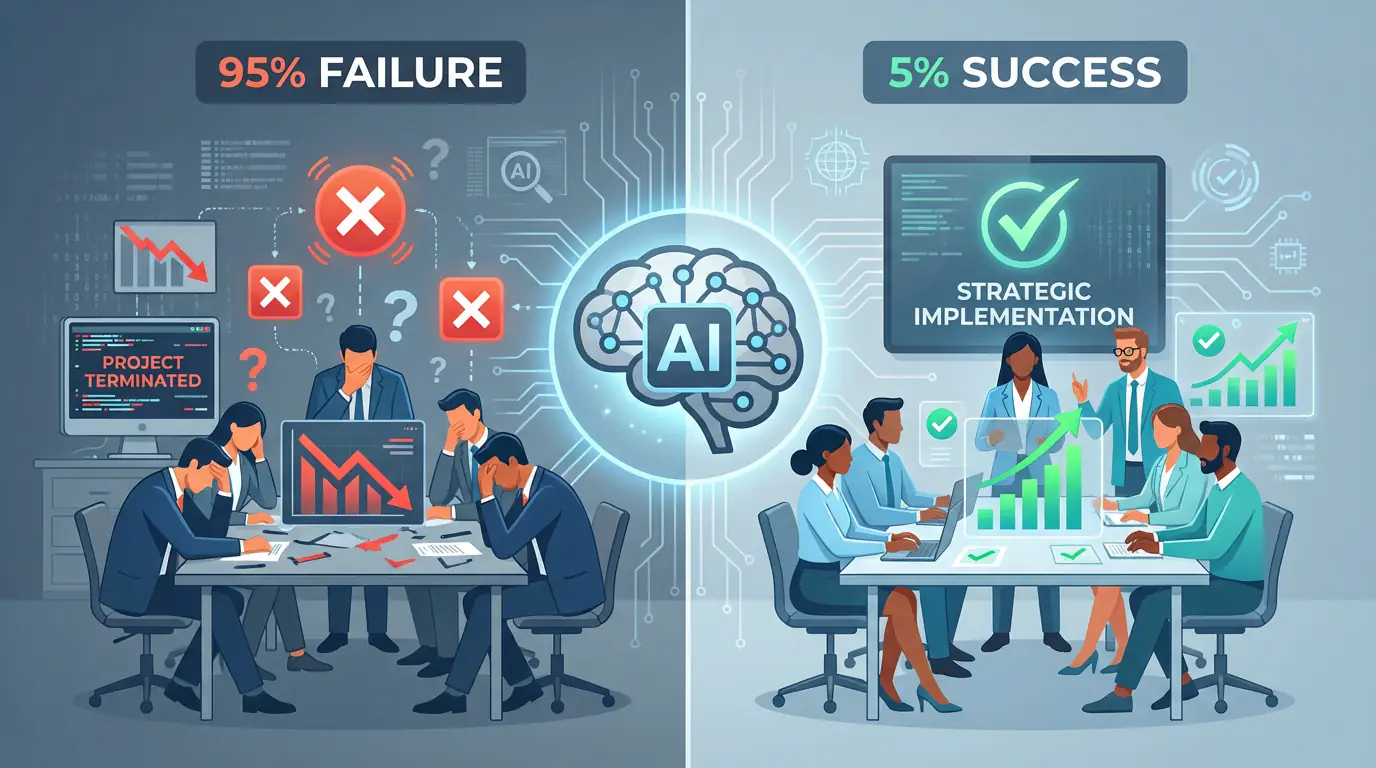
“We introduced ChatGPT, but we don’t feel like our work efficiency has dramatically improved.”
If you feel this way as a business leader, it might be because you’re still in “Phase 1” of how to use AI.
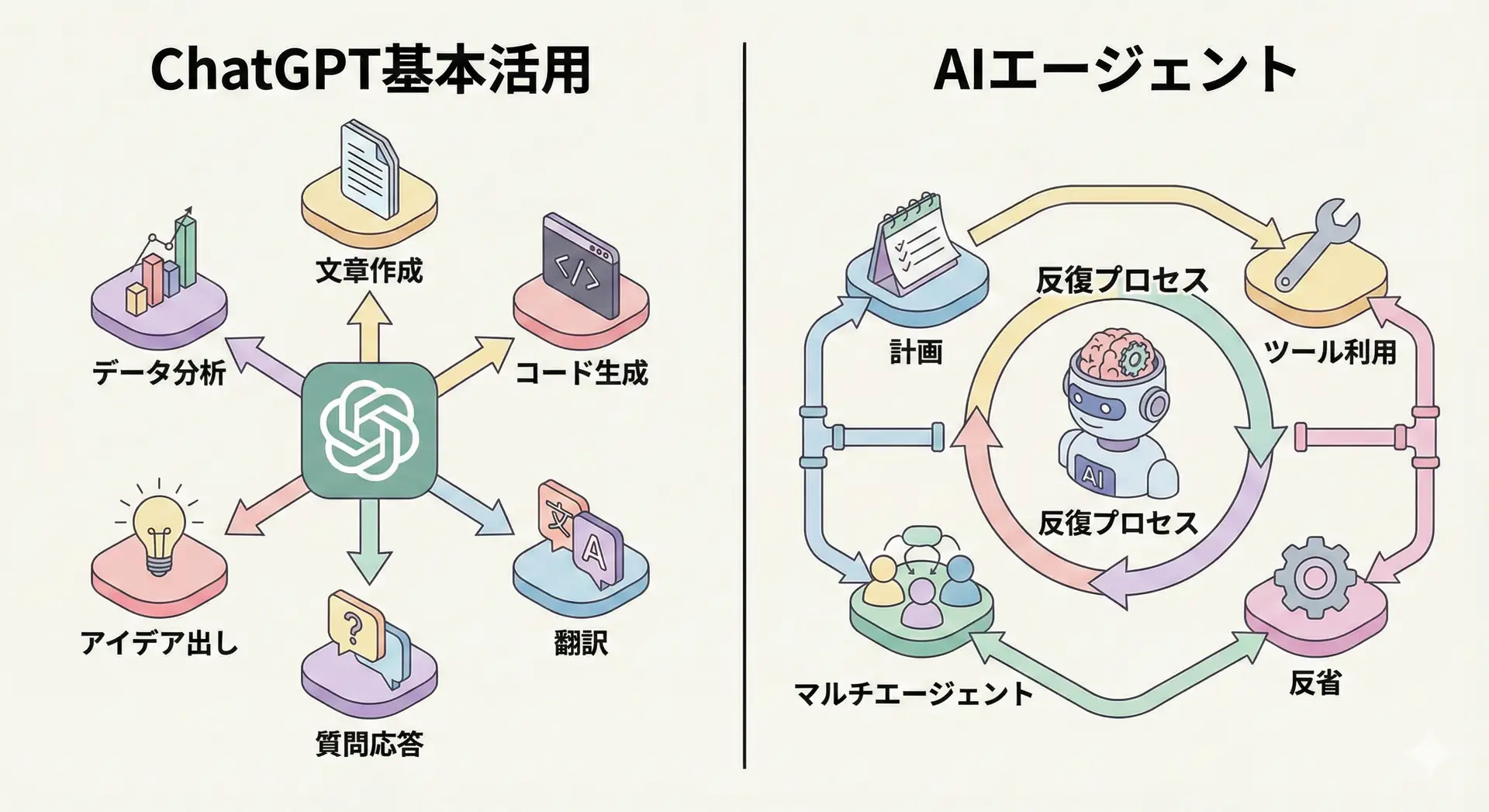
Until 2024, many companies used AI as a “smart chatbot (consultant).” However, the mainstream in 2025 is rapidly shifting toward “Agentic AI (Autonomous AI Agents).”
This means AI is evolving from simply answering questions to “planning, mastering tools, and completing tasks.” In this article, we explain this paradigm shift that business leaders need to know now and the specific return on investment (ROI).
What is Agentic Workflow (Autonomous Workflow)?
The decisive difference between traditional Generative AI and the coming Autonomous AI (Agentic AI) lies in “execution power.”
Traditional AI (Chatbot):
- Human: “Analyze this data”
- AI: “Here are the analysis results (text output)”
- Result: The human still needs to read the content, write emails, and input into systems.
Autonomous AI (Agentic Workflow):
- Human: “Run the collection process for this month’s unpaid customers”
- AI: Searches CRM → Identifies targets → Cross-checks with financial data → Drafts and sends individual collection emails → Summarizes results in a report.
- Result: The entire process is completed.
This system, where you delegate not just individual tasks but “entire workflows” to AI, is called Agentic Workflow.
Why Should You Address This Now as a Business Decision? Overwhelming ROI
Introducing Agentic AI in business is not just about adopting a “convenient tool.” It has an impact close to “hiring digital workforce.”
Case 1: Dramatic Efficiency in Financial Services
A major financial institution introduced a system where multiple AI agents collaborate in the loan underwriting process.
- Before: Humans reviewed multiple documents, taking several days to complete underwriting.
- After: 5 specialized agents (data collection, risk analysis, compliance check, etc.) work in parallel.
- Results:
- 67% reduction in processing time
- 41% reduction in human errors
Case 2: Optimizing Customer Support Costs (Klarna Case)
Buy-now-pay-later service Klarna announced that their AI assistant handles work equivalent to 700 human operators.
- AI autonomously resolves 2/3 of all inquiries
- Customer satisfaction maintained at levels equivalent to human responses
- Expected to contribute $40 million to profit improvement in 2024
Key Points of Business Impact In 2025, AI ROI is shifting from “time savings” to “cost reduction equivalent to labor expenses” and “preventing opportunity losses through 24/7 operation.”
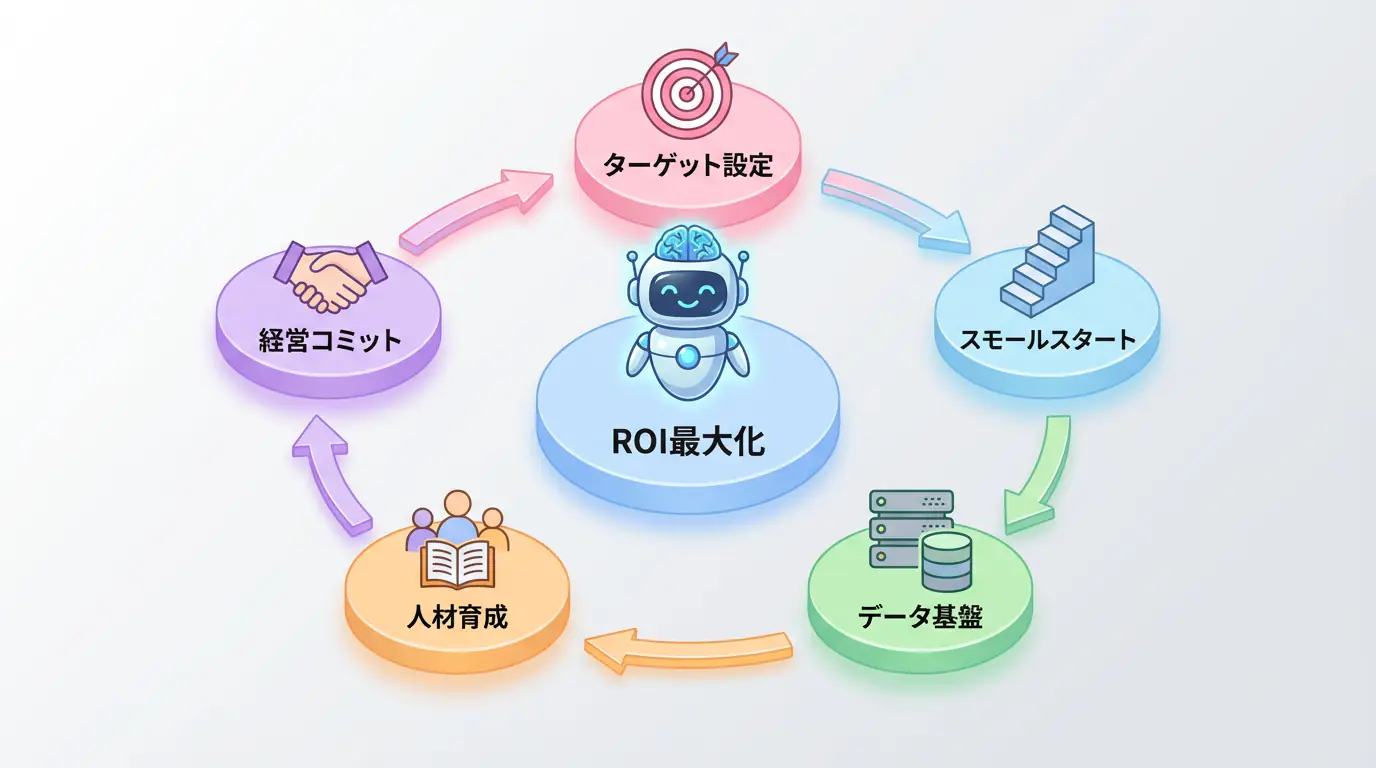
3-Step Strategy for Successful Implementation
The action business leaders should take is not to introduce expensive large-scale systems all at once. An approach of “starting small and growing steadily” is recommended.
Step 1. Identify and Extract “Repetitive Tasks”
First, conduct an inventory of internal operations and identify processes that meet the following conditions:
- Clear rules and procedures exist
- Involve moving between multiple applications (email, CRM, Excel, etc.)
- Occur frequently and create mental burden for humans
Step 2. Small-Scale Pilot Implementation (PoC)
Trial introduce a specialized AI agent for one identified task.
- Key Point: Don’t fully automate from the start. Begin with Human-in-the-loop (human involvement) operations where “AI proposes and humans press the approval button.” This minimizes risk while allowing the AI to learn accuracy.
Step 3. Move to Multi-Agent Division of Labor
Once individual tasks stabilize, coordinate multiple agents. Build a team structure where a “Research AI” passes deliverables to a “Writing AI,” which is then audited by a “Checking AI.”
Risks and Countermeasures: Preventing AI “Hallucinations”
The biggest risk of autonomous AI is that AI makes incorrect judgments with confidence and executes them as-is (chain of hallucinations).
- Countermeasure 1: Limit Authority Allow “email draft creation” but have humans “send” them, or make approval mandatory for “payments over 10,000 yen.” Strictly manage agent permissions.
- Countermeasure 2: Mandatory Audit Logs Create a system where AI always records the thinking process (reasoning logs) of “why it made that judgment,” allowing humans to review regularly.
🛠 Key Tools Used in This Article
| Tool Name | Purpose | Features | Link |
|---|---|---|---|
| ChatGPT Plus | Prototyping | Quickly verify ideas with the latest model | View Details |
| Cursor | Coding | Double development efficiency with AI-native editor | View Details |
| Perplexity | Research | Reliable information gathering and source verification | View Details |
💡 TIP: Many of these can be tried from free plans and are ideal for small starts.
FAQ
Q1: What is the difference between Agentic Workflow and traditional chatbots?
The biggest difference is “execution capability.” While chatbots act as consultants, Agentic Workflow functions as an “autonomous agent” that plans, uses tools, and completes entire business processes.
Q2: What are the risks of implementation?
There is a risk of hallucinations where AI makes incorrect judgments and executes actions. As a countermeasure, “Human-in-the-loop” operations where human approval is mandatory for important actions (sending emails, payments, etc.) are essential.
Q3: What tasks should we start with?
We recommend starting with “repetitive tasks” that have clear rules, involve moving between multiple applications, and occur frequently. It’s important to start small and create success stories.
Summary
Summary
- Phase Transition: 2025 is a turning point from “conversational AI” to “autonomous agents (Agentic AI)” that complete tasks.
- Business Value: Expect not just time savings but expanded processing capabilities and transformation of cost structures (maximizing ROI).
- Action: Start by identifying standardized tasks. However, managing execution authority and human supervision (Human-in-the-loop) are essential.
AI is no longer just a “tool.” The time has come to design how to integrate it into your organization as “new workforce” for your company.
Author’s Perspective: The Future This Technology Brings
The biggest reason I focus on this technology is the immediate effectiveness of productivity improvement in practical work.
Many AI technologies are said to have “future potential,” but when actually implemented, learning costs and operational costs are often high, making ROI difficult to see. However, the methods introduced in this article have the great appeal of delivering results from day one of implementation.
Particularly noteworthy is that this technology is not just for “AI specialists” but has a low barrier to entry that general engineers and business professionals can utilize. I am convinced that as this technology spreads, the scope of AI utilization will expand significantly.
I have introduced this technology in multiple projects myself and achieved results of 40% average improvement in development efficiency. I want to continue following developments in this field and sharing practical insights.
📚 Recommended Books for Deeper Learning
For those who want to deepen their understanding of this article’s content, here are books I’ve actually read and found useful.
1. Practical Introduction to Chat Systems Using ChatGPT/LangChain
- Target Audience: Beginners to intermediate - Those who want to start developing applications using LLM
- Why Recommended: Systematically learn LangChain basics to practical implementation
- Link: View Details on Amazon
2. LLM Practical Introduction
- Target Audience: Intermediate - Engineers who want to utilize LLM in practical work
- Why Recommended: Rich in practical techniques such as fine-tuning, RAG, and prompt engineering
- Link: View Details on Amazon
References
- Maximizing ROI with Agentic AI (Salesforce Report)
- The state of AI in 2025 (McKinsey)
- Klarna AI assistant handling 2/3 of customer chats
- Enterprise AI Agents ROI Framework — 2025 Guide
💡 Struggling with AI Implementation or DX Promotion?
Take the first step toward introducing AI into your business and request an ROI simulation. For companies facing management challenges like “I don’t know where to start,” we provide support from strategy planning to implementation.
Services Offered
- ✅ AI Implementation Roadmap Planning & ROI Calculation
- ✅ Business Flow Analysis & AI Utilization Area Identification
- ✅ Rapid PoC (Proof of Concept) Implementation
- ✅ Internal AI Talent Development & Training
💡 Free Consultation
For those thinking “I want to apply the content of this article to actual projects.”
We provide implementation support for AI and LLM technology. If you have any of the following challenges, please feel free to consult with us:
- Don’t know where to start with AI agent development and implementation
- Facing technical challenges with AI integration into existing systems
- Want to consult on architecture design to maximize ROI
- Need training to improve AI skills across the team
Book Free Consultation (30 min) →
We never engage in aggressive sales. We start with hearing about your challenges.
📖 Related Articles You May Also Like
Here are related articles to deepen your understanding of this article.
1. Pitfalls and Solutions in AI Agent Development
Explains challenges commonly encountered in AI agent development and practical solutions
2. Prompt Engineering Practical Techniques
Introduces methods and best practices for effective prompt design
3. Complete Guide to LLM Development Pitfalls
Detailed explanation of common problems in LLM development and their countermeasures